01Facts
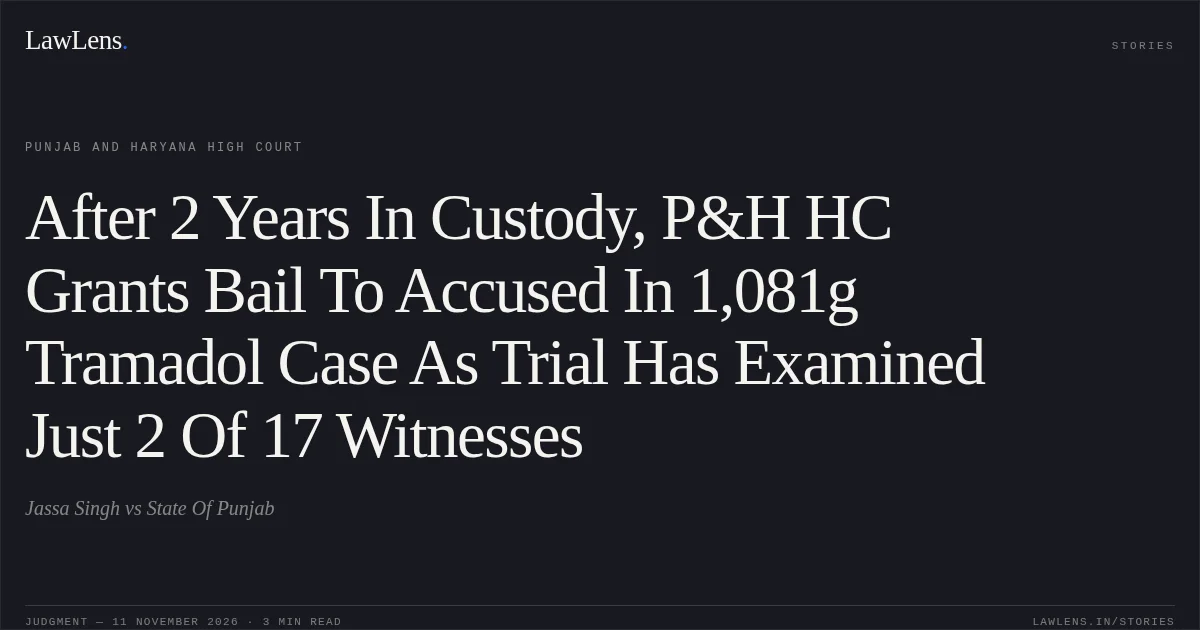
The petitioner sought regular bail under Section 483 of the Bharatiya Nagarik Suraksha Sanhita, 2023, in an NDPS case alleging recovery of 1,081.10 grams of tramadol.
¶ 1–2 · p. 1He had been arrested on 26 August 2024, and the challan was presented on 21 September 2024. Of the 17 prosecution witnesses, only two had been examined by the time of the bail hearing.
¶ 6 · p. 2The petitioner raised alleged non-compliance with mandatory NDPS provisions and delay in trial; the State opposed bail, including on the ground that Section 37 of the NDPS Act barred relief.
¶ 3–4 · p. 1This was his fourth bail petition; the previous petition had been dismissed as withdrawn.
¶ 6.4 · p. 6The custody certificate recorded incarceration of two years, two months and 15 days, and no involvement in another FIR or case.
¶ 6.1 · p. 202Issues
i.Whether the petitioner could be granted regular bail despite the restrictions under Section 37 of the NDPS Act, in light of his prolonged pre-trial detention and the pace of the trial.
¶ 6.1–6.3 · pp. 2–6ii.Whether the petitioner’s fourth bail petition could be entertained, and whether the circumstances justified granting successive bail.
¶ 6.4 · pp. 6–703Law Applied
Section 483 of the BNSS provides the basis for the High Court’s power to grant regular bail, while Section 37 of the NDPS Act imposes restrictions on bail in cases involving commercial quantities.
¶ 1, 4 · p. 1 · ¶ 6.2 · pp. 2–5Article 21 protects the right to life and personal liberty, including the right to a speedy trial; the Court treated prolonged incarceration coupled with unjustified trial delay as a constitutional consideration capable of outweighing Section 37’s restrictions in an appropriate case.
¶ 6.1–6.3 · pp. 2–6The Court relied on Kulwinder v. State of Punjab and the cited Supreme Court authorities on speedy trial and Article 21, as well as Sri Sujit Das v. Union of India, SLP (Crl.) Nos. 12451–12453 of 2026, decided 5 November 2026, as discussed in the judgment.
¶ 6.2 · pp. 2–5 · ¶ 6.3 · pp. 5–6For successive bail petitions, the Court relied on Rafiq Khan v. State of Haryana, which holds that such petitions are maintainable but ordinarily require a substantial change in circumstances, with cogent reasons required for granting relief.
¶ 6.4 · pp. 6–7Provisions in the judgment · 5 · Linked ones open on LawLens
Bharatiya Nagarik Suraksha Sanhita, 2023 Section 483
Narcotic Drugs and Psychotropic Substances Act, 1985 Section 22Section 29Section 37Section 21
04Reasoning
The Court did not determine the parties’ disputed contentions concerning compliance with the NDPS Act, leaving those issues for trial.
¶ 6 · p. 2It instead focused on the petitioner’s custody of more than two years, the fact that only two of 17 prosecution witnesses had been examined, and the absence of material indicating that he might abscond or interfere with the evidence.
¶ 6–6.1 · pp. 2–3It concluded that the trial delay was not attributable to the petitioner and that continued detention, in these circumstances, engaged his Article 21 rights notwithstanding Section 37.
¶ 6.1–6.3 · pp. 2–6Although this was a successive petition, the Court found the extended custody and slow progress of the trial sufficient to favourably consider it, and held further detention as an undertrial unwarranted.
¶ 6.4 · pp. 6–705Holding
The Court allowed the petition and ordered the petitioner’s release on regular bail upon furnishing bail and surety bonds to the satisfaction of the trial Court or Duty Magistrate.
¶ 7 · p. 7Bail was subject to specified conditions, including non-interference with evidence, attendance at trial, surrender of any passport, and monthly affidavits confirming that the petitioner had not been involved in any offence after release; the State or complainant may seek cancellation for breach of conditions or other sufficient cause.
¶ 7–8 · pp. 7–8The Court stated that its observations were not an expression of opinion on the merits of the case.
¶ 10 · p. 8Original Court PDF
Jassa SinghvsState Of Punjab
Click to open original judgment
Original judgment, available to read, download and summarize on LawLens.in