01Facts
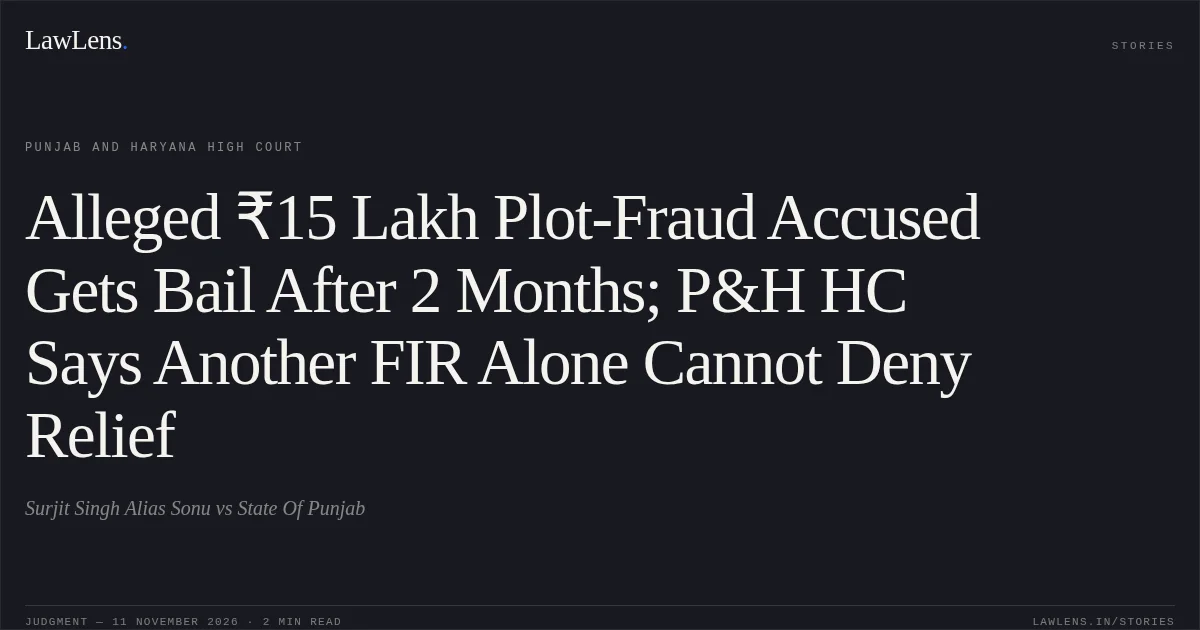
The petitioner sought regular bail under Section 483 of the Bharatiya Nagarik Suraksha Sanhita, 2023, in an FIR alleging his involvement in a conspiracy to defraud the complainant in a property transaction involving a plot allegedly owned by another person.
pp. 1–3The petitioner was arrested on 3 September 2026; the challan was presented on 15 September 2026, and 12 prosecution witnesses were cited, none of whom had been examined by the time of the hearing.
p. 6The petitioner had undergone two months and five days of custody.
p. 6The State opposed bail, relying on the seriousness of the allegations and the petitioner’s involvement in another FIR.
p. 4, 602Issues
i.Whether the petitioner should be granted regular bail in the circumstances of the case, including the stage of investigation and trial, the period of custody, and the risk of absconding or interfering with evidence.
pp. 6–7ii.Whether the petitioner’s involvement in another FIR, by itself, was sufficient to deny regular bail in the present case.
p. 603Law Applied
Section 483 of the BNSS empowers the Court to grant regular bail.
The Court applied the principles in Gudikanti Narasimhulu v. Public Prosecutor, AIR 1978 SC 429, that bail discretion must account for personal liberty, the interests of justice and society, and the need to secure the accused’s attendance, while guarding against absconding, evidence tampering, and threats to public peace.
pp. 4–5It also relied on Gurcharan Singh v. State (UT of Delhi), (1978) 1 SCC 118, which identifies securing the accused’s appearance as the primary inquiry in bail decisions.
p. 5Sanjay Chandra v. CBI, (2012) 1 SCC 40, holds that bail is neither punitive nor preventive and that pre-trial detention should be based on necessity.
pp. 5–6The Court further relied on Maulana Mohd. Amir Rashadi v. State of U.P., 2012 (1) RCR (Criminal) 586, among other authorities, for the principle that antecedents alone do not necessarily justify refusing bail where the circumstances of the case support its grant.
p. 7Provisions in the judgment · 9 · Linked ones open on LawLens
Bharatiya Nagarik Suraksha Sanhita, 2023 Section 483
Bharatiya Nyaya Sanhita, 2023 Section 316Section 318Section 61Section 336Section 338Section 340
Indian Penal Code, 1860 Section 406Section 420
04Reasoning
The Court considered that the challan had been filed, the petitioner had spent over two months in custody, and none of the 12 cited prosecution witnesses had yet been examined; trial was therefore likely to take time.
p. 6The competing arguments raised issues to be determined at trial, and the Court avoided assessing their merits.
p. 6It found no tangible indication that the petitioner would abscond or interfere with prosecution evidence.
p. 6Although the petitioner was reported to be involved in another FIR, that circumstance alone did not warrant refusal of bail in this case.
pp. 6–7In light of the governing bail principles, continued pre-trial detention was not justified.
05Holding
The petition was allowed, and the petitioner was ordered to be released on regular bail upon furnishing bail and surety bonds to the satisfaction of the concerned CJM/Duty Magistrate.
p. 7The Court imposed conditions, including prohibitions on misuse of liberty, evidence tampering, absence from trial, and committing further offences; it also required the petitioner to deposit any passport and comply with specified phone-number and trial-attendance requirements.
pp. 7–8The Court clarified that its observations were not an expression of opinion on the merits of the case.
p. 8Original Court PDF
Surjit Singh Alias SonuvsState Of Punjab
Click to open original judgment
Original judgment, available to read, download and summarize on LawLens.in