01Facts
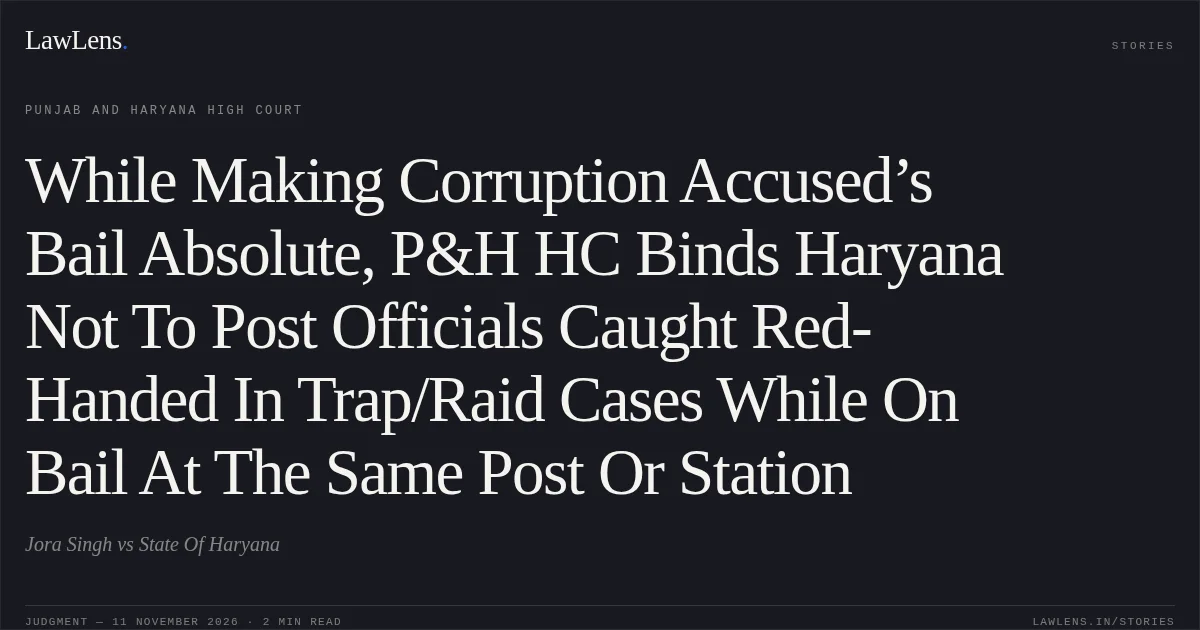
The petitioner sought regular bail under Section 483 of the Bharatiya Nagarik Suraksha Sanhita, 2023 (BNSS), in an FIR alleging offences under Sections 7 and 7A of the Prevention of Corruption Act, 1988, and Sections 61(2) and 308(2) of the Bharatiya Nyaya Sanhita, 2023.
¶ 1He had been granted interim regular bail on August 27, 2026. At that time, the Court noted that the investigation was complete, the challan had been filed, none of the 28 prosecution witnesses had been examined, the petitioner had spent 4 months and 23 days in custody, and he was not shown to be involved in another FIR.
¶ 2The State later filed an affidavit describing transfer instructions for officers or officials accused in trap or raid cases who are on bail.
¶ 302Issues
i.1. Whether the petitioner’s interim regular bail should be made absolute.
¶ 2, 4ii.2. Whether the State’s transfer instructions concerning accused public servants should bind the State in this case.
¶ 3–403Law Applied
Section 483 of the BNSS empowers the High Court to grant regular bail.
¶ 1In assessing bail, the Court considered the completion of the investigation, filing of the challan, the number and examination status of prosecution witnesses, the period of custody, the petitioner’s other-case record, and the absence of material indicating a risk of absconding or interference with evidence.
¶ 2The Court also relied on the State’s affidavit describing instructions that accused officers or officials on bail in trap or raid cases should not be posted to the same post and station, and should be transferred away from the concerned jurisdiction, subject to the stated district-cadre provision.
¶ 3No precedent was cited.
Provisions in the judgment · 4 · Linked ones open on LawLens
Bharatiya Nagarik Suraksha Sanhita, 2023 Section 483
Prevention of Corruption Act, 1988 Section 7
Bharatiya Nyaya Sanhita, 2023 Section 61Section 308
04Reasoning
The Court found no allegation that the petitioner had misused interim bail and considered the prosecution case ready for trial, with the investigation complete but no witnesses yet examined. In light of the custody already undergone and the absence of identified risks of absconding or interference with evidence, it made the interim bail absolute, while imposing conditions to protect the trial process.
¶ 2, 4As to the administrative issue, the Court directed that the State remain bound by the transfer instructions set out in the Chief Secretary’s affidavit.
¶ 3–405Holding
The petition was allowed, and the interim regular bail order was made absolute, subject to conditions imposed by the concerned CJM/Duty Magistrate and additional conditions including non-interference with evidence, attendance at trial, passport deposit if applicable, and restrictions on changing the petitioner’s cellphone number without prior permission.
¶ 4(i)The State was held to its affidavit; any deviation without prior permission of the competent court was stated to invite penal consequences for the Chief Secretary or concerned officers.
¶ 4(ii)The Court clarified that its observations did not express an opinion on the merits of the case.
¶ 6Original Court PDF
Jora SinghvsState Of Haryana
Click to open original judgment
Original judgment, available to read, download and summarize on LawLens.in