Facts
The petitioner sought a direction requiring the Fit Person to conduct the temple’s forthcoming utsavams, rituals and processions according to Agama Sastras, established usage and customary practice until Kumbhabhishekam, and requiring the Executive Officer to facilitate them
Source reference: p.1He alleged that after a Balalayam relating only to the Dhwajasthambam on 23 August 2026, the September Pavitrotsavam and other regular observances were discontinued, with no date fixed for the corresponding Samprokshanam/Kumbhabhishekam
Source reference: pp.2–3The respondents stated that applications had been invited to appoint non-hereditary trustees; the petitioner said that no Board of Trustees had been constituted since the Fit Person’s appointment in 2004
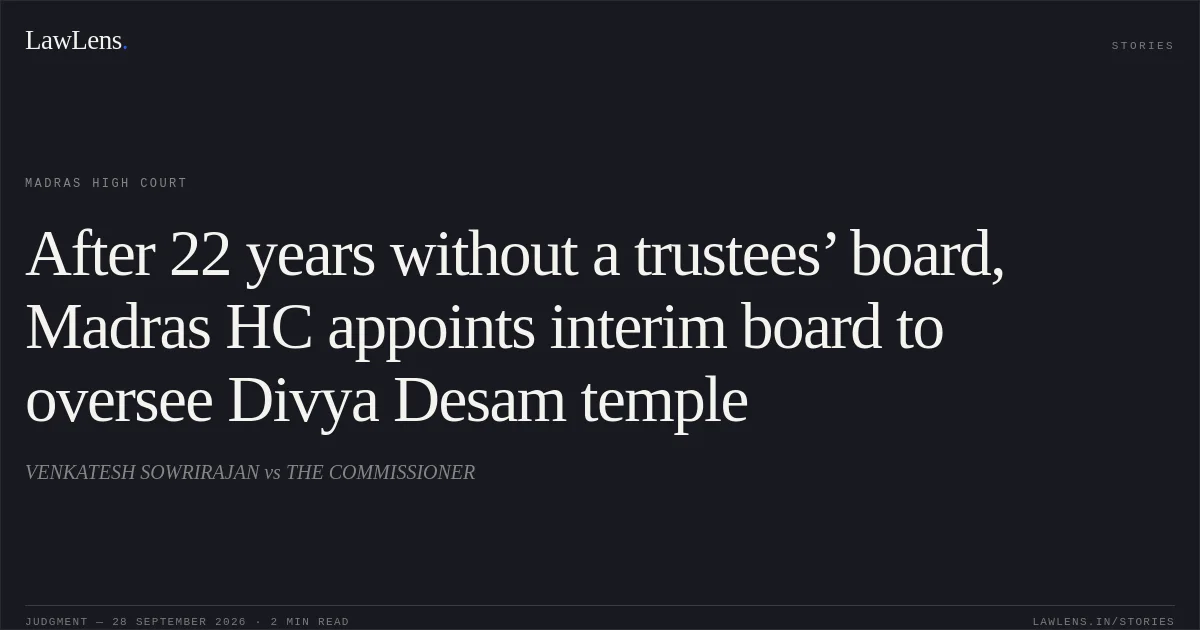
Source reference: pp.3–4The Court directed the parties to furnish names for an interim board and, on considering those names, appointed an Interim Board of Trustees
Source reference: p.5Issues
Whether the Court should direct the temple authorities to conduct the forthcoming utsavams and related observances in accordance with the Agama Sastras, established usage and customary practice
Source reference: pp.1–3Whether an Interim Board of Trustees should be constituted to manage the temple’s affairs pending the formation of a regular Board
Source reference: pp.4–6Law Applied
The petition invoked the High Court’s jurisdiction under Article 226 of the Constitution
Source reference: p.1The order cites no specific statutory provision, precedent or Agama rule as the basis for its decision.
Source reference: no citationIt proceeds on the case-specific view that, given the temple’s operating hours and the Fit Person’s inability to manage its affairs alone, an interim board was appropriate until the department formally reconstituted a regular Board of Trustees
Source reference: pp.4–6Reasoning
The Court noted that the temple had been without a Board of Trustees since 2004 and considered it impracticable for a government-employed Fit Person alone to manage the temple comprehensively, particularly in light of the temple’s extended daily hours
Source reference: pp.4–5As the department had begun the process of appointing non-hereditary trustees but a regular Board had not yet been formed, the Court constituted an Interim Board using names furnished by the parties
Source reference: p.5It left decisions on temple affairs—including utsavams, rituals and administration—to that Board rather than issuing a specific direction to conduct the scheduled Pavitrotsavam
Source reference: p.6Holding
The Court appointed a seven-member Interim Board, comprising five nominated individuals, the Executive Officer and the Fit Person, to function until the department formally reconstituted a regular Board of Trustees
It empowered the Interim Board to decide matters concerning temple affairs, including utsavams, rituals and administration, and disposed of the writ petition with those observations and directions, without costs; the connected miscellaneous petitions were closed
Source reference: p.6Original Court PDF
VENKATESH SOWRIRAJANvsTHE COMMISSIONER
Click to open original judgment
Original judgment, available to read, download and summarize on LawLens.in