Facts
Bhushan Lal was appointed as a Carpenter with All India Radio on 6 May 1982 and had been working since December 1981. His services were terminated with effect from 30 July 1983 without compliance with Section 25F of the Industrial Disputes Act, 1947.
Source reference: pp. 2–4, paras. 3–6The Central Government Industrial Tribunal-cum-Labour Court, by Award dated 28 April 1987, held the termination illegal and directed reinstatement with continuity of service and full back wages.
Source reference: p. 2, paras. 1, 4The Union of India challenged the Award in W.P.(C) No. 136/1988, principally contending that All India Radio was not an “industry” under the Industrial Disputes Act. The writ petition was transferred to the Central Administrative Tribunal in 1990, where it was dismissed as not maintainable in 1997 without adjudication on merits.
Source reference: pp. 3–5, paras. 6–7Bhushan Lal subsequently sought implementation of the Award. This Court directed implementation in 2011, following which he was re-engaged on 10 December 2012 and paid back wages only up to the date of the Award.
Source reference: pp. 5–6, paras. 8–10He claimed further back wages up to reinstatement, continuity of service, salary fixation, leave encashment, pensionary benefits and other consequential benefits.
Source reference: pp. 6–7, paras. 11–16He superannuated on 1 December 2014. The implementation petition, W.P.(C) No. 4237/2015, was thereafter heard along with the revived challenge to the Award.
Source reference: pp. 6–7The challenge was revived in 2019 after the Court set aside the Central Administrative Tribunal’s order, observing that the Tribunal ought to have returned the matter to the High Court rather than dismissing it for want of jurisdiction.
Source reference: pp. 7–9, para. 17During the final hearing, the Union conceded that the issue concerning All India Radio’s status as an “industry” no longer survived in view of the Supreme Court’s decision in All India Radio v. Santosh Kumar & Ors., which held that All India Radio and Doordarshan are industries under the Industrial Disputes Act.
Source reference: pp. 9–10, paras. 20–22Issues
Whether the Award dated 28 April 1987, directing Bhushan Lal’s reinstatement with continuity of service and full back wages, was liable to be set aside on the ground that All India Radio was not an “industry” under Section 2(j) of the Industrial Disputes Act, 1947.
Source reference: pp. 2–4, 9–10, paras. 1, 5–6, 20–22Whether the Award had been fully implemented by the Union of India and All India Radio, or whether Bhushan Lal remained entitled to further consequential monetary and service benefits for the period between the Award and his reinstatement.
Source reference: pp. 6–7, 10–11, paras. 11–16, 23–25Whether, in exercise of jurisdiction under Article 226 of the Constitution, the Court could mould the relief by awarding lump-sum compensation instead of directing a detailed computation of disputed wages, increments, pension and other consequential benefits.
Source reference: pp. 11–12, paras. 25–27Law Applied
The Court applied Section 25F of the Industrial Disputes Act, 1947, which requires compliance with prescribed conditions before retrenchment; non-compliance renders the termination invalid where the workman has completed the requisite period of service.
Source reference: pp. 2, 10–11, paras. 3–4, 25It relied on All India Radio v. Santosh Kumar & Ors., Civil Appeals Nos. 2423/1989, 2135/1993 and 775–776/1998, decided on 5 February 1998, for the rule that All India Radio and Doordarshan constitute “industries” within Section 2(j) of the Industrial Disputes Act.
Source reference: pp. 9–10, paras. 20–22The Court further applied the principle that an Award not set aside or modified by a competent forum continues to subsist and remains binding.
Source reference: p. 9, para. 21In exercising Article 226 jurisdiction, the Court held that it could mould relief and award monetary compensation where such relief would better serve the ends of justice, particularly where a mechanical computation would produce impracticable or further disputed proceedings.
Source reference: pp. 11–12, paras. 26–27Reasoning
The Court found that the original challenge to the Award was founded solely on the contention that All India Radio was not an “industry.” That contention was no longer legally sustainable after All India Radio v. Santosh Kumar, and the Union fairly conceded that the issue stood concluded.
Source reference: pp. 9–10, para. 22Since the Central Administrative Tribunal had never adjudicated the challenge on merits and no competent forum had set aside or modified the Award, the Award continued to operate and remained binding.
Source reference: p. 9, para. 21The Department’s subsequent conduct—re-engaging Bhushan Lal and paying back wages up to the date of the Award—also demonstrated substantial acceptance and implementation of the Award.
Source reference: p. 10, para. 23As to incomplete implementation, the Court noted that the Award granted reinstatement with continuity of service and full back wages, while Bhushan Lal was reinstated only in December 2012, nearly twenty-five years after the Award, and had received back wages only up to April 1987.
Source reference: pp. 6, 10–11, paras. 10–11, 23–25However, given the passage of more than four decades, the workman’s subsequent service until superannuation, and the likely complexity of determining revised wages, increments, pensionary benefits and other consequential claims, the Court exercised its equitable Article 226 jurisdiction to substitute a lump-sum monetary remedy for a further computation exercise.
Source reference: pp. 10–12, paras. 25–27The prolonged administrative and procedural delay was also treated as warranting costs.
Source reference: p. 12, paras. 28–30Holding
The Court rejected the surviving basis of the Union’s challenge and treated the Award dated 28 April 1987 as operative and binding, noting that All India Radio is an “industry” under Section 2(j) of the Industrial Disputes Act.
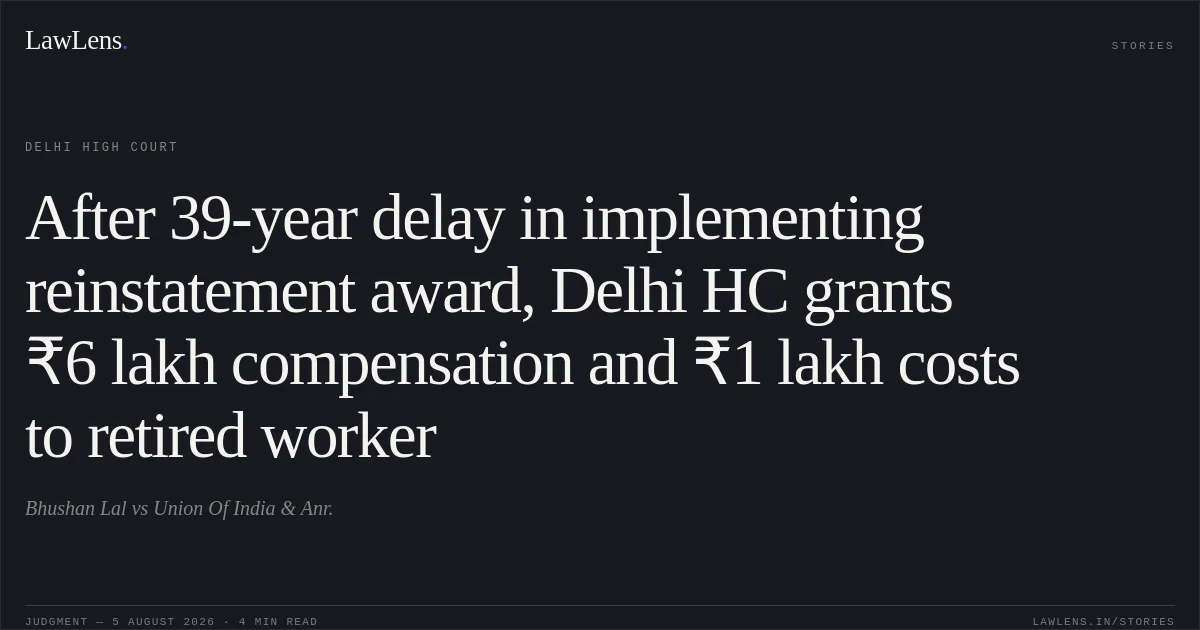
Instead of directing a fresh determination of all disputed service and monetary benefits, it awarded Bhushan Lal ₹6,00,000 as lump-sum compensation in full and final settlement of all claims arising from incomplete implementation of the Award, payable within eight weeks.
Source reference: p. 11, para. 27The Union, All India Radio and Doordarshan were additionally directed to pay ₹1,00,000 as costs within the same period, with liberty to recover the amount from persons responsible for the delay.
Source reference: p. 12, para. 30Both writ petitions and all pending applications were accordingly disposed of.
Source reference: p. 13, para. 31Original Court PDF
Bhushan LalvsUnion Of India & Anr.
Click to open original judgment
Original judgment, available to read, download and summarize on LawLens.in