Facts
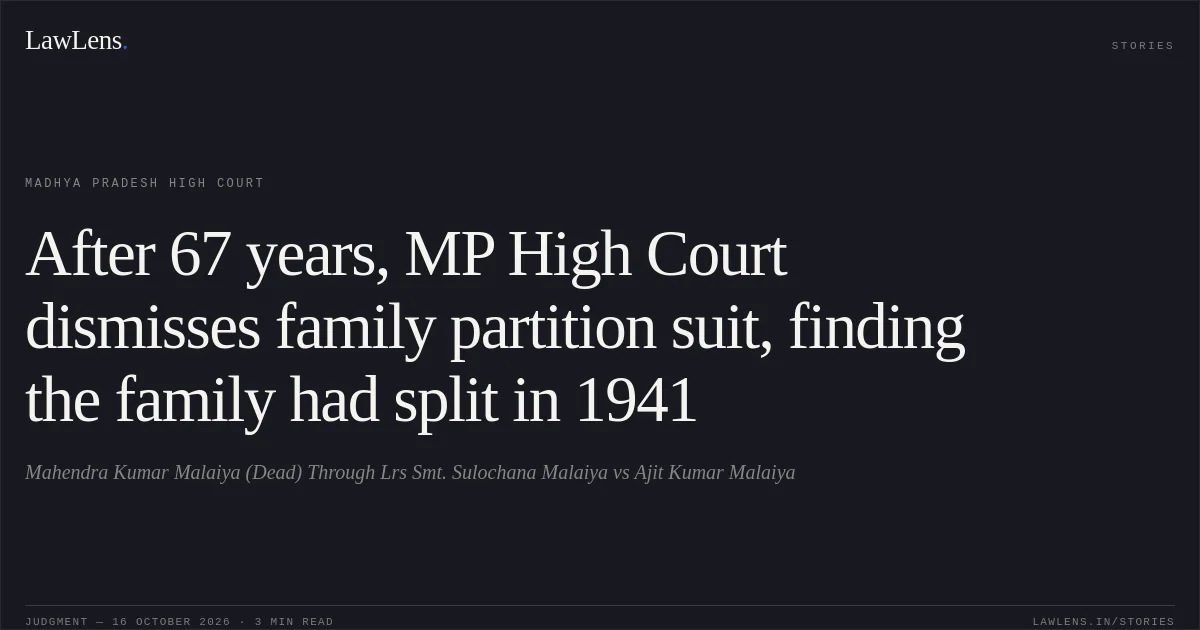
The plaintiffs, representing the branch of Shivprasad Malaiya, brought a partition and accounts suit in 1959 against the branches of his brothers, Shobharam and Balchand.
Source reference: para. 4–5, 27–33They claimed that the family remained joint and that businesses and properties, including several oil mills, were joint-family assets.
Source reference: para. 4–5, 27–33The defendants maintained that the family’s joint status had been severed in 1941 and that an arrangement recorded in July 1949 divided the immovable properties.
Source reference: para. 4–5, 27–33The trial court decreed a one-third share to the plaintiffs in the scheduled properties and granted a right to seek accounts.
Source reference: para. 4–5, 27–33The defendants appealed in two separate appeals.
Source reference: para. 4–5, 27–33Issues
1. Whether the brothers’ joint-family status had been severed in 1941, and whether the 1949 arrangement effected a binding division of the immovable properties.
Source reference: para. 34–35, 50–612. Whether the later business and accounting disputes, or properties not listed in the 1949 arrangement, remained grounds for a partition decree.
Source reference: para. 80–90, 96–983. Whether the applications to amend the pleadings and introduce additional evidence should be allowed.
Source reference: para. 91–94Law Applied
Under Hindu law, a definite and unequivocal intention to separate severs joint status; physical division by metes and bounds may follow, but is not essential to severance (Kalyani v. Narayanan).
Source reference: para. 54The joint-family presumption may be rebutted by evidence of defined shares, separate accounts, and conduct consistent with separate ownership; partnership accounts allocating individual shares differ from the unity of ownership characteristic of a joint-family business (Nanchand Gangaram Shetji v. Mallappa Mahalingappa Sadalge).
Source reference: para. 55The court distinguished the physical-division requirement for recording a partition under Section 25-A of the Income Tax Act, 1922 from the test for severance under Hindu law.
Source reference: para. 48–50Under the family-settlement principles discussed in Kale v. Director of Consolidation and Ravinder Kaur Grewal v. Manjit Kaur, a memorandum recording a prior arrangement need not be registered if it does not itself create or extinguish rights in immovable property; parties who act on the arrangement may be estopped from resiling from it.
Source reference: para. 64–65An unregistered document may also be considered for collateral purposes, including evidence of severance and possession.
Source reference: para. 66Reasoning
The court found that the 1943 partnership deed recorded the prior partition of businesses and properties and defined each brother’s share; separate ledgers and a 1944 civil-court proceeding further supported severance by 1941.
Source reference: para. 36–52It rejected the trial court’s reliance on the Income Tax Appellate Tribunal order, explaining that the tax-law requirement of division into definite portions did not determine whether joint status had been severed under Hindu law.
Source reference: para. 36–52The July 1949 document then allocated specific immovable properties, declared separate possession, and was acted upon by the branches through possession, sales, and later intra-branch partitions.
Source reference: para. 57–66, 82–89The court treated it as recording and implementing the earlier separation, rather than as an unregistered instrument creating rights for the first time.
Source reference: para. 57–66, 82–89Subsequent partnership deeds and the plaintiff’s own conduct showed that the remaining disputes concerned business accounts and management, not the continued existence of a joint family.
Source reference: para. 70–80, 90–94The court therefore rejected the basis for a further partition decree and declined the late amendments and additional-evidence applications.
Source reference: para. 70–80, 90–94Holding
The court held that joint-family status had been severed in 1941 and that the immovable properties were divided under the binding 1949 arrangement.
Later accounting disputes did not sustain a suit for partition, and properties outside that arrangement could not, on the evidence, be treated as joint-family assets.
Source reference: para. 94–100Both appeals were allowed, the trial court’s judgment and decree were set aside, and the partition suit was dismissed without costs.
Source reference: para. 94–100The applications for amendment and additional evidence were not allowed.
Source reference: para. 94–100The judgment was stated not to prejudice any pending challenge concerning the separate suit for accounts.
Source reference: para. 94–100Acts & Sections Cited
1 provisions across 1 statute referred to in this judgment. Each provision opens on LawLens.
Registration Act, 19081
Original Court PDF
Mahendra Kumar Malaiya (Dead) Through Lrs Smt. Sulochana MalaiyavsAjit Kumar Malaiya
Click to open original judgment
Original judgment, available to read, download and summarize on LawLens.in