Facts
The petitioner, Mukesh Kumar, was serving as Estate Officer-I, Haryana Shehri Vikas Pradhikaran (HSVP), Gurugram. The dispute concerned SCO Nos. 8 and 30 in Sector 23-A and SCO No. 13 in Sector 23, Gurugram, which had originally been auctioned in 1997. After the allotments were cancelled and the allottees’ statutory remedies were dismissed, applications for restoration were made in 2018. Acting pursuant to directions from superior authorities, the petitioner issued provisional/conditional allotment letters, subject to final approval by the Chief Administrator, HSVP. Those conditional allotments were subsequently cancelled or withdrawn
Source reference: pp.3–4A vigilance inquiry report dated 3 October 2022 allegedly found that no financial loss had been caused to the Government. Nevertheless, FIR No. 43 dated 28 November 2022 was registered concerning SCO Nos. 8 and 30, and FIR No. 11 dated 5 March 2023 was registered concerning SCO No. 13, alleging offences under Sections 409, 418, 420, 467, 468 and 120-B IPC and relevant provisions of the Prevention of Corruption Act. The prosecution alleged that the petitioner, in connivance with officials and private parties, had facilitated re-allotment at old rates, thereby conferring an undue benefit and causing wrongful loss to HSVP
Source reference: pp.4–5The petitioner had earlier sought anticipatory bail. His applications were dismissed by the High Court on 20 March 2024, and the challenge before the Supreme Court was dismissed on 16 April 2024. He had also earlier withdrawn a petition seeking quashing of FIR No. 43, with liberty to raise his contentions at the appropriate stage
Source reference: p.5Thereafter, the petitioner filed the present petition under Section 528 of the Bharatiya Nagarik Suraksha Sanhita, 2023 (“BNSS”), seeking quashing of both FIRs and consequential proceedings, as well as other ancillary reliefs
Source reference: pp.1–3Issues
Whether a petition under Section 528 BNSS seeking quashing of FIRs is maintainable after the petitioner’s anticipatory-bail applications had been dismissed on merits by the High Court and the Supreme Court, particularly when the petitioner had not submitted himself to the jurisdiction of the investigating agency or competent court?
Source reference: pp.6–8Whether the distinction between anticipatory bail proceedings and proceedings for quashing an FIR permits the petitioner to invoke the inherent jurisdiction of the High Court without demonstrating any material change in circumstances?
Source reference: pp.6–7Whether the present petition ought to be entertained and the FIRs and consequential proceedings quashed on the ground that they were illegal, mala fide or an abuse of process?
Source reference: pp.8–13Law Applied
The Court applied Section 528 BNSS, corresponding to Section 482 of the Code of Criminal Procedure, 1973, governing the inherent powers of the High Court to prevent abuse of process and secure the ends of justice
Source reference: p.1It considered the distinct statutory framework governing anticipatory bail under Section 482 BNSS, corresponding to Section 438 CrPC, and held that although anticipatory bail and quashing proceedings operate in different legal fields, they cannot be viewed wholly independently when they arise from the same factual matrix
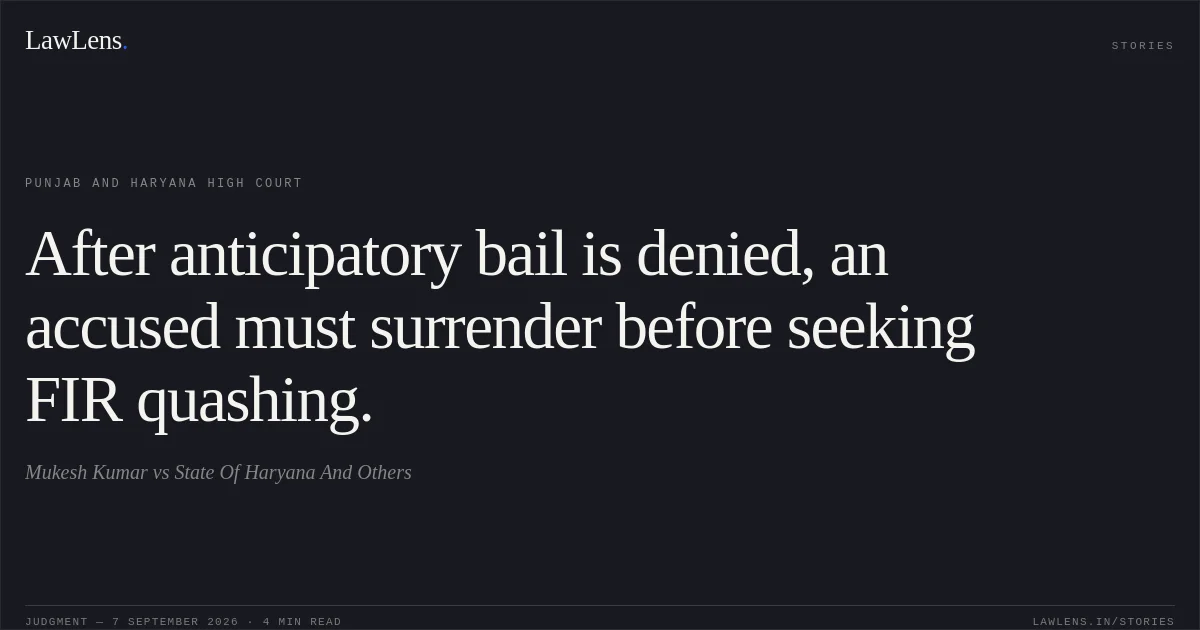
Source reference: pp.8–10Relying on Kuldeep Singh v. State of Punjab and Others, 2026:PHHC:069608, the Court held that after dismissal of anticipatory bail on merits, particularly where the order has attained finality, an immediate petition for quashing the FIR is ordinarily not entertainable in the absence of a material or radical change in circumstances
Source reference: pp.8–10The Court also applied the principles that inherent jurisdiction must be exercised sparingly, that a litigant cannot obtain indirectly what he failed to obtain directly, and that a person evading investigation cannot simultaneously seek equitable and extraordinary relief from the Court
Source reference: pp.11–12Reasoning
The Court acknowledged that anticipatory bail and quashing of an FIR involve different reliefs and legal considerations; therefore, dismissal of anticipatory bail does not automatically create a statutory bar to a quashing petition
Source reference: pp.6–8However, the Court held that the petitioner’s conduct was decisive. His anticipatory-bail applications had been rejected on merits by the High Court, and the Supreme Court had declined to interfere. Despite those orders, he had neither surrendered before the competent court nor made himself available for the purposes of investigation
Source reference: p.11In these circumstances, the present petition was viewed as an attempt to keep the criminal proceedings in suspended animation and to secure, through a differently framed prayer for quashing, relief substantially greater than the protection from arrest that had already been denied
Source reference: pp.10–12Since no material change in circumstances was shown and the petitioner had not submitted himself to the process of law, the Court found it incongruous to entertain the prayer for quashing. The Court also clarified that it was not deciding the merits of the prosecution case or conclusively determining the legality of the FIRs at that stage
Source reference: pp.12–13Holding
The High Court held that the petition was not entertainable at that juncture because the petitioner’s anticipatory-bail applications had been dismissed on merits, the dismissal had attained finality, and he had not surrendered or made himself available for investigation
The petition seeking quashing of FIR No. 43 dated 28 November 2022, FIR No. 11 dated 5 March 2023, and consequential proceedings was accordingly dismissed for the nonce, while reserving liberty to the petitioner to approach the Court again after submitting himself to the jurisdiction of the process of law, if a fresh cause of action arose
Source reference: p.13The Court directed that its observations and the submissions recorded in the judgment would not affect the merits of the case, and that the investigating/prosecuting authorities could proceed in accordance with law
Source reference: p.13Pending applications, if any, were also disposed of
Source reference: p.13Acts & Sections Cited
9 provisions across 3 statutes referred to in this judgment. Each provision opens on LawLens.
Bharatiya Nagarik Suraksha Sanhita, 20232
Code of Criminal Procedure, 19732
Indian Penal Code, 18605
Original Court PDF
Mukesh KumarvsState Of Haryana And Others
Click to open original judgment
Original judgment, available to read, download and summarize on LawLens.in