01Facts
The complainant alleged that he agreed to purchase a bungalow in the “Sun Villa Bungalows” scheme and paid amounts towards the purchase through the principal accused and their representatives, including the applicant.
¶ 4The principal accused later acknowledged receipt of ₹20,41,000 by written undertaking but did not execute the sale deed; the complainant subsequently discovered that the bungalow had been conveyed to a third party.
¶ 8.2The applicant sought quashing of the FIR under Section 482 of the Code of Criminal Procedure, 1973, alleging that the dispute was civil in nature and that no criminal role was attributed to him.
¶ 1, 5.1–5.302Issues
i.Whether the FIR, taken at face value, disclosed the ingredients of offences under Sections 406, 468, 420 and 114 of the Indian Penal Code against the applicant.
¶ 8.1ii.Whether the criminal proceedings against the applicant should be quashed under Section 482 of the Code of Criminal Procedure.
¶ 8.1–8.303Law Applied
Section 482 of the Code of Criminal Procedure empowers the High Court to quash proceedings to prevent abuse of process or secure the ends of justice.
¶ 8Under State of Haryana v. Bhajan Lal, AIR 1992 SC 604, illustrative grounds for intervention include cases where allegations, accepted in their entirety, do not prima facie constitute an offence.
¶ 8In Madhavrao Jiwaji Rao Scindia v. Sambhajirao Chandrojirao Angre, AIR 1988 SC 709, the Supreme Court held that, at the initial stage, the court considers whether uncontroverted allegations prima facie establish the offence and may quash proceedings where continuation would serve no useful purpose, including where the dispute is predominantly civil and criminal ingredients are absent.
¶ 8.4The alleged offences were under Sections 406, 468, 420 and 114 IPC.
¶ 1, 8.1Provisions in the judgment · 7 · Linked ones open on LawLens
Code of Criminal Procedure, 1973 Section 482Section 156Section 155
Indian Penal Code, 1860 Section 406Section 468Section 420Section 114
04Reasoning
Applying the Bhajan Lal framework, the Court found that the FIR attributed the sale transaction and the written acknowledgment of payment to the principal accused.
¶ 8.2It treated the applicant’s role as that of a representative through whom payments were made and found no direct role or overt act by him establishing the alleged offences.
¶ 8.2–8.3In the Court’s view, the allegations against the applicant did not satisfy the essential ingredients of the charged offences, and the dispute, as regards him, was essentially civil in character.
¶ 9The Court therefore considered continuation of the prosecution against him futile.
¶ 8.3–905Holding
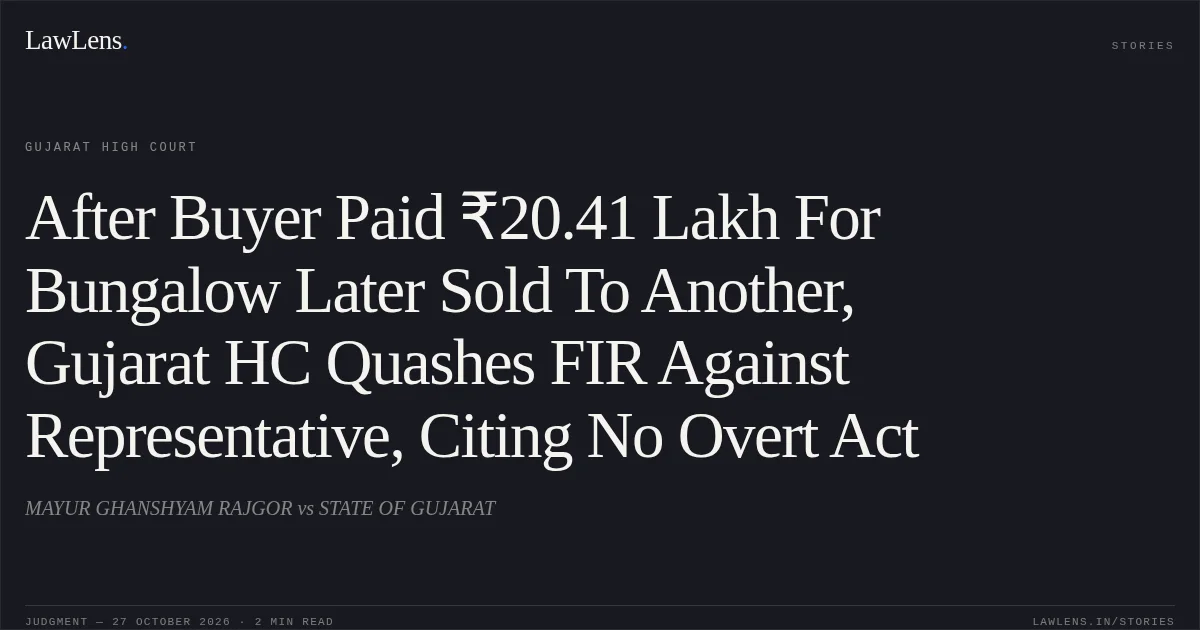
The High Court allowed the application and quashed the FIR and consequential proceedings under Sections 406, 468, 420 and 114 IPC qua the applicant only.
¶ 10The Rule was made absolute; the Court clarified that its observations would not affect any pending litigation concerning the subject matter.
¶ 10.1Original Court PDF
MAYUR GHANSHYAM RAJGORvsSTATE OF GUJARAT
Click to open original judgment
Original judgment, available to read, download and summarize on LawLens.in