01Facts
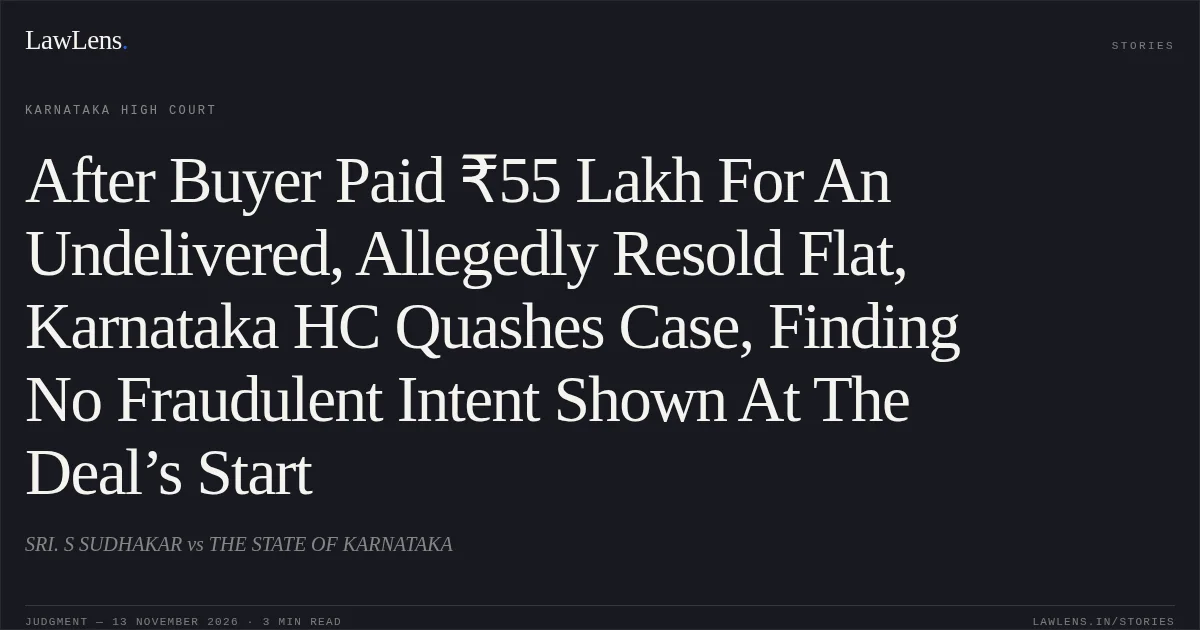
Respondent No. 2 complained that he had entered into agreements for the purchase and construction of an apartment in a project promoted by a company of which the petitioner was stated to be a director.
¶ 2–3, 6He alleged that he paid ₹55,00,000 of the stated ₹64,00,000 consideration, but the apartment was not delivered, was sold to another person, and the amount was not refunded.
¶ 2–3, 6The complaint led to registration of Crime No. 154/2019 and proceedings in C.C. No. 8837/2021 for alleged offences under Sections 420, 504, 506 and 34 IPC; the petitioner sought quashing under Section 482 CrPC, corresponding to Section 528 BNSS.
¶ 1–202Issues
i.1. Whether the complaint’s allegations, taken at face value, disclosed the ingredients of cheating under Sections 417, 418 or 420 IPC, including dishonest intention at the time of inducement.
¶ 7–13ii.2. Whether the allegations disclosed the ingredients of intentional insult under Section 504 IPC or criminal intimidation under Section 506 IPC.
¶ 14–15iii.3. Whether continuation of the criminal proceedings would amount to an abuse of process warranting quashing.
¶ 17–1903Law Applied
Section 415 IPC defines cheating by requiring deception and consequent inducement to deliver property, consent to its retention, or do or omit an act causing or likely to cause harm; Sections 417 and 420 prescribe punishment for forms of cheating, with Section 420 requiring dishonest inducement to deliver property.
¶ 7, 11, 13Cheating depends on the accused’s intention at the time of inducement: subsequent non-performance alone does not establish that a promise was made dishonestly from the outset, though later conduct may be considered.
¶ 8Section 418 requires cheating with knowledge that wrongful loss may ensue to a person whose interests the accused is bound by law or legal contract to protect.
¶ 12Section 504 requires intentional insult and the requisite intention or knowledge that it may provoke a breach of peace or another offence; Sections 503 and 506 require a threat of injury made with the intention of causing alarm or compelling or restraining conduct.
¶ 14–15Section 34 IPC provides for joint liability where a criminal act is done by several persons in furtherance of their common intention; it does not create a separate offence.
¶ 16A civil remedy does not bar criminal proceedings where the allegations independently disclose an offence, but a contractual dispute cannot be converted into a criminal prosecution merely because of non-performance.
¶ 17Provisions in the judgment · 10 · Linked ones open on LawLens
Code of Criminal Procedure, 1973 Section 482
Bharatiya Nagarik Suraksha Sanhita, 2023 Section 528
Indian Penal Code, 1860 Section 34Section 415Section 417Section 418Section 420Section 503Section 504Section 506
04Reasoning
The Court found no specific allegation that, when the agreements were made or payment received, the petitioner knowingly made a false representation or had already decided not to perform.
¶ 9–13The alleged non-delivery, subsequent sale and failure to refund, without material showing dishonest intention at inception, did not establish cheating under Sections 417 or 420; nor were the additional requirements of Section 418 shown.
¶ 9–13The complaint also did not set out a specific intentional insult likely to provoke a breach of peace, or a specific threat made with intent to cause alarm, as required for Sections 504 and 506.
¶ 14–15Since the basic offences were not disclosed, Section 34 could not sustain the prosecution. The dispute, on the allegations before the Court, was contractual and amenable to civil remedies.
¶ 16–1805Holding
The Court held that the complaint did not disclose the essential ingredients of the alleged offences and that continuing the prosecution would amount to an abuse of process.
¶ 19It allowed the petition and quashed the proceedings in C.C. No. 8837/2021 arising from Crime No. 154/2019 before the II Additional CJM, Bengaluru, while reserving Respondent No. 2’s liberty to pursue appropriate proceedings for specific performance and/or recovery of money.
¶ 19 · Order, clauses (i)–(iii)Original Court PDF
SRI. S SUDHAKARvsTHE STATE OF KARNATAKA
Click to open original judgment
Original judgment, available to read, download and summarize on LawLens.in