01Facts
The respondent filed a complaint under Section 200 CrPC read with Section 138 of the Negotiable Instruments Act, 1881; it was registered as C.C. No. 37650 of 2022.
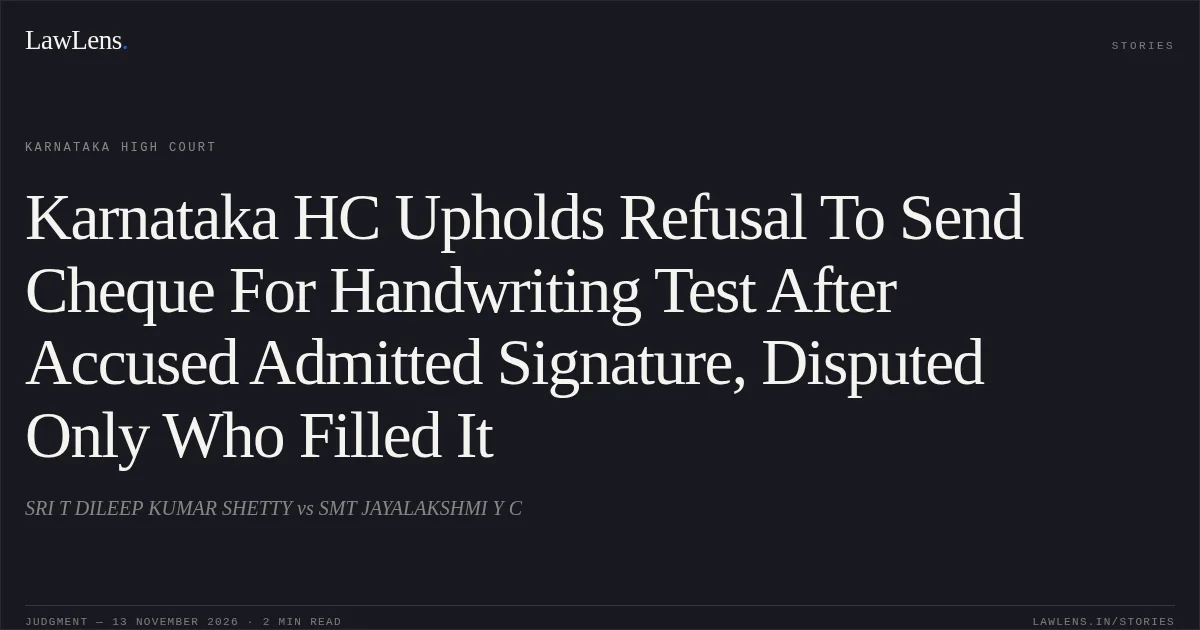
p. 2After the complainant’s evidence and cross-examination, the petitioner, who admitted signing the cheque, applied under Section 45 of the Indian Evidence Act to have its particulars examined by a handwriting expert.
pp. 2–4He alleged that the respondent had forcibly obtained a signed blank cheque and that someone else filled in the particulars.
pp. 2–4The Magistrate dismissed the application, and the petitioner challenged that order under Section 482 CrPC/Section 528 BNSS.
pp. 2–4, 802Issues
i.Whether, where the drawer admits his signature but disputes who filled in the cheque’s particulars, expert examination of those particulars is relevant and necessary to rebut the presumption under Section 139 of the Negotiable Instruments Act.
pp. 8–9 · ¶ 14–15ii.Whether the Magistrate’s refusal to direct that examination warrants interference in light of the accused’s right to a fair trial and to adduce defence evidence.
pp. 4–7, 19, 2303Law Applied
Section 45 of the Indian Evidence Act permits expert opinion on matters including handwriting.
¶ 6–7Under Section 139 of the Negotiable Instruments Act, the statutory presumption applies to a cheque, and the accused may seek to rebut it; Section 20 of that Act was also referred to in considering a signed blank instrument.
¶ 6–7, 15–17Sections 243(2) CrPC and the fair-trial principles discussed in Kalyani Baskar v. M.S. Sampoornam and T. Nagappa v. Y.R. Muralidhar recognise an accused’s right to present relevant defence evidence, while permitting refusal of an application that is vexatious, dilatory, or seeks evidence that would not assist in deciding a material issue.
¶ 8–11, 19Expert examination is not automatic: the court must assess the relevance and utility of the evidence sought.
¶ 19Provisions in the judgment · 8 · Linked ones open on LawLens
Code of Criminal Procedure, 1973 Section 482Section 200Section 243
Bharatiya Nagarik Suraksha Sanhita, 2023 Section 528
Negotiable Instruments Act, 1881 Section 138Section 20Section 118Section 139
04Reasoning
The petitioner’s signature was admitted; the requested expert opinion concerned only who wrote the cheque’s particulars.
¶ 16–22Even if the opinion showed that another person filled them in, that fact alone would not establish that the cheque was forcibly obtained, that it was not issued towards a liability, or that no legally enforceable debt existed.
¶ 16–22The Court distinguished Kalyani Baskar, where the signature was disputed, and T. Nagappa, where the requested examination concerned the age of the signature in relation to the other writings and supported a specific defence of subsequent misuse.
¶ 16–22Because the proposed examination would address authorship of the particulars, but not the material circumstances of issuance or liability, the Magistrate’s refusal disclosed no error warranting interference.
¶ 22–2305Holding
The High Court dismissed the criminal petition and declined to set aside the Magistrate’s order refusing expert examination of the cheque.
¶ 25It stated that the petitioner remained at liberty to raise legally permissible defences, including that the cheque was forcibly obtained and was not issued towards a legally enforceable debt or liability; the observations were confined to the expert-examination request and did not determine the defence on its merits.
¶ 24Original Court PDF
SRI T DILEEP KUMAR SHETTYvsSMT JAYALAKSHMI Y C
Click to open original judgment
Original judgment, available to read, download and summarize on LawLens.in