Facts
The applicant, a retired Branch Manager of the State Bank of India, Barwaha Branch, was alleged to have facilitated 57 unauthorised electronic transfers from customers’ accounts to the account of co-accused Anil Mahavi during his tenure between 14 June 2021 and 7 June 2023.
Source reference: para. 1–2The CBI registered Crime No. RCO0082025A0005 and filed a charge-sheet alleging offences under Sections 120-B and 409 of the IPC and Sections 13(2) read with 13(1)(a) of the Prevention of Corruption Act, 1988.
Source reference: para. 1–2The applicant was not arrested during the investigation, cooperated with the Investigating Agency, and the relevant bank records had been seized.
Source reference: para. 3–4After cognizance was taken, the Special Court issued summons requiring him to appear on 6 July 2026; apprehending that he might be taken into custody upon appearance, he sought anticipatory bail.
Source reference: para. 3–4Issues
Whether the applicant, accused of offences involving criminal conspiracy, criminal breach of trust and corruption, had established exceptional circumstances warranting anticipatory bail?
Source reference: para. 8–9Whether, after completion of investigation, filing of the charge-sheet, issuance of summons, and the Investigating Agency’s decision not to arrest the applicant, a formal arrest was necessary or justified?
Source reference: para. 7, 10–11Law Applied
The Court applied Section 482 of the Bharatiya Nagarik Suraksha Sanhita, 2023, corresponding to Section 438 of the Code of Criminal Procedure, 1973, governing anticipatory bail, along with the statutory offences under Sections 120-B and 409 of the IPC and Sections 13(2) read with 13(1)(a) of the Prevention of Corruption Act, 1988.
Source reference: para. 1Relying on Central Bureau of Investigation v. V. Vijay Sai Reddy, AIR 2013 SC 2216, and Devinder Kumar Bansal v. State of Punjab, 2025 INSC 320, the Court noted that anticipatory bail in serious corruption cases is an exceptional remedy and ordinarily requires circumstances such as prima facie false implication, political motivation, or frivolous allegations.
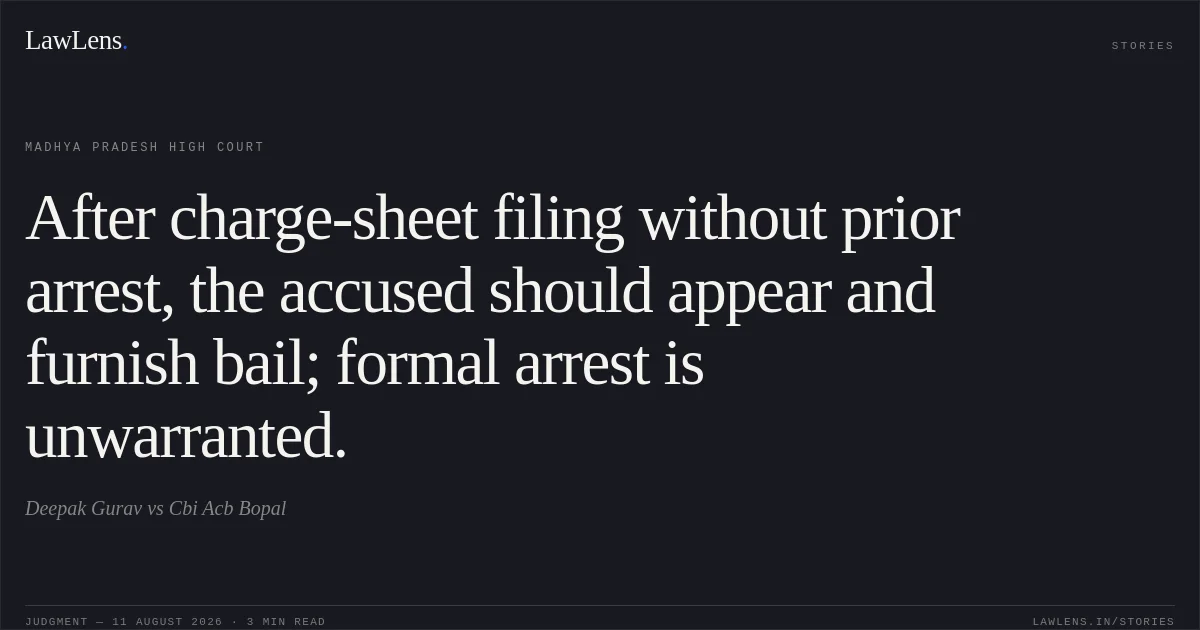
Source reference: para. 6, 8However, relying on Musheer Alam v. State of Uttar Pradesh, 2025 LiveLaw (SC) 83, the Court applied the principle that once investigation is complete and the charge-sheet has been filed, the accused should ordinarily be directed to appear before the trial court and furnish bail; where custodial interrogation was necessary, the Investigating Officer should have arrested the accused during investigation, and a formal arrest thereafter is generally unwarranted.
Source reference: para. 10Reasoning
Although the Court acknowledged that corruption-related offences ordinarily require a stringent approach and that recovery of the alleged amount does not by itself establish innocence, the applicant’s circumstances materially supported protection from arrest.
Source reference: para. 3, 7He had not been arrested during the entire investigation, had cooperated with the authorities, was already retired, and the prosecution had filed the charge-sheet without seeking his custodial interrogation.
Source reference: para. 3, 7The trial court had issued only summons and no warrant of arrest.
Source reference: para. 6–7Applying Musheer Alam, the Court held that after completion of investigation and filing of the charge-sheet, there was no apparent justification for a formal arrest merely because the applicant was required to appear before the trial court.
Source reference: para. 10–11These circumstances were therefore treated as sufficient to make the case fit for anticipatory bail, notwithstanding the general restriction applicable in corruption cases.
Source reference: para. 11Holding
The High Court allowed the anticipatory bail application.
It directed that, in the event of arrest in connection with the registered crime, the applicant be released on bail upon executing a personal bond of ₹50,000 and furnishing one solvent surety in the like amount to the satisfaction of the Arresting/Investigating Officer.
Source reference: para. 12The applicant was directed to remain available for interrogation whenever required and to comply with the conditions under Section 438(2) of the CrPC.
Source reference: para. 13Acts & Sections Cited
4 provisions across 4 statutes referred to in this judgment. Each provision opens on LawLens.
Bharatiya Nagarik Suraksha Sanhita, 20231
Code of Criminal Procedure, 19731
Indian Penal Code, 18601
Prevention of Corruption Act, 19881
Original Court PDF
Deepak GuravvsCbi Acb Bopal
Click to open original judgment
Original judgment, available to read, download and summarize on LawLens.in