Facts
The petitioners sought to quash proceedings in C.C. No. 169/2020 for offences under Sections 420, 468 and 471 read with Section 34 IPC, arising from P.C.R. No. 40/2019.
Source reference: p.2They claimed to be subsequent purchasers from I.P. Subbaiah, an auction purchaser, and relied on a sale certificate said to have been issued in Execution Petition No. 72/1998.
Source reference: p.2–3The respondent disputed the certificate’s authenticity and alleged that the petitioners purchased the property during the pendency of Execution Petition No. 93/2007, knowing of the dispute.
Source reference: p.3–4By the time the High Court considered the petition, charges had been framed.
Source reference: p.4Issues
1. Whether the criminal proceedings should be quashed under Section 482 Cr.P.C. where charges had already been framed and the petitioners disputed the basis for the alleged offences.
Source reference: p.4–5, 72. Whether the allegations disclosed a basis to quash the charges of forgery-related offences and cheating against the petitioners, who claimed they had no role in creating or using the disputed documents.
Source reference: p.6–7Law Applied
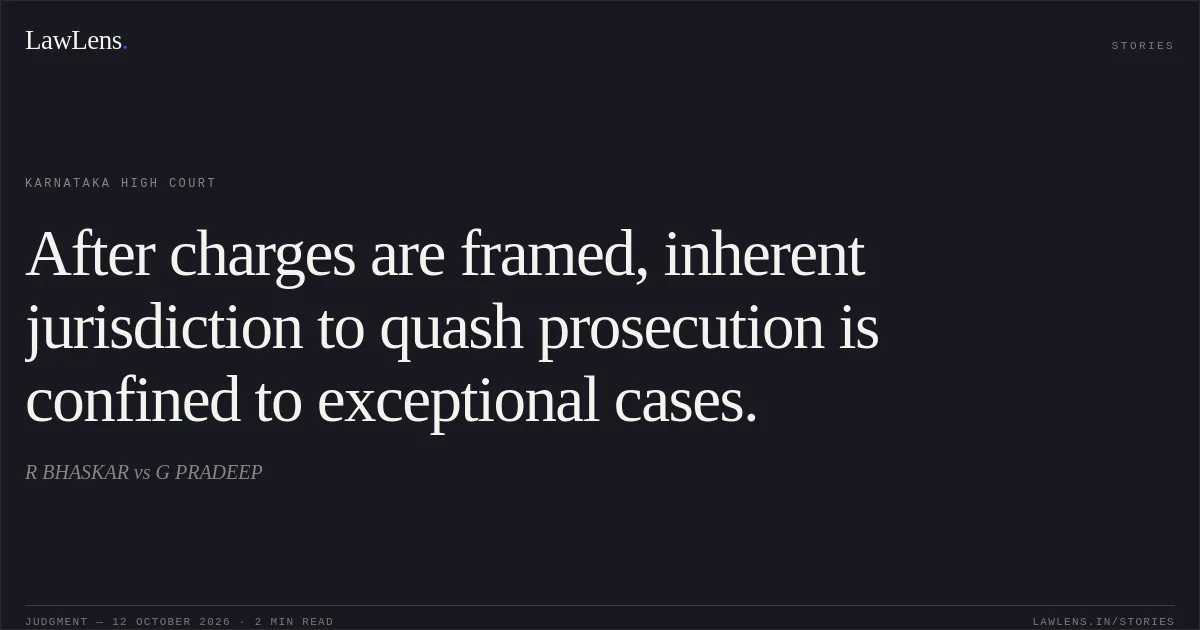
Section 482 Cr.P.C. preserves the High Court’s inherent power, but its exercise to quash proceedings after charges have been framed is limited.
Source reference: p.5Relying on Manakshi Bala v. Sudhir Kumar, 1994 SCC (4) 142, the Court noted that, after framing of charges, the High Court ordinarily should not rely on material beyond that contemplated by Sections 239 and 240 Cr.P.C.; invoking inherent jurisdiction to quash is confined to rare cases where compelling circumstances justify it.
Source reference: p.5The alleged offences were under Sections 420, 468 and 471 read with Section 34 IPC.
Source reference: p.2Reasoning
The petitioners’ status as subsequent purchasers and their asserted lack of involvement in creating the sale certificate did not, at this stage, resolve the disputed allegations concerning the certificate or their knowledge of the pending execution proceedings.
Source reference: p.5–7The Court observed that the material did not prima facie disclose a role for the petitioners in the alleged forgery, but considered whether the ingredients of Section 420 IPC were made out to be a matter for the trial court.
Source reference: p.7Given that charges had already been framed and the High Court’s limited power under Section 482, the petitioners’ grounds could be raised before the trial court.
Source reference: p.7Holding
The High Court dismissed the criminal petition and declined to quash the proceedings in C.C. No. 169/2020.
It left the petitioners’ contentions concerning the alleged offences, including the applicability of Section 420 IPC, to be raised before the trial court.
Source reference: p.7Acts & Sections Cited
7 provisions across 2 statutes referred to in this judgment. Each provision opens on LawLens.
Code of Criminal Procedure, 19733
Indian Penal Code, 18604
Original Court PDF
R BHASKARvsG PRADEEP
Click to open original judgment
Original judgment, available to read, download and summarize on LawLens.in


