01Facts
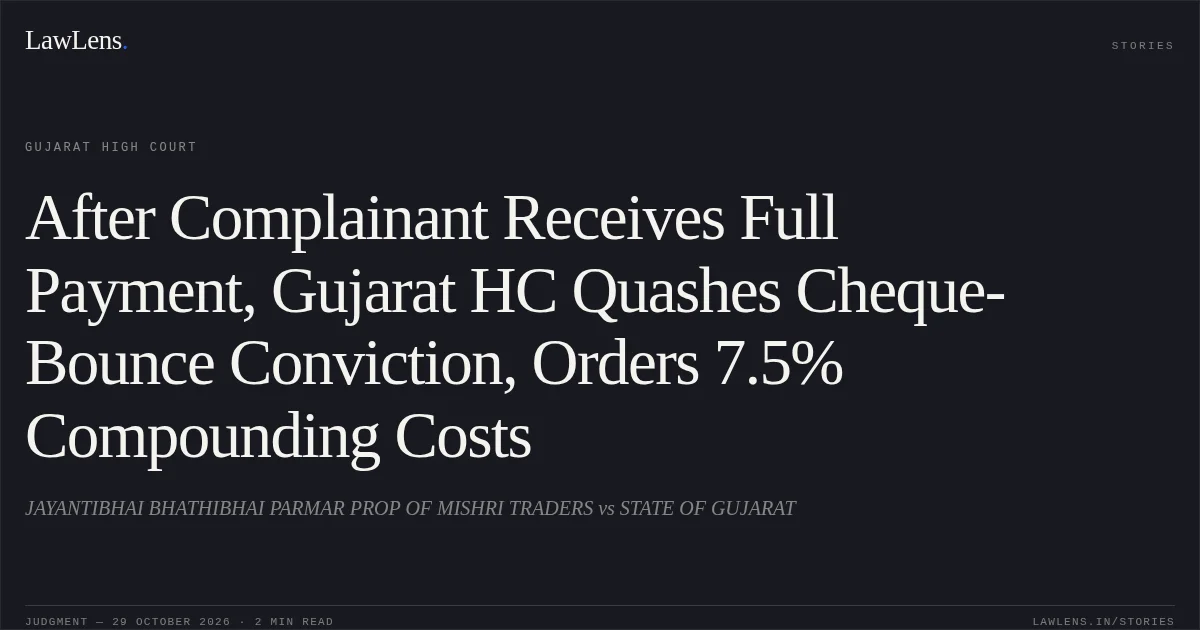
The petitioner was convicted under Section 138 of the Negotiable Instruments Act, 1881, by the 7th Additional Chief Judicial Magistrate, Ahmedabad City, in Criminal Case No. 5801 of 2020, by judgment dated 18 April 2026.
pp. 1–2The petitioner sought relief under Section 528 of the Bharatiya Nagarik Suraksha Sanhita, 2023, stating that the dispute had been amicably settled. The complainant appeared through video conference, confirmed the settlement, and stated that he had received the settlement amount.
pp. 2–3The State left the matter to the Court.
p. 202Issues
i.1. Whether the conviction and consequential proceedings under Section 138 of the Negotiable Instruments Act could be quashed in light of the parties’ amicable settlement and the complainant’s receipt of the settlement amount.
pp. 2–4ii.2. Whether, following settlement at the High Court stage, the petitioner should be directed to pay costs in accordance with the applicable compounding guidelines.
pp. 4–503Law Applied
Section 528 of the Bharatiya Nagarik Suraksha Sanhita, 2023, empowers the High Court to make orders necessary to secure the ends of justice or prevent abuse of the process of a court.
p. 2 · pp. 3–4The Court relied on Gian Singh v. State of Punjab, Madan Mohan Abbot v. State of Punjab, Nikhil Merchant v. Central Bureau of Investigation, Manoj Sharma v. State, Narinder Singh v. State of Punjab, and State of Haryana v. Bhajan Lal in considering quashing on the basis of settlement.
p. 2 · pp. 3–4It also referred to Sanjabij Tari v. Kishore S. Borcar, 2025 LawSuit (SC) 1302, which sets out costs-based guidelines for compounding cheque-dishonour offences at different stages; under the guideline for payment before a High Court in revision or appeal, costs are 7.5% of the cheque amount.
p. 4Provisions in the judgment · 2 · Linked ones open on LawLens
Bharatiya Nagarik Suraksha Sanhita, 2023 Section 528
Negotiable Instruments Act, 1881 Section 138
04Reasoning
The Court accepted the parties’ submissions that the dispute had been settled and noted the complainant’s confirmation that he had received the settlement amount.
pp. 2–3Applying the cited settlement-quashing principles, it concluded that continuing the criminal proceedings would cause unnecessary harassment, serve no useful purpose, and amount to an abuse of process; quashing was therefore appropriate to secure the ends of justice.
pp. 3–4As the matter was settled before the High Court, the Court directed the petitioner to deposit 7.5% of the cheque amount, relying on the Sanjabij Tari guidelines.
pp. 4–505Holding
The petition was allowed, and the judgment of conviction dated 18 April 2026 in Criminal Case No. 5801 of 2020 was quashed; the Court also referred to quashing the FIR and consequential proceedings.
p. 5The petitioner was directed to deposit 7.5% of the cheque amount with the Gujarat High Court Legal Aid Services Authority within two weeks. If unpaid, the amount is recoverable as a fine and as arrears of land revenue. The petitioner was ordered released forthwith if not required in another case, and the Rule was made absolute.
p. 5Original Court PDF
SALMANKHAN MAHEMUDKHAN PATHANvsSTATE OF GUJARAT
Click to open original judgment
Original judgment, available to read, download and summarize on LawLens.in