01Facts
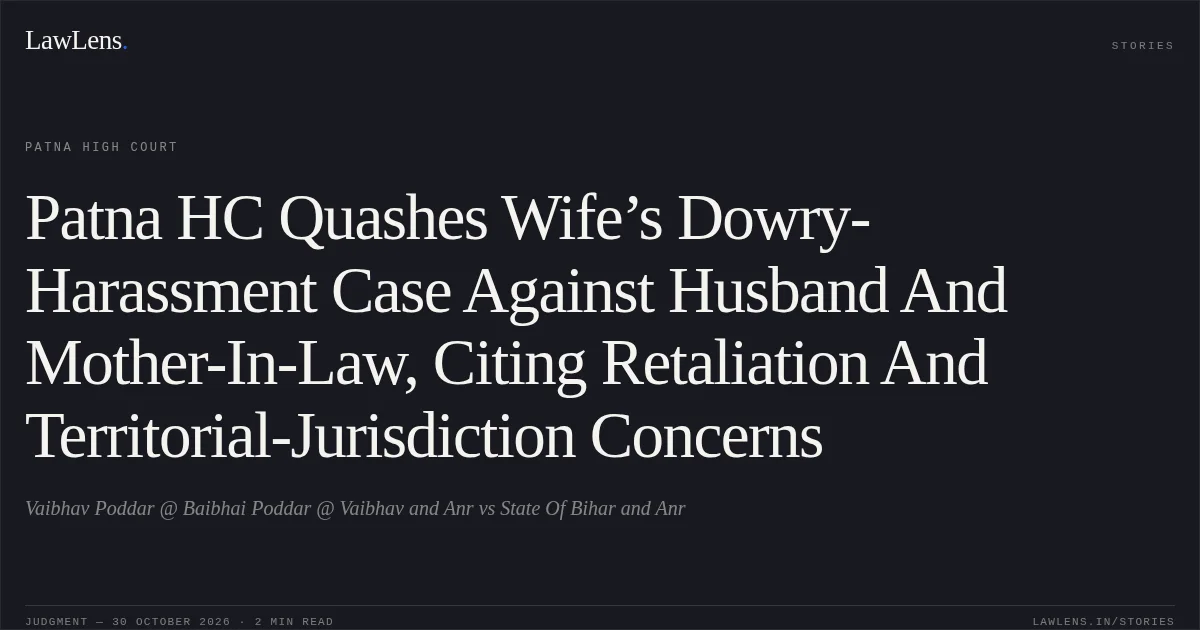
The complainant alleged that the petitioners—her mother-in-law, father-in-law, and husband—assaulted her and ousted her from the matrimonial home over non-fulfilment of dowry demands.
p. 2The Judicial Magistrate took cognizance against them under Section 498A IPC in Complaint Case No. 780C of 2022 on 17 October 2022.
p. 2The petitioners challenged that order, alleging false implication and inconsistencies between the complaint and inquiry-witness statements.
pp. 2–3During the proceedings, the spouses obtained a divorce by mutual consent under Section 13B of the Hindu Marriage Act, and the complainant’s counsel supported quashing the criminal proceedings.
pp. 3–402Issues
i.1. Whether the cognizance order and criminal proceedings under Section 498A IPC should be quashed in light of the parties’ settlement and mutual-consent divorce.
pp. 3–6ii.2. Whether continuation of the proceedings would serve a legitimate purpose given the alleged discrepancies in the complaint and inquiry statements and the subsequent settlement.
pp. 4–603Law Applied
Section 482 CrPC preserves the High Court’s inherent power to quash criminal proceedings to secure the ends of justice.
p. 5Under Gian Singh v. State of Punjab, as quoted in Mange Ram v. State of Madhya Pradesh, even non-compoundable proceedings may be quashed where a genuine settlement—particularly in a matrimonial or family dispute—makes conviction unlikely and continuation would defeat justice.
p. 5Naushey Ali v. State of U.P. (2025) 4 SCC 78 cautions that settlement-based quashing in matrimonial cases, especially those involving family members, requires careful judicial consideration.
p. 5The proceedings arose from an allegation under Section 498A IPC, while the parties’ marriage was dissolved by mutual consent under Section 13B of the Hindu Marriage Act.
pp. 2–4Provisions in the judgment · 1 · Linked ones open on LawLens
Code of Criminal Procedure, 1973 Section 482
04Reasoning
The Court considered the apparent discrepancies between the complaint and inquiry-witness statements, the timing of the complaint after the husband’s divorce filing, and the parties’ subsequent mutual-consent divorce and settlement.
pp. 4–5Applying the principles governing the High Court’s inherent power, it concluded that the dispute had been resolved and that continuing the prosecution would serve no useful or legitimate purpose.
pp. 5–605Holding
The Court allowed the application and quashed the Magistrate’s order dated 17 October 2022 taking cognizance under Section 498A IPC.
p. 6The Court quashed all criminal prosecution arising from Complaint Case No. 780C of 2022 against the petitioners.
p. 6Original Court PDF
AASHA DEVIvsThe State of Bihar
Click to open original judgment
Original judgment, available to read, download and summarize on LawLens.in