01Facts
The complainant alleged that, following her 2004 marriage, her husband and his relatives subjected her to cruelty and demanded ₹1,00,000 to enable her husband to start a business.
¶ 3–5She further alleged that she was turned out of the matrimonial home after an attempted killing in November 2011.
¶ 3–5The Magistrate took cognizance under Section 498A IPC and relevant provisions of the Dowry Prohibition Act; the complainant, her mother, and uncle were examined before charge.
¶ 6–7The petitioners, the complainant’s in-laws, sought discharge under Section 245 CrPC, contending that the allegations and pre-charge evidence disclosed no specific role for them. The Magistrate rejected that application, prompting the present petition invoking the High Court’s inherent jurisdiction.
¶ 8–1002Issues
i.1. Whether the criminal proceeding could continue against the petitioners where the allegations and pre-charge evidence allegedly disclosed no specific act or individual role on their part.
¶ 13, 16–17ii.2. Whether the Magistrate’s rejection of the petitioners’ application for discharge should be set aside to prevent abuse of the process of the Court.
¶ 20–2203Law Applied
Section 245 CrPC provides for discharge in a complaint case where the evidence contemplated by that provision does not warrant proceeding against the accused.
¶ 16The High Court’s inherent jurisdiction may be exercised to prevent abuse of the process of the Court where the allegations, even taken at face value, do not disclose a sufficient basis to prosecute the particular accused.
¶ 20In Abhishek v. State of Madhya Pradesh, 2023 SCC OnLine SC 1083, the Supreme Court cautioned against prosecuting a husband’s relatives in matrimonial disputes on general and omnibus allegations alone; the allegations must disclose the ingredients of the offence and a factual basis for proceeding against each person.
¶ 14The petitioners also relied on Priyanka Srivastava and Another v. State of Uttar Pradesh and Others, (2015) 6 SCC 287, concerning safeguards against misuse of criminal process, including the significance of affidavits.
¶ 11, 18Provisions in the judgment · 1 · Linked ones open on LawLens
Code of Criminal Procedure, 1973 Section 245
04Reasoning
The Court considered the complaint and the evidence recorded before charge and found no specific act of cruelty, harassment, or dowry-related demand attributable individually to the petitioners.
¶ 15, 17, 19The allegations were directed principally against the complainant’s husband, and the petitioners’ relationship to him was not, by itself, sufficient grounds for prosecution.
¶ 15, 17, 19Applying the caution against proceeding on general allegations against matrimonial relatives, the Court concluded that the record did not provide a sufficient factual basis to continue the case against these petitioners.
¶ 18–21The absence of an affidavit was noted, but the decision rested on the lack of specific allegations and supporting material.
¶ 18–2105Holding
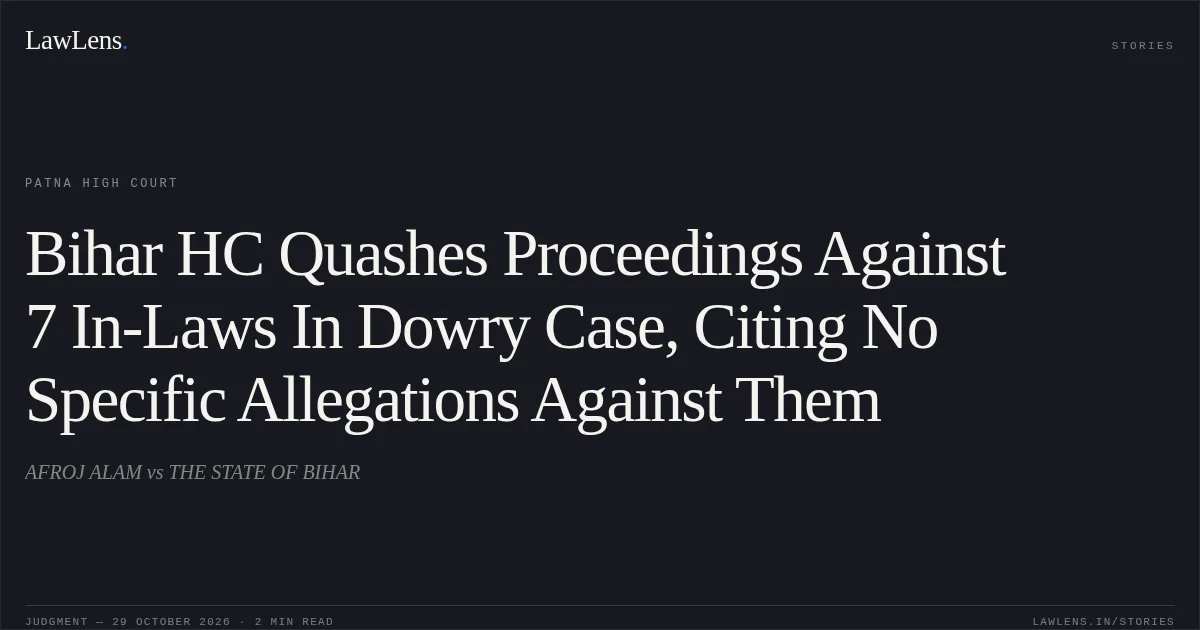
The High Court allowed the petition and set aside/quashed the Magistrate’s order dated 6 October 2018, together with its consequential proceedings, qua all the petitioners.
¶ 21–24It held that continuing the prosecution against them, in the absence of specific allegations and material showing individual involvement, would amount to an abuse of the process of the Court.
¶ 21–24Original Court PDF
AFROJ ALAMvsTHE STATE OF BIHAR
Click to open original judgment
Original judgment, available to read, download and summarize on LawLens.in