Facts
The petitioners were defendants in O.S. No. 172/1999, a suit for specific performance based on an agreement of sale executed in 1997.
Source reference: pp. 3–5; paras. 1, 5The suit proceeded ex parte and culminated in a judgment and decree dated 31 January 2005.
Source reference: pp. 3–5; paras. 1, 5After substantial delay of nearly seven years, the petitioners filed an application under Order IX Rule 13 CPC in Misc. No. 8/2012 seeking to set aside the ex parte decree.
Source reference: pp. 3–5; paras. 5, 14–17In the meantime, the decree had been enforced in Execution Petition No. 214/2010; a registered sale deed was executed in favour of the respondents through the Court Commissioner, and the execution proceedings were closed as fully satisfied.
Source reference: pp. 3–5; paras. 5, 14–17The Trial Court rejected the Order IX Rule 13 application, finding no sufficient cause for the petitioners’ absence and delay.
Source reference: pp. 3–5; paras. 5, 14–17The First Appellate Court affirmed that order in M.A. No. 27/2016.
Source reference: pp. 3–5; paras. 5, 14–17The petitioners challenged both orders under Articles 226 and 227 of the Constitution.
Source reference: pp. 3–5; paras. 1, 5, 14–17Issues
Whether an application under Order IX Rule 13 CPC remains maintainable or capable of granting effective relief after a decree for specific performance has been fully executed through a registered sale deed and the execution proceedings have been closed as satisfied?
Source reference: pp. 5–11; paras. 6–10Whether the High Court should interfere under Article 227 of the Constitution with the concurrent findings of the Courts below rejecting the petitioners’ delayed application for setting aside the ex parte decree?
Source reference: pp. 17–19; paras. 14–17Whether completion of execution of the decree deprives the defendants of their statutory right to challenge the ex parte decree by an appeal under Section 96(2) CPC?
Source reference: pp. 11–17; paras. 11–13Law Applied
The Court applied Section 54 of the Transfer of Property Act, 1882, holding that a decree for specific performance by itself does not transfer title and that title to immovable property passes upon execution and registration of a valid sale deed.
Source reference: pp. 6–9; paras. 7–9It relied on the scheme of Section 28 of the Specific Relief Act, 1963, under which the Court retains jurisdiction over a decree for specific performance until the contractual obligations are performed or the contract is rescinded.
Source reference: p. 7; para. 8Order IX Rule 13 CPC provides a limited remedy to set aside an ex parte decree where summons were not duly served or the defendant was prevented by sufficient cause from appearing; it cannot be used to indirectly annul a completed conveyance brought into existence through execution.
Source reference: pp. 9–11; paras. 9–10A defendant retains the independent statutory remedy of appeal against an ex parte decree under Section 96(2) CPC, and consequential relief may be worked out through restitution under Section 144 CPC if the decree is reversed.
Source reference: pp. 11–16; paras. 11–12However, once an appeal under Section 96(2) is finally adjudicated on merits, the decree merges with the appellate decree, rendering a parallel Order IX Rule 13 proceeding infructuous.
Source reference: pp. 15–17; para. 13Interference under Article 227 is warranted only where there is jurisdictional error, perversity, or material irregularity; concurrent factual findings ordinarily do not warrant supervisory interference.
Source reference: pp. 17–19; paras. 14–16Reasoning
The Court held that the petitioners’ application under Order IX Rule 13 CPC had become infructuous because the ex parte decree had already been completely worked out through execution of a registered sale deed by the Executing Court, thereby crystallising the respondents’ title and leaving no executory obligation outstanding.
Source reference: pp. 8–11, 17–19; paras. 9–10, 14, 17Setting aside the decree under Order IX Rule 13 in these circumstances would indirectly unsettle a completed conveyance, which exceeded the limited scope of that provision.
Source reference: pp. 9–11; paras. 9–10Independently, the petitioners had failed to explain their nearly seven-year delay and had exhibited gross negligence and lack of diligence, as concurrently found by the Trial Court and the Appellate Court.
Source reference: pp. 4–5, 18; paras. 5, 15The Court clarified that execution of the decree did not extinguish the petitioners’ right to file an appeal under Section 96(2) CPC; any reversal could be followed by restitution or appropriate consequential orders.
Source reference: pp. 11–16; paras. 11–12Nevertheless, that appellate remedy could not enlarge the scope of Order IX Rule 13 CPC.
Source reference: pp. 11–16; paras. 11–12Since no perversity or jurisdictional error was demonstrated, Article 227 could not be invoked to disturb the concurrent orders.
Source reference: pp. 17–19; paras. 14–16Holding
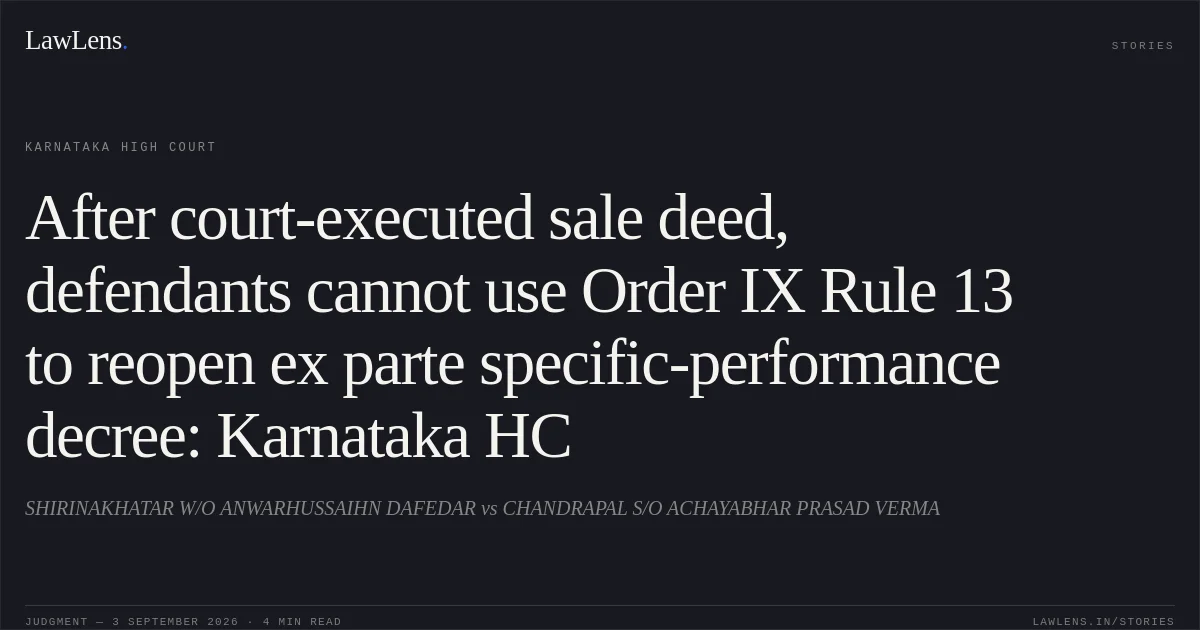
The High Court dismissed the writ petition and upheld the orders rejecting the petitioners’ application under Order IX Rule 13 CPC.
It held that, after execution of the specific-performance decree through a registered sale deed and closure of the execution proceedings, no effective relief survived under Order IX Rule 13 CPC and the provision could not be used to nullify the completed conveyance.
Source reference: pp. 17–19; paras. 14, 16–19The Court clarified that the petitioners could still pursue the statutory appellate remedy under Section 96(2) CPC, subject to limitation and other legal requirements.
Source reference: p. 19; para. 18It further permitted them to apply before the Executing Court for release of any unpaid balance of sale consideration deposited on their behalf, subject to verification of identity and entitlement.
Source reference: p. 19; para. 18Acts & Sections Cited
4 provisions across 3 statutes referred to in this judgment. Each provision opens on LawLens.
Transfer of Property Act, 18821
Specific Relief Act, 19631
Code of Civil Procedure, 19082
Original Court PDF
SHIRINAKHATAR W/O ANWARHUSSAIHN DAFEDARvsCHANDRAPAL S/O ACHAYABHAR PRASAD VERMA
Click to open original judgment
Original judgment, available to read, download and summarize on LawLens.in