Facts
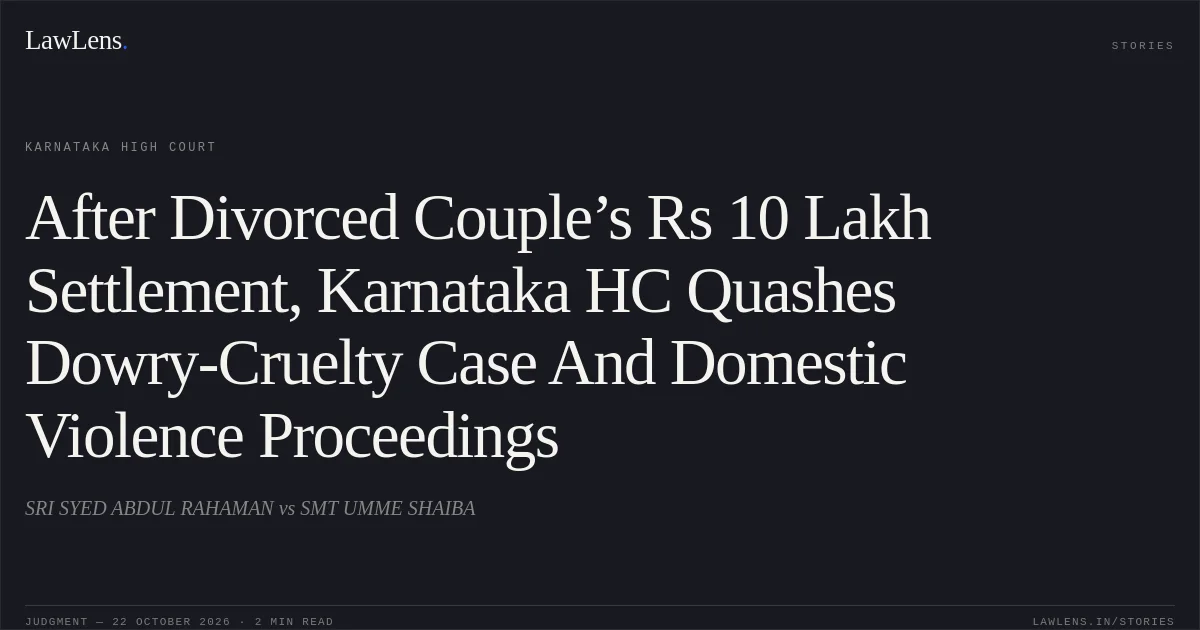
The wife’s complaint led to registration of Crime No. 135/2022 and C.C. No. 15/2023 against the petitioners for offences under Sections 498A, 323, 504 and 506 read with Section 34 IPC, and Sections 3 and 4 of the Dowry Prohibition Act, 1961.
Source reference: p.5She had also initiated proceedings under Section 12 of the Protection of Women from Domestic Violence Act, 2005, in Crl.Misc. No. 2/2023, seeking relief under Sections 18, 19, 22 and 23 of that Act.
Source reference: p.5During the petitions, the parties filed a joint memo stating that they had voluntarily settled their matrimonial disputes, obtained a dissolution of marriage, and that the wife had received ₹10 lakh under their settlement.
Source reference: p.6–9She consented to quashing the pending proceedings.
Source reference: p.6–9Both parties appeared before the Court and confirmed the settlement.
Source reference: p.9Issues
1. Whether the criminal proceedings for the alleged offences, including non-compoundable offences, could be quashed in view of the parties’ settlement of their matrimonial dispute.
Source reference: p.5, p.9–102. Whether the order and proceedings under the Protection of Women from Domestic Violence Act, 2005, could be set aside and quashed on the basis of the settlement.
Source reference: p.5–6, p.10–11Law Applied
The petitions invoked the High Court’s inherent jurisdiction under Section 482 of the Code of Criminal Procedure (also referred to in the petition caption as Section 528 of the Bharatiya Nagarik Suraksha Sanhita).
Source reference: p.3, p.5Relying on Gian Singh v. State of Punjab, (2012) 10 SCC 303, the Court held that proceedings involving non-compoundable offences may be quashed where the dispute is private and matrimonial in nature and the parties have amicably settled it.
Source reference: p.10The underlying proceedings concerned Sections 498A, 323, 504 and 506 read with Section 34 IPC, Sections 3 and 4 of the Dowry Prohibition Act, 1961, and Section 12 of the Protection of Women from Domestic Violence Act, 2005.
Source reference: p.5, p.7, p.10–11Reasoning
The Court took the joint memo on record and noted that both parties appeared and confirmed their amicable settlement.
Source reference: p.6–9The settlement addressed the matrimonial disputes and related proceedings, recorded payment of ₹10 lakh to the wife, and included her consent to quashing the pending cases.
Source reference: p.6–9Because the criminal allegations arose from a private matrimonial dispute that had been settled, the Court applied the principle in Gian Singh to quash the criminal case despite the non-compoundable character of the offences.
Source reference: p.10It also set aside the order in the Domestic Violence Act proceeding and quashed the proceedings initiated under it.
Source reference: p.10–11Holding
The High Court allowed the petitions in view of the settlement.
It quashed C.C. No. 15/2023 against accused Nos. 1 to 6 for the offences under the IPC and Dowry Prohibition Act, and set aside the order dated 4 January 2023 in Crl.Misc. No. 2/2023 and quashed the proceedings under the Domestic Violence Act.
Source reference: p.10–11The husband also undertook to provide the wife, when requested, his passport and specified identity and other documents required for the children’s passport applications.
Source reference: p.11Acts & Sections Cited
13 provisions across 5 statutes referred to in this judgment. Each provision opens on LawLens.
Bharatiya Nagarik Suraksha Sanhita, 20231
Code of Criminal Procedure, 19731
Indian Penal Code, 18604
Protection of Women from Domestic Violence Act, 20055
Original Court PDF
SRI SYED ABDUL RAHAMANvsSMT UMME SHAIBA
Click to open original judgment
Original judgment, available to read, download and summarize on LawLens.in