Facts
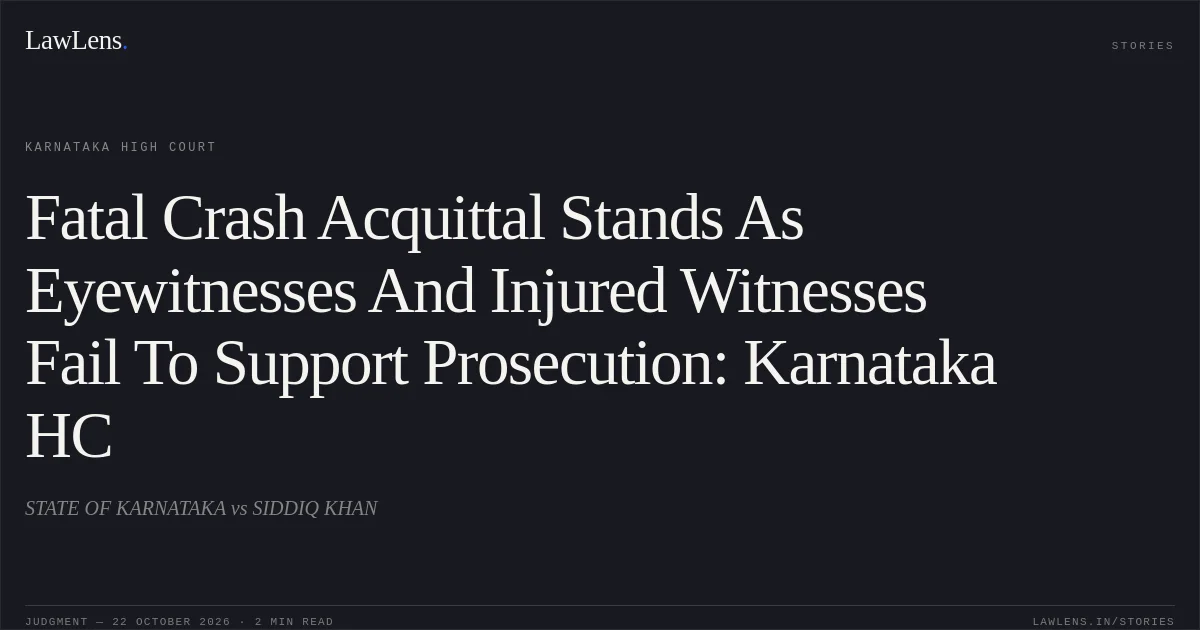
The prosecution alleged that on 3 June 2014, the respondent, driving a Renault Duster on National Highway 66, drove rashly and negligently, causing a collision that injured several people and killed pedestrian Leelavathi. He was charged under Sections 279, 338 and 304A of the Indian Penal Code (IPC).
Source reference: para. 3, p. 3The trial court acquitted him on 1 February 2017; the State appealed under Section 378(1) and (3) of the Code of Criminal Procedure (CrPC).
Source reference: paras. 1, 6, pp. 2, 4Issues
Whether the State had established grounds to interfere with the trial court’s judgment of acquittal
Source reference: para. 9, p. 6What order should follow from the Court’s determination of the appeal
Source reference: para. 9, p. 6Law Applied
Under Section 378 CrPC, an appellate court may reappreciate the evidence in an appeal against acquittal, but the acquittal reinforces the presumption of innocence. If the trial court’s view is a possible view on the evidence, the appellate court must not reverse it merely because another view is available; interference is warranted where the acquittal is perverse, rests on a misreading or omission of material evidence, or where guilt is the only reasonable conclusion.
Source reference: para. 11, pp. 6–8The Court relied on Constable 907 Surendra Singh v. State of Uttarakhand, (2025) 5 SCC 433; Babu Sahebgouda Rudragoudar v. State of Karnataka, (2024) 8 SCC 149; Chandrappa v. State of Karnataka, (2007) 4 SCC 415; and H.D. Sundara v. State of Karnataka, (2023) 9 SCC 581.
Source reference: para. 11, pp. 6–7The alleged offences were under IPC Sections 279, 338 and 304A.
Source reference: para. 3, p. 3Reasoning
The Court found no basis to disturb the acquittal because the material witnesses did not support the prosecution. PW1 described the accident but could not identify the driver, and the prosecution elicited no favourable evidence from him in cross-examination; PW2 and PW3, as well as injured and eyewitnesses PW5 to PW7, also did not support the prosecution.
Source reference: paras. 13–14, pp. 9–10On that record, the trial court’s acquittal was a permissible view, and the High Court found no illegality, infirmity or error warranting appellate intervention.
Source reference: paras. 15–16, p. 10Holding
The Court answered the principal issue in the negative, holding that the State had not established grounds to interfere with the acquittal.
It dismissed the appeal, leaving the trial court’s acquittal in force.
Source reference: p. 11Acts & Sections Cited
4 provisions across 2 statutes referred to in this judgment. Each provision opens on LawLens.
Code of Criminal Procedure, 19732
Indian Penal Code, 18602
Original Court PDF
STATE OF KARNATAKAvsSIDDIQ KHAN
Click to open original judgment
Original judgment, available to read, download and summarize on LawLens.in