Facts
Barik and Shahbad were convicted under Sections 302/34 and 307/34 IPC for a group attack arising from a dispute over boundary trees and land.
Source reference: para. 1–3, 5–10Two persons were killed and two injured.
Source reference: para. 1–3, 5–10The Sessions Court imposed the death penalty for murder and referred the sentence for confirmation under Section 366 CrPC; it also convicted both appellants under Section 4/25 of the Arms Act.
Source reference: para. 1–3, 5–10The appellants challenged their convictions and sentences
Source reference: para. 1–3, 5–10On appeal, the High Court found that the FIR was ante-timed, the informant was not a reliable eyewitness, and the investigation and recovery evidence had serious defects.
Source reference: para. 18–30, 35–36It nevertheless accepted the evidence of the two injured witnesses, whose presence was established by their injuries and whose account was supported on material points by the medical and scene evidence
Source reference: para. 18–30, 35–36Issues
Whether the FIR was ante-timed and the defects in the inquest records undermined the prosecution case
Source reference: para. 17(i)–(ii); paras. 18–20Whether the informant and the injured eyewitnesses were reliable, and whether non-examination of the other named witnesses affected the prosecution case
Source reference: para. 17(iii), (v)–(vi); paras. 21, 23–25Whether the place of occurrence and the medical evidence supported the account of the injured witnesses
Source reference: para. 17(vii)–(viii); paras. 26–27Whether the recoveries and forensic reports were admissible and could incriminate the appellants
Source reference: para. 17(ix); paras. 28–31Whether each appellant’s participation and common intention were proved, establishing offences under Sections 302/34 and 307/34 IPC, and whether the Arms Act convictions could stand
Source reference: para. 17(x); paras. 32–34Whether the death sentences should be confirmed or commuted
Source reference: para. 17(xi); paras. 37–40Law Applied
Under Sections 302 and 307 read with Section 34 IPC, criminal liability may attach to participants who act in furtherance of a common intention; Section 34 does not require every participant to be tried together [Mohan Singh v. State of Punjab, para. 34].
Source reference: para. 34An injured witness’s testimony carries assurance of presence and should not be rejected without strong grounds, though it must be scrutinised for material contradictions or clear falsity [Abdul Sayeed v. State of M.P., para. 24; Balu Sudam Khalde v. State of Maharashtra, para. 24].
Source reference: para. 24An FIR is not substantive evidence, and an ante-timed FIR calls for closer scrutiny but does not alone require acquittal if the eyewitness evidence is otherwise reliable [Meharaj Singh v. State of U.P., para. 19].
Source reference: para. 19An inquest is directed to the apparent cause of death and is not substantive evidence for contradicting eyewitnesses [Radha Mohan Singh v. State of U.P., para. 20].
Source reference: para. 20A recovery under Section 27 of the Evidence Act requires a proved disclosure statement; a circumstance not put to an accused under Section 313 CrPC ordinarily cannot be used against that accused [Subramanya v. State of Karnataka, para. 28; Sharad Birdhichand Sarda v. State of Maharashtra, para. 31].
Source reference: para. 28; para. 31Defective investigation does not itself entitle an accused to acquittal where reliable evidence independently establishes guilt [C. Muniappan v. State of T.N., para. 35].
Source reference: para. 35The death penalty is confined to the “rarest of rare” cases in which life imprisonment is unquestionably foreclosed, and sentencing requires meaningful consideration of the individual offender’s prospects of reform and mitigating circumstances [Bachan Singh v. State of Punjab; Machhi Singh v. State of Punjab; Manoj v. State of M.P.; paras. 37–40].
Source reference: paras. 37–40Reasoning
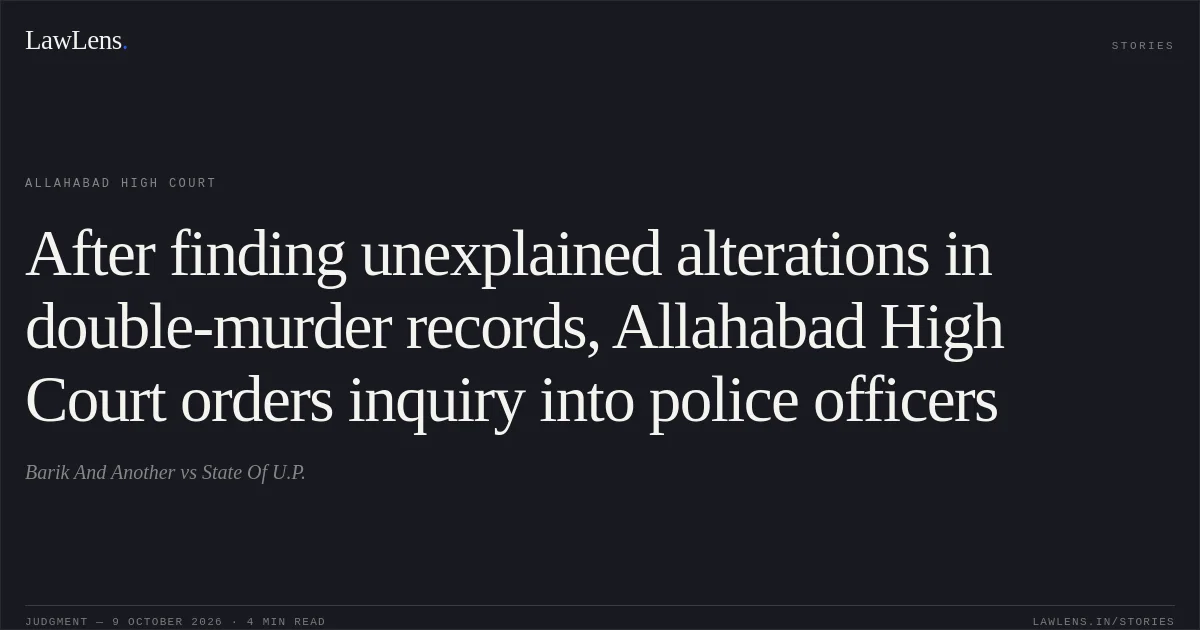
The timing inconsistencies, unexplained alterations in the inquest papers and the FIR’s account of events that occurred later than its recorded registration time led the Court to find that the FIR was ante-timed; these defects discredited the informant and required careful scrutiny, but did not negate the injured witnesses’ independent evidence
Source reference: paras. 18–20The informant’s conduct and inconsistent account made him unreliable as an eyewitness, while the injured witnesses’ presence was established by their contemporaneous medical examination.
Source reference: para. 21; para. 24Although they differed on weapons and the attribution of particular blows, the Court accepted their consistent evidence that Barik and Shahbad participated in the armed attack, supported by the medical evidence and the scene evidence
Source reference: paras. 24–27, 32The unproved disclosures, inconsistent arrest accounts and other defects meant that the alleged weapon recoveries and related forensic material could not be relied on; the Arms Act convictions therefore failed
Source reference: paras. 28–31, 34The joint armed attack and the appellants’ participation established common intention and liability for murder and attempted murder
Source reference: paras. 32–34The death penalty was not justified because the attack arose from a land dispute, the evidence did not identify which appellant inflicted the fatal injuries, investigative defects remained relevant in mitigation, and the record did not establish that either appellant was incapable of reform.
Source reference: paras. 37–40The trial court had also failed to conduct a proper individualised sentencing assessment
Source reference: paras. 37–40Holding
The Court answered the death reference in the negative and declined to confirm the death sentences.
It upheld the appellants’ convictions under Sections 302/34 and 307/34 IPC, commuting the death sentences to life imprisonment while maintaining the sentences for attempted murder; it set aside the Arms Act convictions and acquitted the appellants of those charges
Source reference: paras. 41–42Sentences were ordered to run concurrently, with set-off under Section 428 CrPC.
Source reference: para. 42The Court also directed compensation under Section 357(3) CrPC to the deceaseds’ next of kin and the injured persons, asked the District Legal Services Authority to consider compensation under Section 357-A CrPC, and ordered an independent police inquiry into the handling of the official records
Source reference: paras. 42–47Acts & Sections Cited
14 provisions across 3 statutes referred to in this judgment. Each provision opens on LawLens.
Code of Criminal Procedure, 19738
Indian Penal Code, 18603
Arms Act, 19593
Original Court PDF
Barik And AnothervsState Of U.P.
Click to open original judgment
Original judgment, available to read, download and summarize on LawLens.in