Facts
The applicant, the original complainant, sought leave to appeal against the Sessions Court’s judgment dated 19 August 2025 acquitting the accused of offences under Sections 302, 120B, 201 and 506(2) of the Indian Penal Code.
Source reference: pp. 2–3, 6–8The prosecution alleged that the accused murdered the complainant’s son, moved his body to a railway track to make the death appear suicidal, and threatened his daughter.
Source reference: pp. 2–3, 6–8The case rested substantially on circumstantial evidence.
Source reference: pp. 2–3, 6–8The High Court noted that the daughter, described as the principal eyewitness, was declared hostile and did not support the prosecution; the prosecution also failed to establish the alleged relationship between the accused or their presence and involvement at the scene.
Source reference: pp. 2–3, 6–8The complainant’s evidence did not establish the accused’s involvement.
Source reference: p. 7Issues
Whether the applicant had shown grounds for leave to appeal against the acquittal, including that the trial court’s findings were perverse or otherwise unsustainable.
Source reference: pp. 8–9, 13–14Whether the prosecution evidence established a complete chain of circumstances pointing to the accused’s guilt and excluding other reasonable conclusions.
Source reference: pp. 7–8Law Applied
The Court considered the offences charged under Sections 302, 120B, 201 and 506(2) IPC, and the application for leave under Section 419 of the Bharatiya Nagarik Suraksha Sanhita, 2023, as stated in the judgment.
Source reference: pp. 2, 13In a circumstantial-evidence case, the circumstances relied upon must be fully established and form a complete chain pointing to guilt while excluding other reasonable hypotheses.
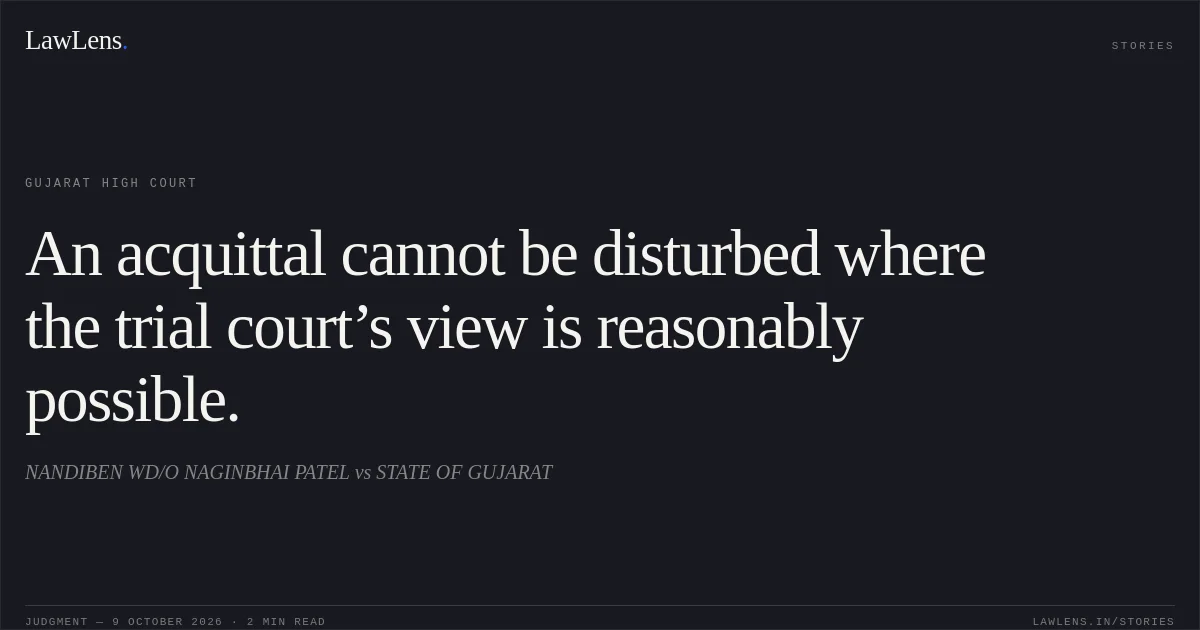
Source reference: pp. 7–8On an appeal against acquittal, the appellate court may review the evidence, but the acquittal strengthens the presumption of innocence; where the trial court’s view is a reasonable possible view, the acquittal should not be disturbed merely because another view is possible.
Source reference: pp. 8–13Interference is warranted where, among other grounds, the judgment is perverse or materially misreads or omits evidence.
Source reference: pp. 8–13The Court relied on Ramesh Babulal Doshi v. State of Gujarat (1996) 9 SCC 225 and the principles reproduced from Tulasareddi @ Mudakappa & Anr. v. State of Karnataka & Ors., 2026 INSC 67.
Source reference: pp. 8–13Reasoning
The Court found that the principal eyewitness did not support the prosecution and that the evidence did not establish the alleged relationship, the accused’s presence at the deceased’s house, or their involvement in transporting the body.
Source reference: p. 6The complainant’s testimony, including matters based on hearsay, did not cure those evidentiary gaps or implicate the accused.
Source reference: p. 7The circumstances therefore did not form a complete chain pointing to guilt.
Source reference: pp. 7–8The applicant also failed to demonstrate that the trial court’s assessment was perverse, contrary to the evidence, or otherwise unsustainable; the acquittal represented a possible view of the evidence.
Source reference: pp. 8–9, 13–14Holding
The High Court held that no case was made out to grant leave to appeal against the acquittal.
It dismissed the application for leave and, consequentially, dismissed the captioned criminal appeal.
Source reference: pp. 13–14Acts & Sections Cited
8 provisions across 3 statutes referred to in this judgment. Each provision opens on LawLens.
Indian Penal Code, 18603
Bharatiya Nagarik Suraksha Sanhita, 20231
Code of Criminal Procedure, 19734
Original Court PDF
NANDIBEN WD/O NAGINBHAI PATELvsSTATE OF GUJARAT
Click to open original judgment
Original judgment, available to read, download and summarize on LawLens.in