Facts
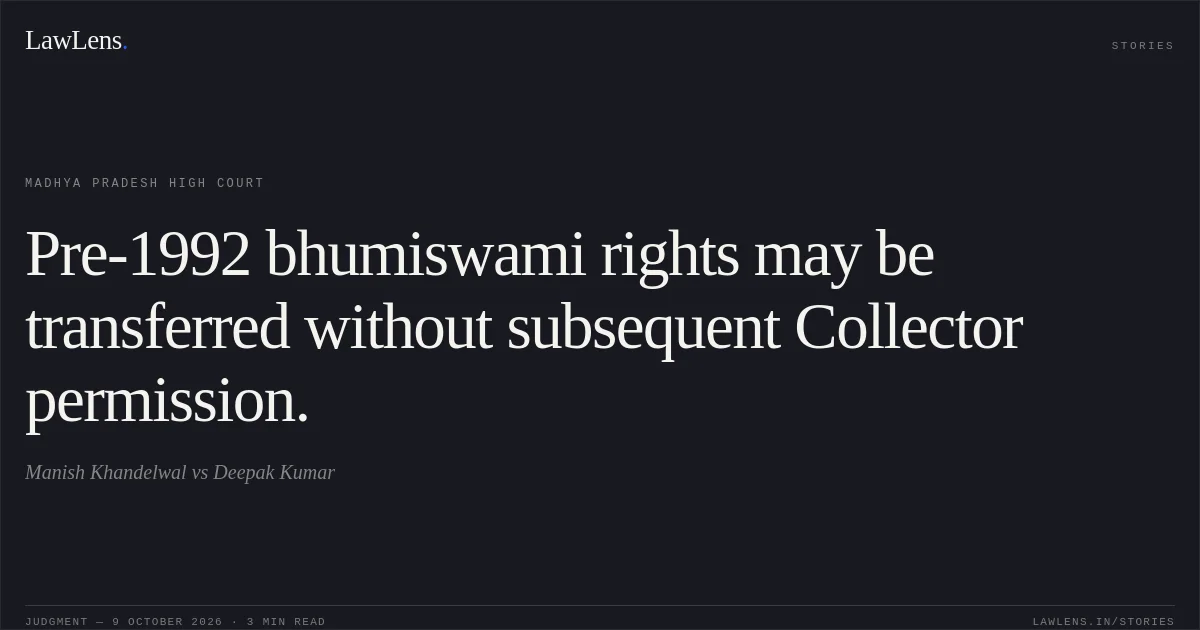
The petitioners sought mutation of land at Village Sanawadiya, Indore, purchased from respondent no. 1 by registered sale deed dated 3 August 2010.
Source reference: no citationThe Tehsildar rejected the petitioners’ mutation application in 2016, relying on a Patwari report that the land was Government land according to the Misal Bandobast; the SDO and Additional Commissioner affirmed that decision in 2017 and 2018, respectively.
Source reference: para. 2, 8During the petition’s pendency, the Additional Collector passed an ex parte order dated 18 October 2021 setting aside respondent no. 1’s mutation on the ground that the land was patta land transferred without permission.
Source reference: para. 9The petitioners challenged the 2016–2018 orders under Article 227 of the Constitution.
Source reference: para. 1–2Issues
Whether the revenue authorities could refuse mutation on the basis of a Patwari report asserting Government ownership, despite earlier revenue entries recording private bhumiswami rights and registered sale deeds.
Source reference: para. 7–11Whether the orders refusing mutation and the Additional Collector’s later order cancelling respondent no. 1’s mutation warranted interference under Article 227.
Source reference: para. 9, 16–20Law Applied
Section 158(3) of the Madhya Pradesh Land Revenue Code, 1959, as discussed by the Court, treats qualifying holders of land in bhumiswami right under a lease or allotment as bhumiswamis; the transfer restrictions introduced by the 1992 amendment applied prospectively to the circumstances considered by the Court.
Source reference: para. 10–11, 18A registered document is prima facie presumed valid, and the burden lies on the person disputing it to rebut that presumption (Prem Singh v. Birbal, (2006) 5 SCC 353).
Source reference: para. 11The Court also relied on Ranveer Singh v. State of M.P., 2010 (4) MPLJ 178, concerning the time limit for suo motu revenue action, and on Estralla Rubber v. Dass Estate (P) Ltd., (2001) 8 SCC 97, and Surya Dev Rai v. Ram Chander Rai, (2003) 6 SCC 675, for the principle that Article 227 permits intervention where a subordinate authority’s error causes grave injustice, but is not a general appellate jurisdiction.
Source reference: para. 12, 16–17Reasoning
The Court found that the record showed the land in private names in earlier years, that bhumiswami rights had been recorded pursuant to an order dated 15 April 1986, and that subsequent revenue entries recorded Chhotelal and then his heirs as bhumiswamis.
Source reference: para. 8Against that history, the authorities relied on the Patwari’s Misal Bandobast report without, in the Court’s view, producing a sufficient record to displace the earlier entries and registered transactions.
Source reference: para. 7–8, 11The Court held that the rights recorded before the 1992 amendment were not shown to have been set aside by a competent authority, and concluded that the later transfer restriction could not justify refusal of mutation on these facts.
Source reference: para. 11, 18It considered the concurrent orders perverse and unjust, warranting supervisory interference.
Source reference: para. 16–18Although the 2021 order was not formally challenged by amendment, the Court treated it as consequential, noted that it had been passed ex parte without impleading the petitioners, and set it aside as well.
Source reference: para. 9, 19–20Holding
The Court allowed the petition and granted the reliefs sought against the Tehsildar’s, SDO’s and Additional Commissioner’s orders refusing mutation.
It also set aside the Additional Collector’s order dated 18 October 2021, notwithstanding the absence of a formal amendment challenging it, and disposed of the petition.
Source reference: para. 20–21Acts & Sections Cited
9 provisions across 2 statutes referred to in this judgment. Each provision opens on LawLens.
MP Land Revenue Code 19598
Code of Civil Procedure, 19081
Original Court PDF
Manish KhandelwalvsDeepak Kumar
Click to open original judgment
Original judgment, available to read, download and summarize on LawLens.in