Facts
The parties married on 23 January 2013 and had a son in 2014. They lived separately for a considerable period.
Source reference: pp. 2–5The husband sought divorce on grounds of cruelty and desertion; the wife denied those allegations, alleging harassment and that she had been driven from the matrimonial home.
Source reference: pp. 2–5The Family Court granted divorce on both grounds, relying, among other matters, on the wife’s limited stay in the matrimonial home, her residence at Hajipur, and proceedings she had initiated.
Source reference: p. 5The wife appealed, contending that the Family Court had misappreciated the evidence.
Source reference: p. 6During the appeal, both parties’ counsel acknowledged that the marriage had failed and that neither party wished to resume married life.
Source reference: p. 6Issues
1. Whether the parties’ prolonged separation and their mutual position that they did not wish to resume cohabitation justified severing the marriage on the ground of cruelty under Section 13(1)(i-a) of the Hindu Marriage Act, 1955.
Source reference: pp. 6–72. Whether, and in what amount, permanent alimony should be awarded to the wife.
Source reference: pp. 7–9Law Applied
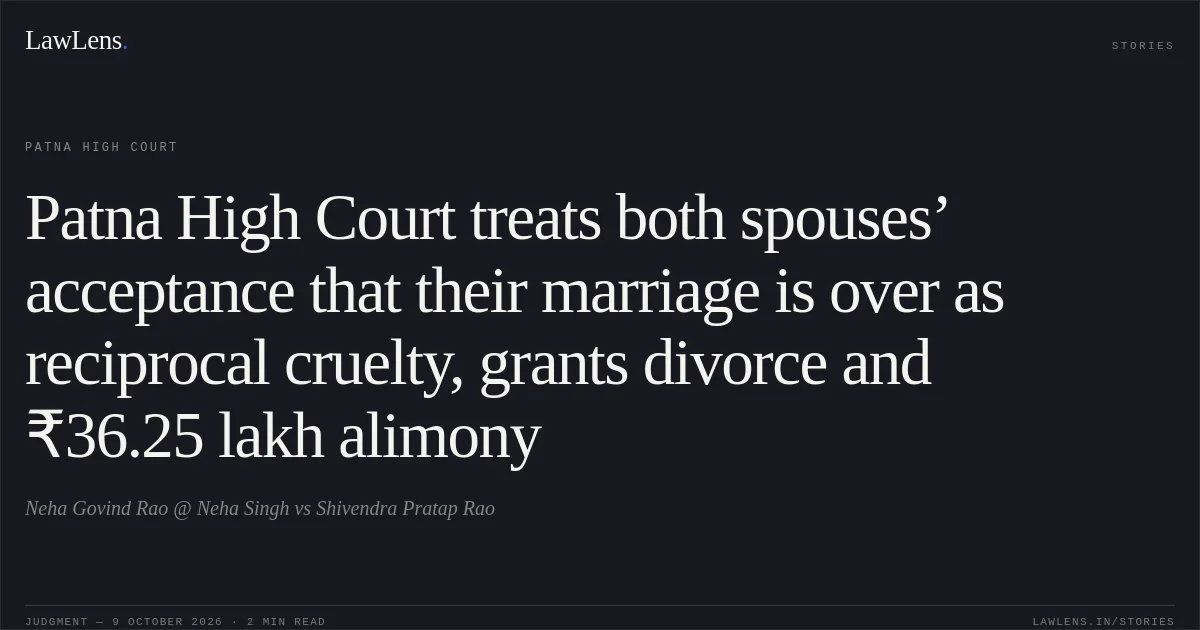
Section 13(1)(i-a) of the Hindu Marriage Act, 1955, permits divorce on the ground of cruelty; the Court treated the parties’ reciprocal conduct and the absence of any intention to resume married life as reciprocal cruelty, rather than granting divorce solely on irretrievable breakdown.
Source reference: p. 7The Court referred to Sri Sanjib Tarafdar v. Smt. Mausumi Tarafdar, [2026:CHC-AS:1102-DJ], in support of that approach.
Source reference: p. 7For quantifying permanent alimony, it adopted a calculation method attributed to Rajnesh v. Neha, (2021) 2 SCC 324, and considered the husband’s disclosed income and remaining service period.
Source reference: pp. 7–8The Court distinguished maintenance under Section 125 of the Code of Criminal Procedure, 1973, described as summary relief, from permanent alimony, which it said should account for the wife’s needs, maintenance, well-being, and other circumstances.
Source reference: p. 8Reasoning
The Court noted that the parties had lived apart for a long time, had no association, and, through counsel, both accepted that the marriage had failed and that they did not wish to reunite.
Source reference: p. 6Although it acknowledged that irretrievable breakdown was not itself a ground on which it could grant divorce, it regarded the parties’ mutual unwillingness to continue the marital relationship as reciprocal cruelty and severed the marriage under Section 13(1)(i-a).
Source reference: p. 7On alimony, it relied on the husband’s disclosed monthly income of approximately ₹85,000 and the calculation approach in Rajnesh, fixing the award at ₹36,25,200.
Source reference: pp. 7–8Holding
The appeal was allowed, and the marriage was severed on the ground of cruelty under Section 13(1)(i-a) of the Hindu Marriage Act.
The husband was directed to pay the wife permanent alimony of ₹36,25,200 in two equal instalments: ₹18,12,600 within one month and the balance within three months of the order. Interest at 12% per annum was directed on any outstanding amount not paid within the specified period.
Source reference: p. 9Acts & Sections Cited
2 provisions across 2 statutes referred to in this judgment. Each provision opens on LawLens.
Hindu Marriage Act, 19551
Code of Criminal Procedure, 19731
Original Court PDF
Neha Govind Rao @ Neha SinghvsShivendra Pratap Rao
Click to open original judgment
Original judgment, available to read, download and summarize on LawLens.in