Facts
The petitioner, the maternal grandfather of a minor child, filed a contempt petition alleging non-compliance with the Supreme Court’s earlier custody directions in Criminal Appeal No. 623 of 2025.
Source reference: pp.1–2, paras.1–3The child’s mother, the petitioner’s daughter, had died, and the maternal grandparents had been caring for the child.
Source reference: pp.1–2, paras.1–3Relying on the father’s status as the natural guardian and precedents permitting custody proceedings under Article 226 of the Constitution, the Court had earlier directed that custody remain with the grandparents until 30 April 2025, while allowing the father structured access and familiarisation with the child.
Source reference: pp.1–2, paras.1–3From 1 May 2025, custody was to be handed over to the father, with the grandparents receiving visitation rights every second Saturday.
Source reference: p.3, para.4The grandparents alleged that the child was never sent to them, while the father contended that they had not come to collect the child; the father had also subsequently moved to another location due to a transfer.
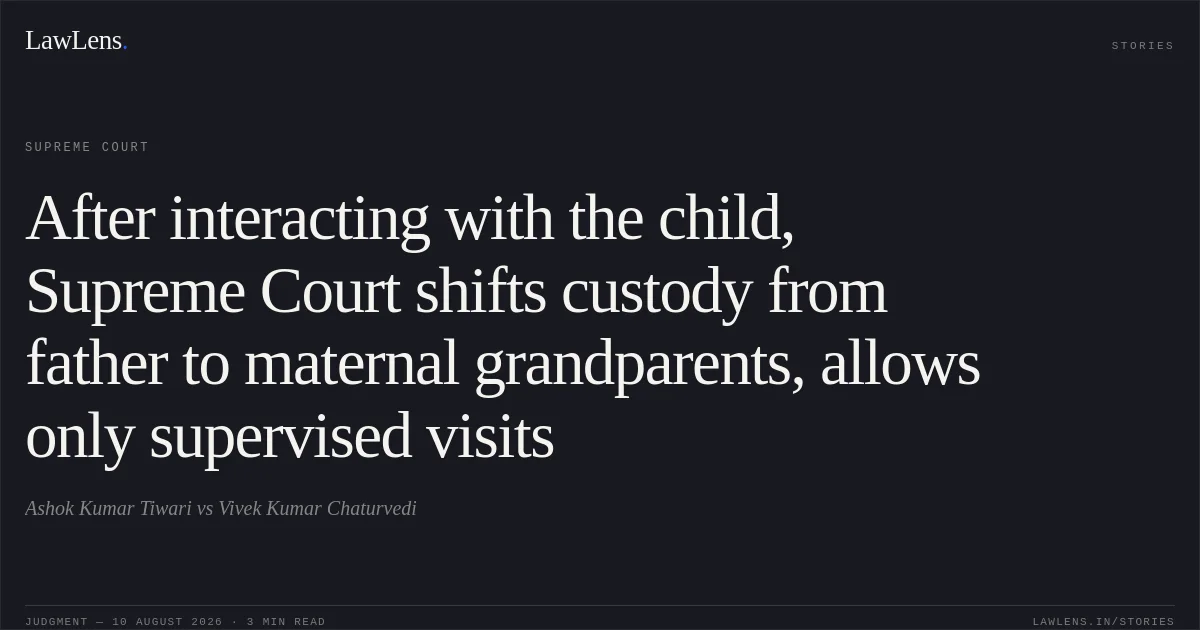
Source reference: p.3, para.4After directing production of the child, the Court interacted with the child and concluded that the child’s welfare would best be served by being cared for by the maternal grandparents.
Source reference: p.3, para.6Issues
1. Whether, while exercising contempt jurisdiction, the Court could reconsider and modify the child-custody arrangement in light of the child’s welfare after interacting with the child.
Source reference: p.4, para.82. Whether custody of the minor child should be restored to the maternal grandparents rather than continued with the father, having regard to the overall circumstances and the child’s best interests.
Source reference: p.3, para.6; p.4, para.73. What visitation and maintenance-related directions should govern the relationship between the child, the father, and the maternal grandparents.
Source reference: p.4, para.7Law Applied
The Court applied the constitutional and welfare-oriented principles governing child custody, including the Court’s power to consider custody under Article 226 of the Constitution where invoked by the father as the natural guardian.
Source reference: p.1, para.2The controlling consideration in custody matters is the welfare and best interests of the child, and the Court may exercise its parens patriae jurisdiction to protect those interests even in proceedings technically instituted for contempt.
Source reference: p.4, para.8The Court also relied on the earlier custody directions, which had structured the child’s transition to the father and preserved visitation rights for the maternal grandparents.
Source reference: pp.2–3, para.3No specific statutory provision or precedent is identified by name in the order.
Source reference: no citationReasoning
The Court treated the child’s welfare as overriding the procedural posture of the contempt petition.
Source reference: no citationAlthough the earlier order had transferred custody to the father and provided visitation rights to the grandparents, the alleged non-compliance, the changed circumstances following the father’s transfer, and, most significantly, the Court’s direct interaction with the child led it to reassess the arrangement.
Source reference: p.3, paras.4–6On its assessment of the child’s interests and the grandparents’ existing caregiving role, the Court concluded that custody with the grandparents would better serve the child’s welfare.
Source reference: no citationIt therefore invoked parens patriae jurisdiction notwithstanding that the proceeding was formally one for contempt.
Source reference: p.4, para.8The Court further considered the need to preserve the father’s relationship with the child while ensuring that contact would occur only after the child developed confidence and, if the child desired it, under supervision.
Source reference: p.4, para.7Holding
The Court closed the contempt petition but directed that custody of the minor child be handed over to the maternal grandparents.
The maternal uncle was permitted to take the child from the Court.
Source reference: no citationThe grandparents were left free to pursue maintenance in accordance with law.
Source reference: p.4, para.7The father may seek visitation once every three months, but only if the child desires it and subject to strict supervision by the grandparents or maternal uncles.
Source reference: p.4, para.7Pending applications, if any, were disposed of.
Source reference: p.4, para.10Original Court PDF
Ashok Kumar TiwarivsVivek Kumar Chaturvedi
Click to open original judgment
Original judgment, available to read, download and summarize on LawLens.in