01Facts
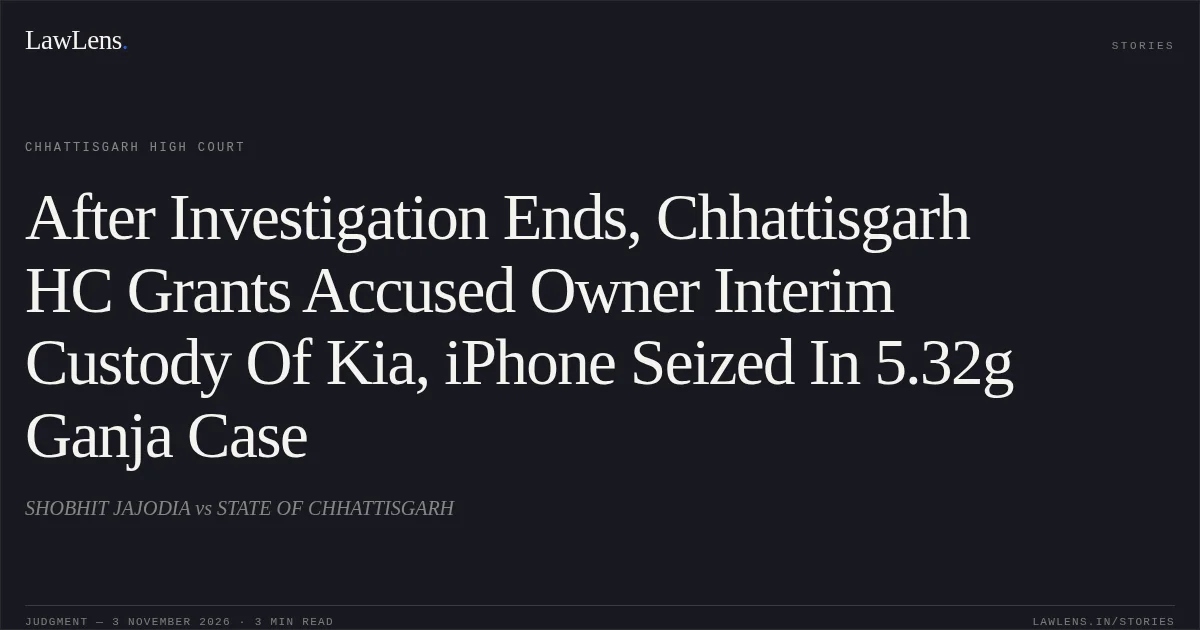
Police registered an NDPS Act case against the petitioner after allegedly recovering 5.32 grams of cannabis from a vehicle registered in his name.
pp. 2–4 · ¶ 2–4The vehicle and his Apple iPhone were seized; the petitioner was arrested and later released on bail.
pp. 2–4 · ¶ 2–4After the investigation was completed and the final report filed, he sought interim custody of both items under Section 503 of the BNSS.
pp. 2–4 · ¶ 2–4The Magistrate rejected the application, and the Sessions Court dismissed his revision, principally because the petitioner was an accused and the contraband had been recovered from his vehicle.
pp. 2–4 · ¶ 2–4He then challenged those orders before the High Court.
pp. 2–4 · ¶ 2–402Issues
i.Whether interim custody of the seized vehicle and mobile phone could be granted while the NDPS proceedings were pending, despite the petitioner being an accused and the alleged contraband having been recovered from his vehicle.
p. 4 · ¶ 8ii.Whether Sections 60(3) and 63 of the NDPS Act precluded interim release of the vehicle pending the trial court’s decision on confiscation.
pp. 6–7 · ¶ 12 · p. 7 · ¶ 1303Law Applied
Section 503 of the BNSS empowers a Magistrate to order delivery of seized property to the person entitled to possession, subject to appropriate conditions.
p. 5 · ¶ 10Sections 36-C and 51 of the NDPS Act apply the BNSS procedure to proceedings under that Act insofar as it is not inconsistent with the Act.
p. 5 · ¶ 11Under Sections 60(3) and 63 of the NDPS Act, a conveyance used to carry contraband may be liable to confiscation, but the trial court determines confiscation in the trial after hearing the claimant; the statutory provisions do not themselves impose a bar on interim release.
pp. 6–7 · ¶ 12–13In Bishwajit Dey v. State of Assam, (2025) 3 SCC 241, the Supreme Court held that there is no specific NDPS Act bar to interim release of a seized vehicle, that each case must be assessed on its facts, and that an owner-accused may be a relevant consideration without making the rule inflexible.
pp. 7–10 · ¶ 14, 16Sunderbhai Ambalal Desai v. State of Gujarat, (2002) 10 SCC 283, supports prompt and conditional release of seized property, with safeguards such as bonds, security, panchnamas and photographs, rather than prolonged police-station custody.
pp. 8–9 · ¶ 15Provisions in the judgment · 10 · Linked ones open on LawLens
Bharatiya Nagarik Suraksha Sanhita, 2023 Section 528Section 503
Narcotic Drugs and Psychotropic Substances Act, 1985 Section 20Section 60Section 51Section 63Section 61Section 62
Code of Criminal Procedure, 1973 Section 451Section 457
04Reasoning
The Court treated the petitioner’s status as an accused and the recovery from his vehicle as relevant, but not conclusive against interim custody.
pp. 10–12 · ¶ 17–20It considered that the alleged quantity—5.32 grams—was substantially below the prescribed small quantity, the petitioner had produced ownership documents, and the investigation was complete, removing the concern that release might impede it.
pp. 10–12 · ¶ 17–20Continued retention of the vehicle in the open could cause deterioration and financial loss; the evidentiary interests could be protected by recording identifying particulars, preparing panchnamas and photographs, and securing any necessary phone data before release.
pp. 10–12 · ¶ 17–20The Court therefore found that conditional custody would preserve the prosecution’s interests without prejudging either culpability or eventual confiscation.
pp. 10–12 · ¶ 17–2005Holding
The High Court allowed the petition and set aside both lower-court orders.
pp. 12–14 · ¶ 21–24It directed interim release of the Kia Seltos and Apple iPhone to the petitioner, subject to a personal bond of ₹7,50,000 with one surety for the like amount and conditions requiring production when directed, verification and documentation of the items, preservation of relevant phone data, restrictions on transfer or alteration, and a prohibition on using the vehicle to commit an offence.
pp. 12–14 · ¶ 21–24Release was expressly made without prejudice to the trial court’s jurisdiction to determine the criminal case and any eventual confiscation.
pp. 12–14 · ¶ 21–24Original Court PDF
SHOBHIT JAJODIAvsSTATE OF CHHATTISGARH
Click to open original judgment
Original judgment, available to read, download and summarize on LawLens.in