01Facts
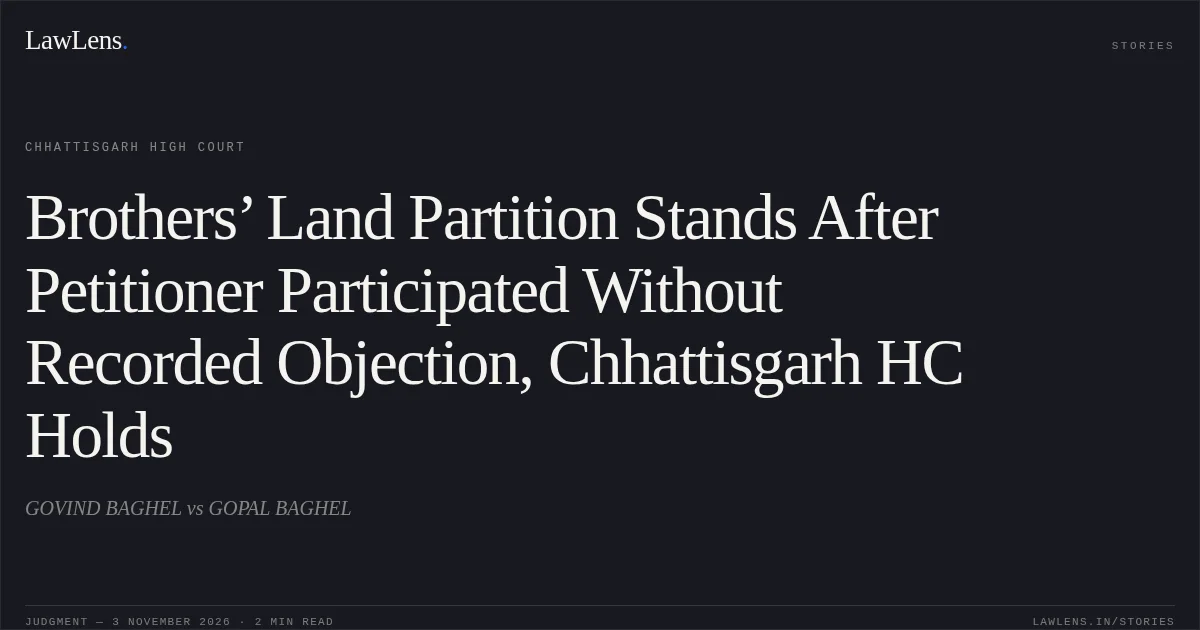
The parties, brothers, held approximately 1.850 hectares of land jointly.
¶ 1–2In partition proceedings initiated under Section 178-A of the Chhattisgarh Land Revenue Code, 1959, the Nayab Tahsildar allotted 0.92 hectares to the respondent and 0.93 hectares to the petitioner.
¶ 1–2The petitioner challenged the partition, alleging that the allocation was unequal in value and that proper procedure had not been followed.
¶ 1–2The Sub-Divisional Officer set aside the partition and remitted the matter for fresh adjudication; the Commissioner dismissed the respondent’s appeal.
¶ 1–2The Board of Revenue allowed the respondent’s revision, restored the Nayab Tahsildar’s order, and the petitioner challenged that decision under Article 227.
¶ 1–2, 402Issues
i.1. Whether the Board of Revenue’s decision affirming the partition involved perversity or jurisdictional error warranting interference under Article 227.
¶ 4–6ii.2. Whether the petitioner’s objections concerning the procedure and comparative value of the allotted lands justified setting aside the Board’s decision in supervisory jurisdiction.
¶ 2, 4–503Law Applied
Section 178-A of the Chhattisgarh Land Revenue Code, 1959, governed the partition proceedings.
¶ 2Under Article 227 of the Constitution, the High Court’s inquiry is supervisory: it may examine jurisdictional error by subordinate authorities, but does not re-evaluate factual disputes concerning the quality, quantity, or potential of land allotted in partition.
¶ 4No judicial precedents were cited.
Provisions in the judgment · 1
Chhattisgarh Land Revenue Code, 1959 Section 178A
04Reasoning
The Court noted that the allotments were nearly equal in area and that any difference in quality or potential was a factual matter outside the scope of Article 227 review.
¶ 4It also relied on the Board’s finding that the petitioner had participated in the proceedings without raising an objection to the partition or the Fard Batwara, and that the parties were in possession of their respective allotted lands.
¶ 5On the record before it, the Court found no perversity or jurisdictional error in the Board’s decision.
¶ 605Holding
The Court dismissed the writ petition, holding that no ground for interference under Article 227 had been established.
¶ 6It left the petitioner at liberty to pursue an appropriate proceeding to redress his grievances, if so advised.
¶ 6Original Court PDF
GOVIND BAGHELvsGOPAL BAGHEL
Click to open original judgment
Original judgment, available to read, download and summarize on LawLens.in