01Facts
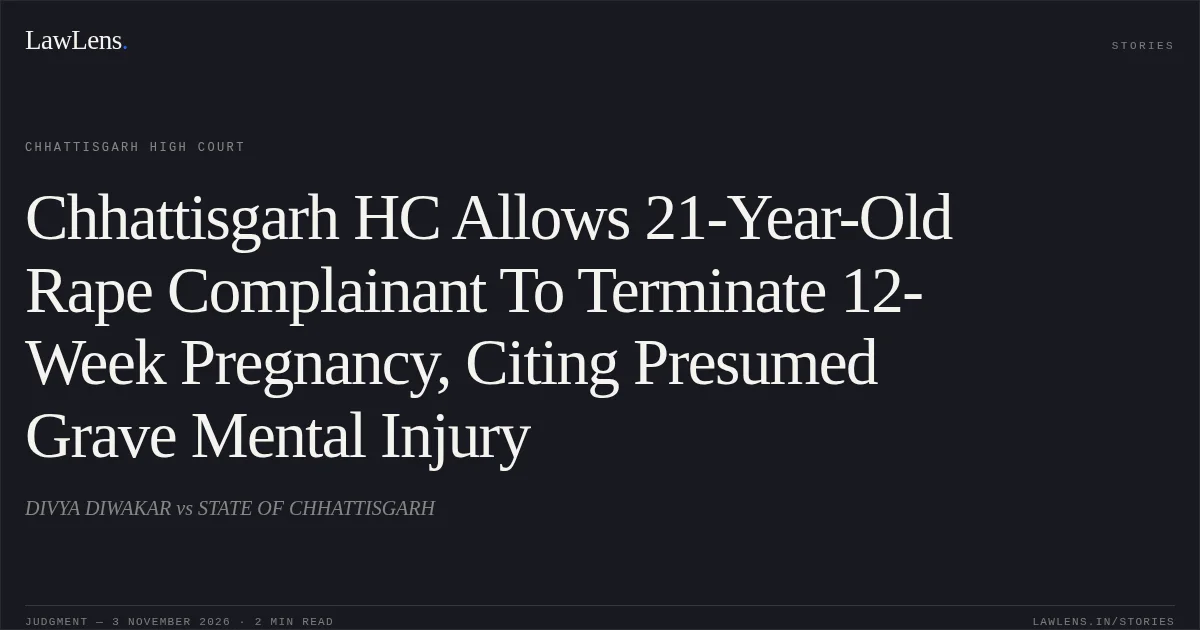
The petitioner, an unmarried 21-year-old woman, alleged that she had been sexually exploited on the false promise of marriage and lodged a police complaint, following which Crime No. 715/2026 was registered under Section 376 IPC.
¶ 2An ultrasound initially indicated an eight-week pregnancy; the Medical Board later assessed the pregnancy at 12 weeks and reported that termination was medically feasible and that the petitioner was fit for the procedure.
¶ 6, 10She sought permission to terminate the pregnancy, stating that she did not wish to continue it.
¶ 1, 302Issues
i.1. Whether the petitioner could be permitted to terminate her 12-week pregnancy, alleged to have resulted from rape, under the Medical Termination of Pregnancy Act, 1971.
¶ 9–10, 18–20ii.2. Whether compelling the petitioner to continue the unwanted pregnancy would impermissibly impair her bodily integrity, dignity and reproductive autonomy under Article 21 of the Constitution.
¶ 15–16, 19–2003Law Applied
Section 3(2)(a) of the Medical Termination of Pregnancy Act, 1971 permits termination of a pregnancy not exceeding 20 weeks where a registered medical practitioner, acting in good faith, forms the opinion that continuation would involve a risk to the pregnant woman’s life or grave injury to her physical or mental health. Explanation 2 to Section 3(2) presumes that the anguish caused by a pregnancy alleged to have resulted from rape constitutes grave injury to the woman’s mental health; Section 3(4)(b) requires the consent of the pregnant woman, except in the circumstances specified in clause (a).
¶ 9The Court also relied on Article 21 and Supreme Court decisions recognising reproductive autonomy and the woman’s decisional and bodily autonomy, including X v. Health & Family Welfare Department, and authorities concerning termination of unwanted pregnancies.
¶ 14–17Provisions in the judgment · 3 · Linked ones open on LawLens
Indian Penal Code, 1860 Section 376
Medical Termination of Pregnancy Act, 1971 Section 3Section 4
04Reasoning
The petitioner was an adult, had clearly expressed her informed wish not to continue the pregnancy, and the Medical Board found her medically fit for termination at 12 weeks.
¶ 6, 10, 20Because the pregnancy was alleged to have resulted from rape, Explanation 2 to Section 3(2) attracted the statutory presumption of grave injury to her mental health.
¶ 18–20The Court reasoned that forcing her to continue the pregnancy would compound the trauma and interfere with her dignity, bodily integrity and reproductive autonomy under Article 21.
¶ 15–16, 19It therefore found no legal impediment to termination.
¶ 2005Holding
The writ petition was allowed.
¶ 21The Court directed that the petitioner be admitted within one week to the District Hospital/Associated Government Medical College Hospital, Bilaspur, or another suitably equipped government hospital, and that termination be performed by a qualified medical team in accordance with the MTP Act and applicable medical protocols.
¶ 21The Court directed that the petitioner’s written consent be obtained and, additionally, that her father/guardian’s consent and concurrence be obtained; the procedure’s risks and requirements were to be explained to them.
¶ 22The order also required logistical and medical assistance, protection of the petitioner’s privacy, preservation of relevant forensic samples, and submission of a compliance report.
¶ 23–27Original Court PDF
DIVYA DIWAKARvsSTATE OF CHHATTISGARH
Click to open original judgment
Original judgment, available to read, download and summarize on LawLens.in