Facts
The petitioners, a married couple without a surviving child after approximately 22 years of marriage, sought IVF/ART treatment.
Source reference: paras. 4–5The wife, aged 47, had previously undergone IUI and suffered a miscarriage; the ART clinic found the couple medically suitable for the proposed treatment, subject to permission from the competent authority.
Source reference: paras. 4–5The authority rejected their application solely because the husband, aged 57, exceeded the statutory upper age limit for a man.
Source reference: paras. 6–9The couple challenged that decision, contending that the wife independently met the statutory age criterion.
Source reference: paras. 6–9Issues
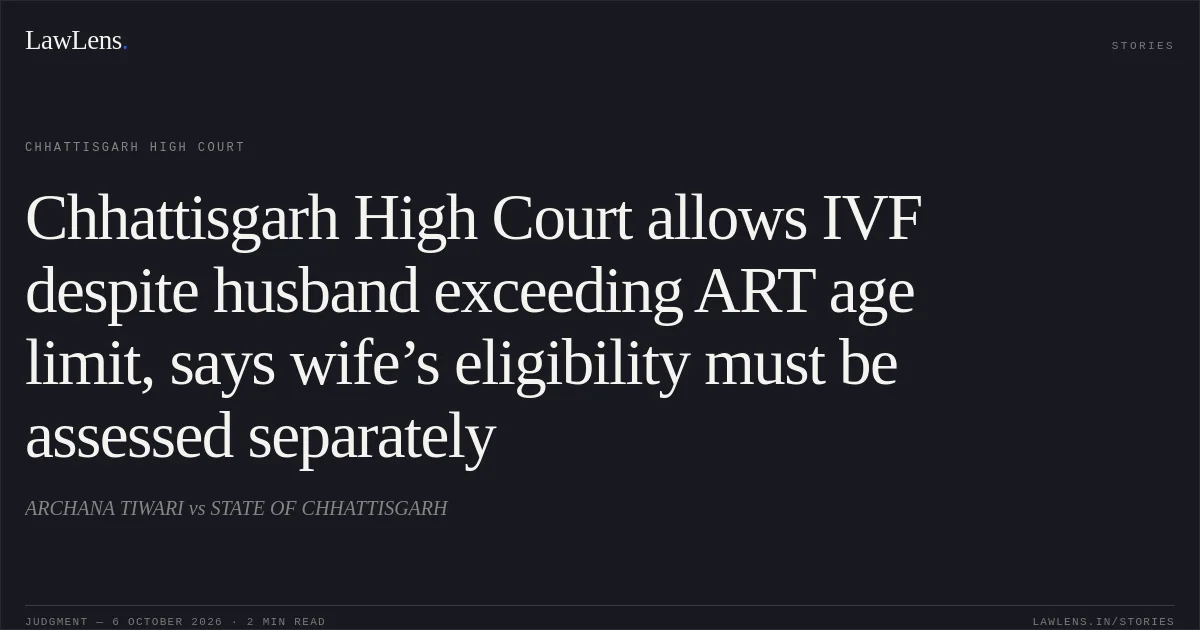
Whether a couple may be denied ART/IVF treatment solely because the husband exceeds the age limit in Section 21(g)(ii) of the ART Act, where the wife independently falls within the age limit in Section 21(g)(i) and is medically suitable.
Source reference: paras. 3, 24Whether the wife may continue an ongoing treatment cycle if she crosses the age of 50 during that cycle, subject to medical advice and other legal requirements.
Source reference: para. 1; para. 45(d)Law Applied
Section 21(g) of the Assisted Reproductive Technology (Regulation) Act, 2021, permits ART services for a woman above 21 and below 50 years and for a man above 21 and below 55 years; Section 2(1)(n) defines “patients” as an individual or couple seeking infertility treatment.
Source reference: paras. 24, 26–27The Court read those provisions as prescribing separate, gender-specific age limits and not a composite age ceiling for a commissioning couple.
Source reference: paras. 26–27, 42It also relied on Article 21 principles recognising reproductive choice and decisional autonomy as aspects of personal liberty, drawing on Suchita Srivastava v. Chandigarh Administration, K.S. Puttaswamy v. Union of India and X v. State (NCT of Delhi).
Source reference: paras. 29–32The Court considered High Court decisions supporting individual application of the statutory age limits and a purposive interpretation consistent with reproductive autonomy, including Shyamoli Saha v. State of West Bengal, Sajitha Abdul Nazar v. Union of India and Shewta Tuteja v. Union of India.
Source reference: paras. 37–39Reasoning
The wife was below 50 and had been medically found suitable, while the sole stated ground for refusal was that her husband was over 55.
Source reference: paras. 25, 28, 41The Court held that treating the husband’s age as automatically disqualifying the wife would import a composite age restriction not expressed in Section 21(g), and would curtail her reproductive choice despite her independent compliance with the applicable age criterion.
Source reference: paras. 27, 40–44The relief remained subject to medical assessment, informed consent and all other statutory, ethical and regulatory requirements; the Court did not dispense with those safeguards.
Source reference: paras. 43, 45(f)Holding
The High Court allowed the petition and set aside the rejection dated 31 July 2026.
It directed the authorities and the clinic to permit the petitioners to proceed with IVF/ART treatment, subject to the wife satisfying applicable medical requirements and compliance with all other legal safeguards; the husband’s age alone could not bar the wife’s treatment.
Source reference: para. 45(b)–(c)If the wife turns 50 during treatment commenced pursuant to the order, that fact alone shall not discontinue an ongoing cycle, subject to medical advisability and other applicable requirements.
Source reference: para. 45(d)The clinic was protected from adverse action merely for complying with the order, and the relief was confined to the circumstances of this case.
Source reference: paras. 45(e), 46Acts & Sections Cited
3 provisions across 1 statute referred to in this judgment. Each provision opens on LawLens.
Assisted Reproductive Technology (Regulation) Act, 20213
Original Court PDF
ARCHANA TIWARIvsSTATE OF CHHATTISGARH
Click to open original judgment
Original judgment, available to read, download and summarize on LawLens.in