01Facts
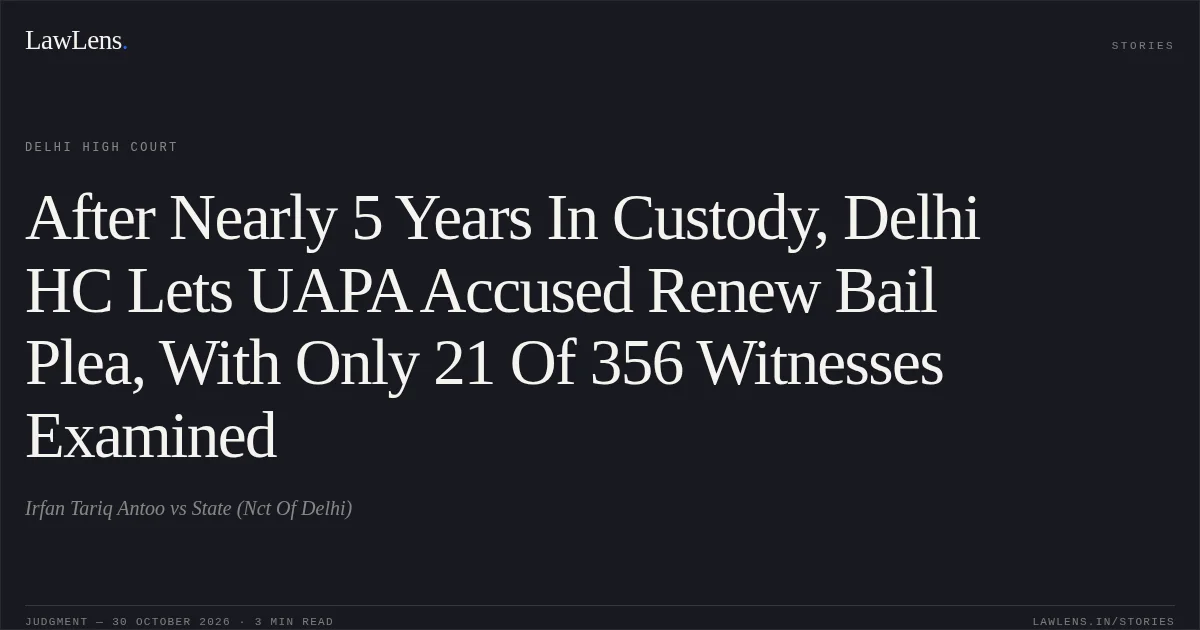
The appellant, accused No. 24 in an NIA prosecution alleging a conspiracy involving proscribed terrorist organisations, appealed under Section 21(4) of the NIA Act against the rejection of his bail application under the UAPA.
pp. 1–3He had been in custody since 16 December 2021.
pp. 1–3After the impugned order, the Trial Court framed charges under Sections 120B and 121A of the IPC and Section 18 of the UAPA, while discharging him of certain other charges; by the time of the appeal, 21 of the 356 prosecution witnesses had been examined.
pp. 3, 19–20The prosecution relied on allegations concerning the supply of grenades, possession and transfer of AK-47 bullets, terror funding, and other assistance to terrorist networks.
pp. 4–7, 11–14The appellant disputed the reliability and sufficiency of that material and relied principally on prolonged pre-trial incarceration.
pp. 4–7, 11–1402Issues
i.Whether the appellate court should consider developments after the Trial Court’s bail decision, including the framing of charges and testimony recorded during trial, when deciding the appeal.
pp. 15–19ii.Whether the appellant’s prolonged custody and the pace of the trial warranted granting bail in the appeal, or whether he should first seek bail from the Trial Court on the basis of subsequent developments.
pp. 19–2103Law Applied
Section 43D(5) of the UAPA restricts bail where, on a perusal of the case diary or police report, the court finds reasonable grounds to believe that the accusation is prima facie true.
p. 15Section 21(4) of the NIA Act provides the appellate route invoked in this case.
p. 1The constitutional guarantee of liberty under Article 21 requires courts to consider whether prolonged pre-trial detention and delay in trial justify release, notwithstanding statutory restrictions on bail; the Court referred to Union of India v. K.A. Najeeb on this principle.
pp. 3, 19–20Relying on Shoma Kanti Sen v. State of Maharashtra, the Court recognised that an appellate court may consider material arising after the decision under appeal, including subsequent charge-sheet material or developments.
pp. 15–18Whether delay warrants bail remains a case-specific inquiry, including consideration of the evidence yet to be recorded and the risk of influencing witnesses.
p. 20Provisions in the judgment · 13 · Linked ones open on LawLens
National Investigation Agency Act, 2008 Section 21Section 6Section 8
Unlawful Activities (Prevention) Act, 1967 Section 18Section 20Section 38Section 39Section 13
Indian Penal Code, 1860 Section 122Section 123
Arms Act, 1959 Section 25
Code of Criminal Procedure, 1973 Section 173Section 439
04Reasoning
The Court accepted that it could consider subsequent developments, but concluded that the effect of the charge-framing order and the testimony of PW-2 (X-1)—who alleged that the appellant supplied him a bag containing grenades—should first be assessed by the Trial Court.
pp. 18–20Other material witnesses, including X-12 and prosecution witnesses concerning alleged SIM cards, money and a vehicle, had yet to testify; the Trial Court was better placed to assess whether they could be examined promptly and whether the appellant might influence them if released.
pp. 18–20Although the Court found merit in the concern that the appellant’s prolonged custody and the examination of only 21 out of 356 witnesses raised an Article 21 issue, it did not determine that delay alone required immediate release.
pp. 19–20It also left the appellant’s medical ground to be raised before the Trial Court, as it had not been advanced there earlier.
pp. 19–2005Holding
The Court disposed of the appeal without granting bail or deciding the merits of the prosecution evidence.
pp. 20–21It granted the appellant liberty to renew his bail application before the Trial Court, which must consider subsequent trial developments and the effect of continued detention, independently of observations in the impugned order or appellate judgment.
pp. 20–21Any renewed application is to be decided expeditiously.
pp. 20–21No order as to costs was made.
p. 21Original Court PDF
Irfan Tariq AntoovsState (Nct Of Delhi)
Click to open original judgment
Original judgment, available to read, download and summarize on LawLens.in