01Facts
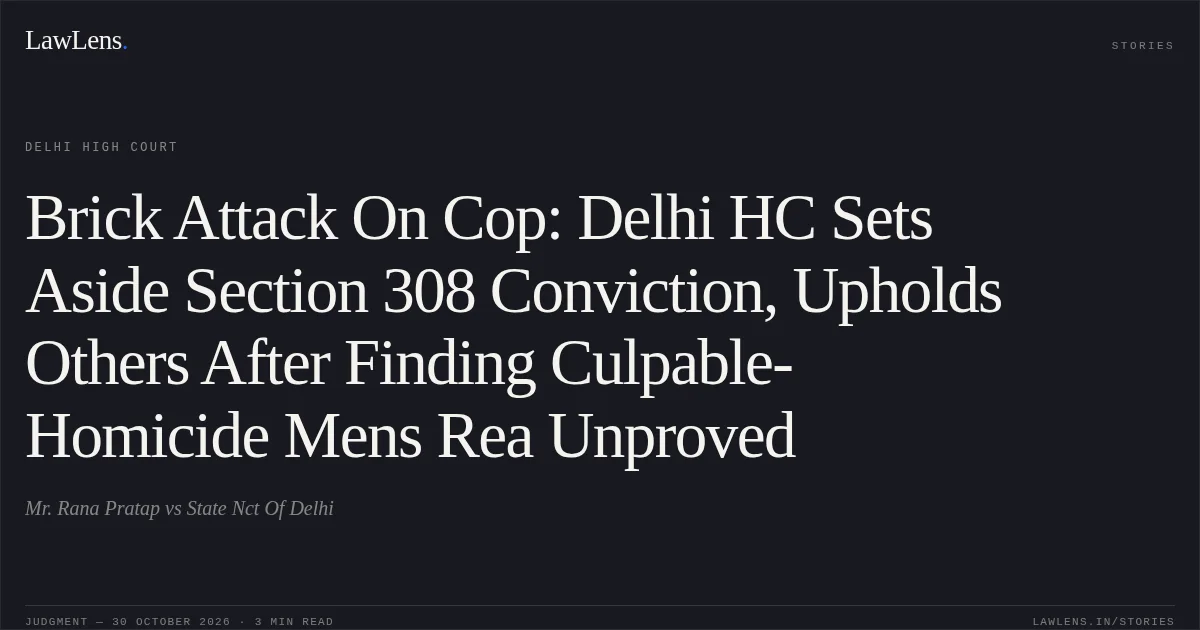
The prosecution alleged that, on 29 December 2010, the appellant and others assaulted police constables who were investigating the sale of illicit liquor.
¶ 2–3The appellant and co-accused Amit were specifically alleged to have struck Constable Ravinder with bricks; Constable Karambir sustained a nasal fracture, while Ravinder’s injuries were opined to be simple.
¶ 2–3, 32–33The Trial Court convicted the appellant under Sections 186, 332, 333, 353 and 308 read with Section 34 IPC, and imposed concurrent sentences, including six years’ imprisonment under Section 333 and four years and six months under Section 308.
¶ 8–9The appellant appealed against his conviction and sentence, challenging, among other matters, the evidence, the complaint requirement under Section 195 CrPC, and the finding under Section 308 IPC.
¶ 10–2302Issues
i.Whether the evidence established the appellant’s guilt under Sections 186, 332, 333 and 353 read with Section 34 IPC, including whether the Section 195 CrPC objection barred the conviction under Section 186.
¶ 34–37ii.Whether the evidence proved that the appellant acted with the intention or knowledge required for conviction under Section 308 IPC.
¶ 38–4003Law Applied
Section 186 IPC penalises obstruction of a public servant in the discharge of public functions; cognizance requires a written complaint by the public servant concerned or an authorised public servant under Section 195(1)(a)(i) CrPC.
¶ 34Sections 332 and 333 IPC address voluntarily causing hurt or grievous hurt to deter a public servant from duty, while Section 353 IPC addresses assault or criminal force used to deter a public servant from duty; Section 34 IPC attributes joint liability where an offence is committed in furtherance of common intention.
¶ 35–37Section 308 IPC requires proof of an act done with such intention or knowledge, and in such circumstances, that if death had resulted, the offender would have been guilty of culpable homicide not amounting to murder.
¶ 38–39The Court also applied Section 71 IPC to avoid separate sentencing for the included Section 332 offence, and Section 428 CrPC to allow set-off for custody already undergone.
¶ 9, 42–43Provisions in the judgment · 11 · Linked ones open on LawLens
Bharatiya Nagarik Suraksha Sanhita, 2023 Section 415
Indian Penal Code, 1860 Section 186Section 353Section 332Section 333Section 308Section 34Section 71
Code of Criminal Procedure, 1973 Section 195Section 313Section 428
04Reasoning
The Court relied on the consistent testimony of the injured constables, supported by the medical evidence, to find that the appellant participated in obstructing the police and assaulting Ravinder with bricks while the officers were performing their duties; it considered the evidentiary objections insufficient to undermine that account.
¶ 32–35It rejected the Section 186 objection because ACP A.K. Lall’s written complaint, Ex. PW-13/A, had been proved.
¶ 34The Court upheld the Section 333 conviction, treating the grievous nasal fracture suffered by Karambir and the coordinated assault as sufficient to sustain the appellant’s liability with the other accused under Section 34 IPC.
¶ 36–37It set aside the Section 308 conviction because, although a brick was used against the head, Ravinder’s injuries were simple and the evidence did not establish repeated blows or other circumstances proving the requisite intention or knowledge; the incident was sudden, with no established premeditation or prior enmity.
¶ 39–4005Holding
The appeal was partly allowed. The convictions under Sections 186, 332, 333 and 353 read with Section 34 IPC were upheld, and the conviction under Section 308 IPC was set aside.
¶ 41–42The sentence imposed under Section 308, including the fine and default imprisonment, was also set aside; the remaining sentences and their concurrency were maintained, with the appellant entitled to Section 428 CrPC benefit in accordance with law.
¶ 42–43Original Court PDF
Mr. Rana PratapvsState Nct Of Delhi
Click to open original judgment
Original judgment, available to read, download and summarize on LawLens.in