01Facts
The respondent, employed as a waiter from April 1998, alleged that the Club terminated his services in retaliation for his union activities and demand for a barman’s pay scale.
¶ 1–4, 6–12The Club relied on two chargesheets: one concerning possession of 12 bottles of whisky and another concerning delayed deposit of sale proceeds.
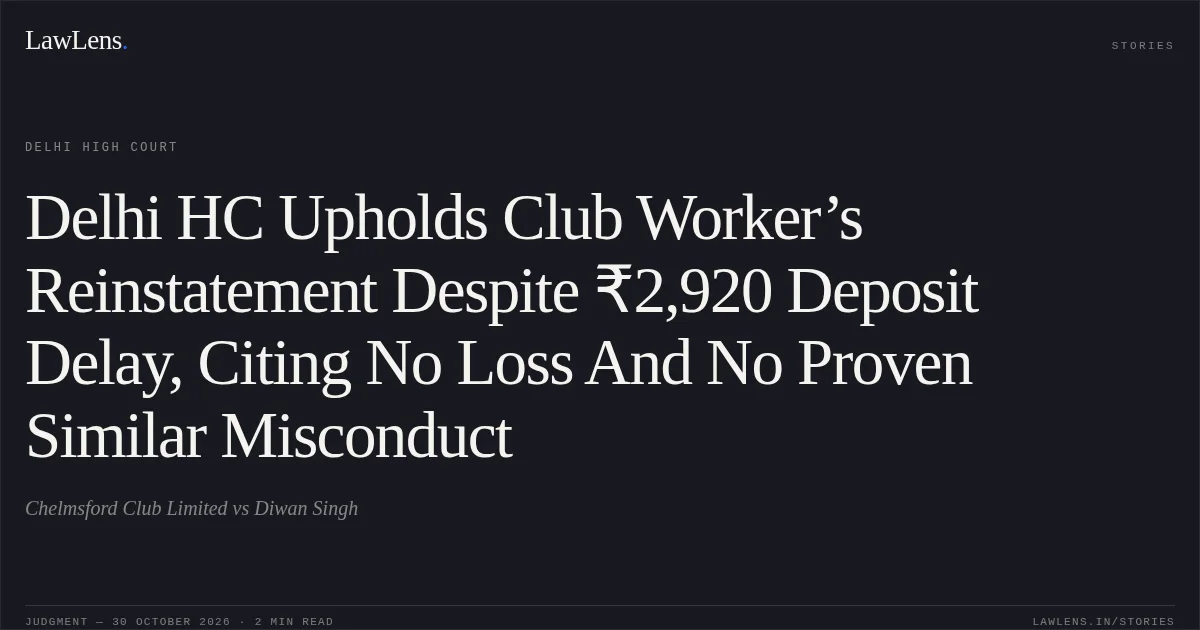
¶ 1–4, 6–12The Labour Court held that the Club was an “industry” under Section 2(j) of the Industrial Disputes Act, 1947, found misconduct only in the delayed deposit of Rs.2,920, and ordered reinstatement with continuity of service and 25% back wages.
¶ 1–4, 6–12The Club challenged the award under Articles 226 and 227 of the Constitution.
¶ 1–4, 6–1202Issues
i.Whether the Labour Court erred in holding that the Club was an “industry” under Section 2(j) of the Industrial Disputes Act, 1947
¶ 6, 15ii.Whether the Labour Court’s findings on the alleged misconduct and the justification for termination warranted interference
¶ 8–10, 17–18iii.Whether the award of reinstatement, continuity of service and 25% back wages disclosed a ground for interference
¶ 11, 19iv.Whether the award otherwise suffered from a jurisdictional or patent legal error permitting supervisory interference under Articles 226 and 227
¶ 14, 2003Law Applied
Section 2(j) of the Industrial Disputes Act, 1947 governs whether an undertaking is an “industry”; the inquiry turns on the nature and organisation of its activities, including the services provided and the workforce engaged.
¶ 6, 15Under Articles 226 and 227, the High Court’s certiorari and supervisory jurisdiction is not appellate: factual findings based on evidence are not ordinarily reopened merely because another view is possible.
¶ 20As stated in Syed Yakoob v. K.S. Radhakrishnan, AIR 1964 SC 477, interference may be justified where the tribunal acts without or in excess of jurisdiction, violates natural justice, commits an error of law apparent on the face of the record, or reaches a finding based on no evidence.
¶ 20Provisions in the judgment · 1
Industrial Disputes Act, 1947 Section 2
04Reasoning
The Labour Court’s finding that the Club was an industry rested on evidence of its bars, restaurants, banquet facilities, membership charges and workforce; the Club’s member-focused or non-profit character did not make that finding perverse.
¶ 6, 15The Labour Court separately assessed the charges: it accepted the explanation that the whisky had been gifted by a member and found misconduct only in the delayed deposit of Rs.2,920. It considered the eventual deposit, absence of pecuniary loss and lack of evidence of similar past misconduct before finding termination unjustified.
¶ 8–10, 17The Labour Court also considered the respondent’s length of service and restricted back wages to 25%; the High Court found no legal infirmity warranting substitution of its own assessment.
¶ 11, 19The Club’s challenge sought a fresh evaluation of evidence, which did not meet the limited grounds for supervisory interference.
¶ 18, 2005Holding
The High Court held that the Club had shown no perversity, jurisdictional defect or patent legal error in the Labour Court’s award.
¶ 20–22It upheld the award dated 20 January 2018, dismissed the writ petition and disposed of the pending applications.
¶ 20–22Original Court PDF
Chelmsford Club LimitedvsDiwan Singh
Click to open original judgment
Original judgment, available to read, download and summarize on LawLens.in