01Facts
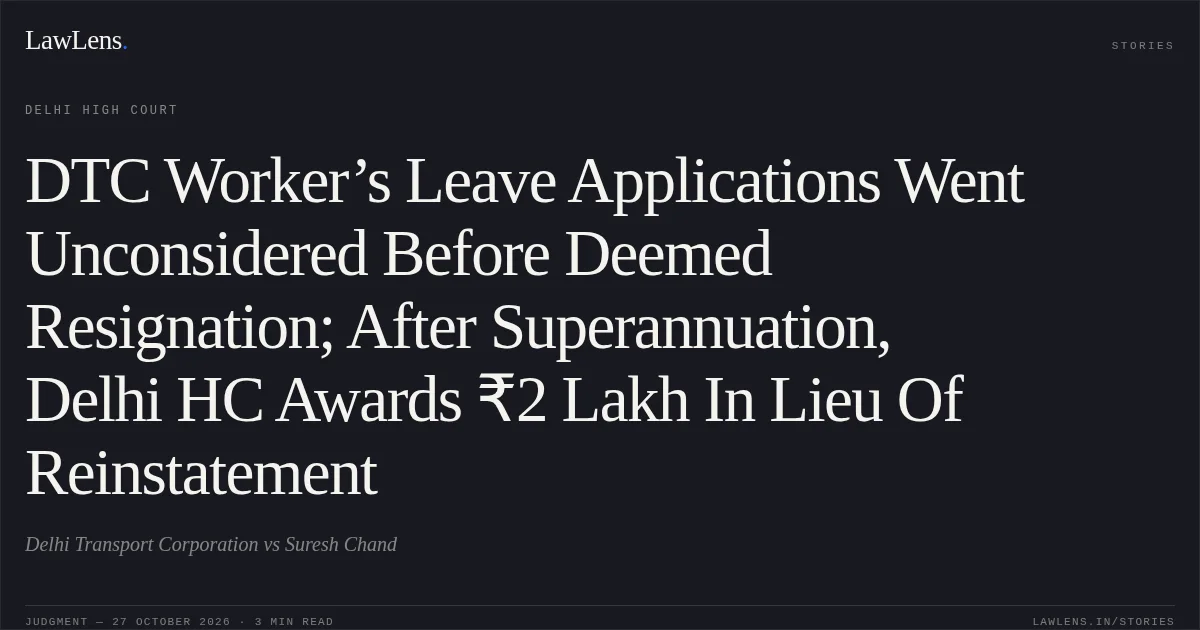
Suresh Chand, a DTC conductor appointed in 1985, remained absent from duty from 10 October 1989.
pp. 1–3After notices directing him to resume duty and a show-cause notice, DTC declared him to have deemed to have resigned under Regulation 14(10)(c) of the DRTA Regulations, 1952.
pp. 1–3The Labour Court found the action illegal and unjustified, and ordered reinstatement with full back wages, noting that DTC had not properly considered Chand’s leave applications or afforded him a fair opportunity.
pp. 1–3DTC challenged the award under Articles 226 and 227. By the time the petition was decided, Chand had attained superannuation and had received ₹6,52,241 pursuant to the award.
pp. 5, 13–1402Issues
i.1. Whether DTC validly invoked Regulation 14(10)(c) to declare Chand deemed to have resigned, having regard to the requirement of natural justice and its treatment of his leave applications.
pp. 7–8, 11–13 · ¶ 19, 24–27ii.2. Whether the Labour Court’s award warranted interference under Articles 226 and 227, and what relief was appropriate given Chand’s superannuation and the amounts already received.
pp. 7, 13–14 · ¶ 18, 29–3203Law Applied
Regulation 14(10)(c) of the DRTA (Conditions of Appointment and Service) Regulations, 1952 provided for deemed resignation where an employee failed to resume duty in the circumstances specified by the provision.
p. 8 · ¶ 20In DTC v. Om Kumar, 2001 SCC OnLine Del 1183, the Court read the requirement of audi alteram partem into Regulation 14(10)(c): the employee must receive a prior opportunity to explain the absence, and the explanation must be considered before the provision is invoked; this does not invariably require a domestic enquiry.
pp. 8–9 · ¶ 21DTC v. Lakhmi Chand and the Division Bench decision in LPA No. 628/2018 affirmed that the regulation was not invalid per se, but its invocation without compliance with natural justice was vitiated.
pp. 9–11 · ¶ 22–23Under International Airport Authority of India v. International Air Cargo Workers Union, (2009) 13 SCC 374, a writ court does not reappreciate Labour Court findings and may interfere where findings are perverse, based on no or irrelevant evidence, or disclose patent illegality or jurisdictional error.
p. 7 · ¶ 1804Reasoning
Although DTC had issued notices, its witness admitted that five leave applications from Chand and an application from his wife had been received but were neither considered nor decided, and no verification of the stated circumstances was undertaken.
pp. 11–12 · ¶ 25The Court held that submission of leave applications does not itself establish sanctioned leave, but the applications constituted Chand’s explanation for the absence and had to be considered before deemed resignation was imposed.
pp. 12–13 · ¶ 26–27The order declaring deemed resignation did not address them; issuing a notice without considering the explanation was only formal compliance with natural justice.
pp. 12–13 · ¶ 26–27The Labour Court’s conclusion was therefore a plausible view supported by the record and did not warrant writ interference.
p. 13 · ¶ 29–30Since Chand had reached superannuation, reinstatement was no longer feasible; considering his service and the amount already received, the Court found compensation in lieu of reinstatement appropriate.
p. 14 · ¶ 31–3205Holding
The Court upheld the Labour Court’s finding that DTC’s deemed-resignation decision was unlawful for failure to consider Chand’s explanation, but modified the award because reinstatement was no longer possible after superannuation.
p. 14 · ¶ 32–34It directed DTC to pay Chand an additional ₹2,00,000 as lump-sum compensation in lieu of reinstatement, within eight weeks.
p. 14 · ¶ 32–34The petition was disposed of and the award modified accordingly.
p. 14 · ¶ 32–34Original Court PDF
Delhi Transport CorporationvsSuresh Chand
Click to open original judgment
Original judgment, available to read, download and summarize on LawLens.in