01Facts
The respondent-workman claimed that he had worked as a Junior Paramedic with the petitioner from 2 February 2009 until his services were terminated on 1 October 2014, without notice, after he demanded service benefits.
p. 2The Labour Court held the termination illegal and awarded reinstatement with full back wages, continuity of service and consequential benefits.
p. 1The petitioner challenged the award, contending that the workman’s employment had been renewed on a contractual basis and expired under an agreement dated 4 April 2014, bringing the termination within Section 2(oo)(bb) of the Industrial Disputes Act, 1947.
pp. 2–3The respondent was unrepresented and the petition proceeded ex parte.
p. 102Issues
i.1. Whether the petitioner established that the workman’s services ended upon expiry of a fixed-term contract, so that the termination fell within the exception in Section 2(oo)(bb) of the Industrial Disputes Act, 1947.
p. 3, 5ii.2. Whether the Labour Court’s findings warranted interference under Articles 226 and 227 of the Constitution, and whether reinstatement with back wages remained appropriate relief.
pp. 3, 5–603Law Applied
Section 2(oo)(bb) of the Industrial Disputes Act excludes from “retrenchment” termination upon expiry of an employment contract, provided the termination accords with the contract’s terms; the employer must establish the fixed-term engagement and the relevant terms governing cessation.
p. 3In S.M. Nilajkar v. Telecom District Manager, Karnataka, (2003) 4 SCC 27, the applicability of the exception depends on the nature of the engagement and the terms governing cessation.
p. 4Under Syed Yakoob v. K.S. Radhakrishnan, AIR 1964 SC 477, Articles 226 and 227 confer supervisory, not appellate, jurisdiction; factual findings are not to be reopened merely because the evidence could be assessed differently, absent such defects as a finding based on no evidence or an apparent error of law.
p. 5Reinstatement with back wages is not automatic upon a finding of illegal termination; monetary compensation may be appropriate depending on the circumstances, including the nature and duration of employment and the passage of time, as recognised in Jagbir Singh v. Haryana State Agriculture Marketing Board, (2009) 15 SCC 327, and Bharat Sanchar Nigam Limited v. Bhurumal, (2014) 7 SCC 177.
p. 6Provisions in the judgment · 4
Industrial Disputes Act, 1947 Section 10Section 12Section 2Section 33C
04Reasoning
The petitioner did not produce sufficient evidence to establish the alleged extensions of probation or the terms of the asserted fixed-term employment.
p. 4The Labour Court had also declined to rely on the agreement dated 4 April 2014 because the original was not produced and the workman had not been confronted with the document or the purported signatures.
p. 4The petitioner therefore failed to prove that the workman’s services ended on expiry of a duly established contract, and the High Court found no perversity or patent illegality in the Labour Court’s findings warranting supervisory intervention.
pp. 4–5Although the petitioner asserted that the workman had been gainfully employed elsewhere, it provided no supporting material for that contention.
p. 5However, considering the substantial time elapsed since the workman’s employment ceased and the award was passed, the Court concluded that compensation, rather than reinstatement, was appropriate.
pp. 6–705Holding
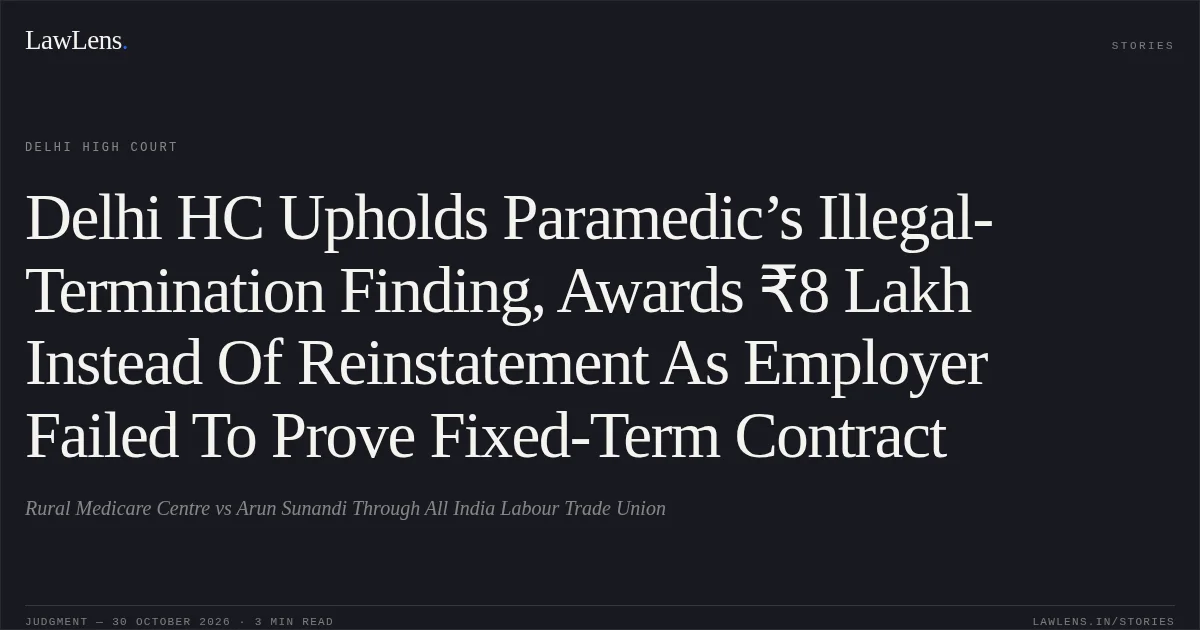
The Court upheld the finding that the termination was illegal but modified the award by substituting lump-sum compensation of ₹8,00,000 for reinstatement.
p. 7The petitioner was directed to pay the amount within four weeks; thereafter, it would carry interest at 9% per annum. The award was modified accordingly, and the pending application was disposed of.
p. 7Original Court PDF
Rural Medicare CentrevsArun Sunandi Through All India Labour Trade Union
Click to open original judgment
Original judgment, available to read, download and summarize on LawLens.in