Facts
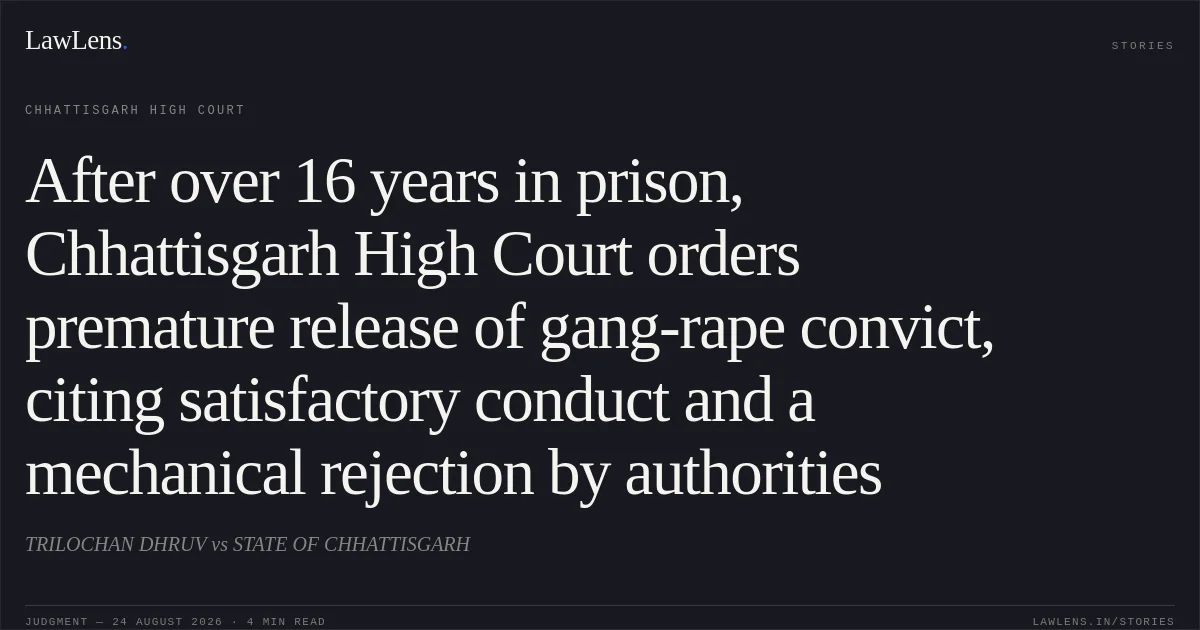
The petitioner was serving a sentence of life imprisonment following his conviction under Section 376(g) of the Indian Penal Code, 1860, for gang rape, by the Additional Sessions Judge (FTC), Dhamtari, on 29 January 2010.
Source reference: para. 2The conviction was affirmed by the High Court and the petitioner’s Special Leave Petition was dismissed by the Supreme Court.
Source reference: para. 2He had remained in custody since 16 October 2009 and claimed to have completed the requisite period for consideration of premature release, including remission.
Source reference: para. 2The sentencing Court expressed no objection to remission and reported that his prison conduct was reformative; the Jail Superintendent also reported satisfactory conduct, timely surrender after parole, prospects of rehabilitation, and that continued incarceration was unnecessary.
Source reference: para. 3Nevertheless, the State Sentence Review Board rejected his claim, principally relying on the gravity of the offence and adverse reports from the District Magistrate and Superintendent of Police concerning local resentment and the possibility of an untoward incident.
Source reference: paras. 3, 6The petitioner challenged the rejection order dated 10 April 2026 as arbitrary, non-speaking, and contrary to Rule 358 of the Chhattisgarh Prison Rules, 1968.
Source reference: paras. 4–5Issues
1. Whether the State’s rejection of the petitioner’s claim for remission/premature release under Section 432 of the Code of Criminal Procedure, 1973, read with Rule 358 of the Chhattisgarh Prison Rules, 1968, was arbitrary, non-speaking, and based on non-application of mind.
Source reference: paras. 4, 8–112. Whether the petitioner was entitled to premature release in view of his prolonged incarceration, satisfactory prison conduct, favourable opinion of the sentencing Court, and positive recommendation of the Jail authorities.
Source reference: paras. 8–123. Whether the competent authority could reject premature release solely on the gravity of the offence and a negative recommendation of the State Sentence Review Board without adequately considering the statutory factors and favourable material on record.
Source reference: paras. 9–12Law Applied
The Court applied Section 432 of the Code of Criminal Procedure, 1973, read with Rule 358 of the Chhattisgarh Prison Rules, 1968, which requires fair consideration of premature release/remission having regard to the prisoner’s period of incarceration, conduct, nature and circumstances of the offence, likelihood of reoffending, prospects of reformation and rehabilitation, and relevant reports of the sentencing Court, jail authorities, District Magistrate and Superintendent of Police.
Source reference: para. 8In Laxman Naskar v. State of West Bengal, (2000) 7 SCC 626, the Supreme Court identified the relevant considerations for premature release, including the effect of the offence on society, likelihood of recurrence, loss of criminal propensity, and the utility of continued incarceration.
Source reference: para. 9Epuru Sudhakar v. Government of Andhra Pradesh, (2006) 8 SCC 161, establishes that remission orders are subject to judicial review when arbitrary, mala fide, based on extraneous considerations, or vitiated by non-application of mind.
Source reference: para. 9State of Haryana v. Jagdish, (2010) 4 SCC 216, requires remission policies to be applied fairly, consistently and non-discriminatorily in furtherance of their reformative purpose.
Source reference: para. 9The Court also relied on the constitutional guarantee against arbitrariness under Article 14, as explained in E.P. Royappa v. State of Tamil Nadu, (1974) 4 SCC 3.
Source reference: para. 12Reasoning
The Court held that the impugned order did not demonstrate a meaningful evaluation of the factors mandated by Rule 358.
Source reference: para. 8The petitioner had undergone the prescribed period of imprisonment, maintained satisfactory conduct, surrendered within time after parole, and received favourable assessments from both the Jail authorities and the sentencing Court.
Source reference: paras. 3, 8, 10–11Against this material, the State relied essentially on the gravity of the offence and a generalised negative recommendation concerning possible local resentment.
Source reference: paras. 8, 11The Court found no substantive adverse material establishing unsatisfactory prison conduct, a likelihood of recurrence, or a continuing threat to society.
Source reference: paras. 8, 11Since the State Sentence Review Board’s recommendation was treated mechanically and the favourable reports were not properly addressed, the decision amounted to arbitrary exercise of discretion and failed the standards of reasoned decision-making and judicial review under Laxman Naskar, Epuru Sudhakar and Jagdish.
Source reference: paras. 9–12Holding
The Court answered the issues in favour of the petitioner.
It quashed and set aside the State’s order dated 10 April 2026 rejecting remission.
Source reference: para. 13The respondents were directed to grant the petitioner remission/premature release under Section 432 of the CrPC, or the corresponding provisions of the Bharatiya Nagarik Suraksha Sanhita, 2023, and to release him forthwith if he was not required in any other case, subject to the usual terms and conditions under the Chhattisgarh Prison Rules, 1968.
Source reference: para. 13The writ petition was accordingly allowed, with no order as to costs.
Source reference: paras. 13–14Acts & Sections Cited
2 provisions across 2 statutes referred to in this judgment. Each provision opens on LawLens.
Code of Criminal Procedure, 19731
Indian Penal Code, 18601
Original Court PDF
TRILOCHAN DHRUVvsSTATE OF CHHATTISGARH
Click to open original judgment
Original judgment, available to read, download and summarize on LawLens.in