Facts
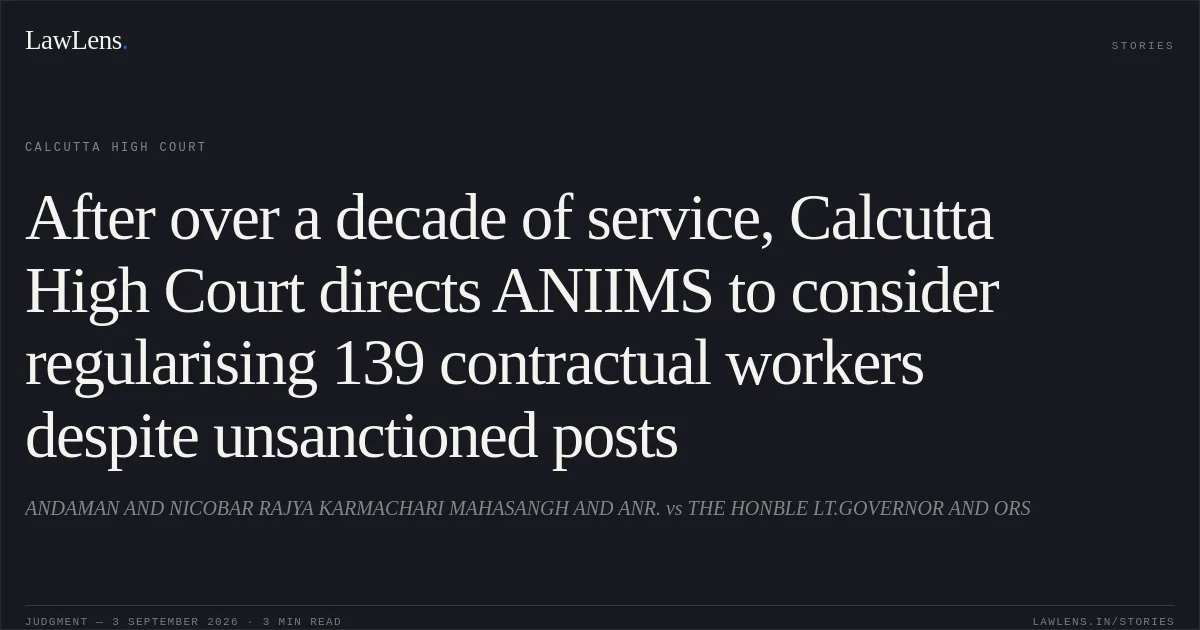
The appellant Association represented 139 contractual employees engaged by the Andaman and Nicobar Islands Medical Education and Research Society, which manages the Andaman and Nicobar Islands Institute of Medical Science (ANIIMS), both being treated as “State” under Article 12.
Source reference: para. 3–5The employees were engaged pursuant to walk-in interviews and vacancy notices issued in 2015, after scrutiny of qualifications and selection by a Selection Committee. Their engagement letters described the appointments as short-term, renewable contractual engagements and stated that no right to future appointment would accrue; however, formal contracts were not executed.
Source reference: para. 6–8Their contractual engagements were repeatedly extended, and they continued performing essential, full-time functions of ANIIMS.
Source reference: para. 8–9, 12In March 2020, the Society approved the creation of 425 posts in addition to 107 previously created posts, subject to framing recruitment rules and other conditions.
Source reference: para. 10–11In December 2021, ANIIMS issued a notice inviting applications for fresh contractual engagement in the same posts, which the appellants challenged. The Single Judge dismissed the challenge and declined regularization, while permitting the employees to participate in any future recruitment process subject to eligibility.
Source reference: para. 12–13Issues
1. Whether contractual employees who were selected through a publicly notified selection process and had rendered more than a decade of continuous, satisfactory service in essential and perennial functions could claim regularization or absorption despite the contractual terms of engagement.
Source reference: para. 14–16, 26–312. Whether the absence, at the relevant time, of finalized recruitment rules and sanctioned posts barred consideration of the employees for regularization or absorption.
Source reference: para. 19–22, 27, 47–503. Whether the respondents could initiate fresh contractual recruitment to replace the existing contractual employees without first considering their claim to continued or regular employment.
Source reference: para. 12–13, 55–56Law Applied
The Court considered the constitutional principles governing public employment and regularization, particularly Secretary, State of Karnataka v. Umadevi (3), which ordinarily prohibits regularization of persons appointed through backdoor or wholly illegal processes, but held that the decision was not an absolute bar in cases involving prolonged, continuous service and exploitative contractual engagement.
Source reference: para. 22, 47–49Relying on Sheo Narain Nagar, Vinod Kumar, Jaggo, Shripal, K. Velajagan, Dharam Singh, Bhola Nath, Mohammad Sagir and Sukhendu Bhattacharjee, the Court emphasized that the nature and permanence of the work, the fairness of the selection process, long and satisfactory service, and the State’s obligation to act as a model employer are relevant to regularization.
Source reference: para. 32–43The Court further relied on the Division Bench decision in Andaman Sarvajanik Nirman Vibhag Mazdoor Sangh and the Port Blair Municipal Council v. A. Subramaniam litigation for the proposition that “backdoor entry” cannot be used to justify perpetual temporary engagement in integral and perennial State functions.
Source reference: para. 44–45The Court also invoked constitutional commitments to social and economic justice and fair treatment of workers.
Source reference: para. 60–64Reasoning
The Court found that the employees were not backdoor entrants because they had responded to public notices, possessed the prescribed qualifications, underwent testimonial verification and interview, and were selected by a Selection Committee.
Source reference: para. 6, 14–15, 49Their work was held to be essential, perennial and foundational to the functioning of ANIIMS, and their repeated contractual extensions for over ten years demonstrated that the arrangement was not genuinely temporary.
Source reference: para. 26–29Although the respondents relied on the contractual disclaimers, the Court held that those terms could not defeat constitutional requirements of fairness where the employees had rendered long, uninterrupted and satisfactory service.
Source reference: para. 29–31, 39The Court also noted that posts had subsequently been created and that recruitment rules had been approved or were in the process of approval; the respondents’ failure to complete the regular recruitment process could not indefinitely postpone consideration of regularization.
Source reference: para. 50–54Applying the cited precedents, the Court concluded that the employees’ engagement against posts described as unsanctioned was not wholly illegal and that continued contractual employment would amount to unfair exploitation.
Source reference: para. 30–31, 47–55Holding
The Division Bench allowed the appeal and set aside the Single Judge’s judgment.
It directed respondent authorities to consider and decide whether to regularize or absorb the appellant Association’s members into regular service, in an appropriate pay scale and from their initial dates of appointment, consistently with the cited Supreme Court precedents.
Source reference: para. 55After regularizing or absorbing the existing contractual employees, the respondents were directed to conduct a regular selection process for the remaining vacancies in the created posts.
Source reference: para. 56The decision was to be taken within ninety days from communication of the judgment, with no order as to costs.
Source reference: para. 57–58Original Court PDF
ANDAMAN AND NICOBAR RAJYA KARMACHARI MAHASANGH AND ANR.vsTHE HONBLE LT.GOVERNOR AND ORS
Click to open original judgment
Original judgment, available to read, download and summarize on LawLens.in