01Facts
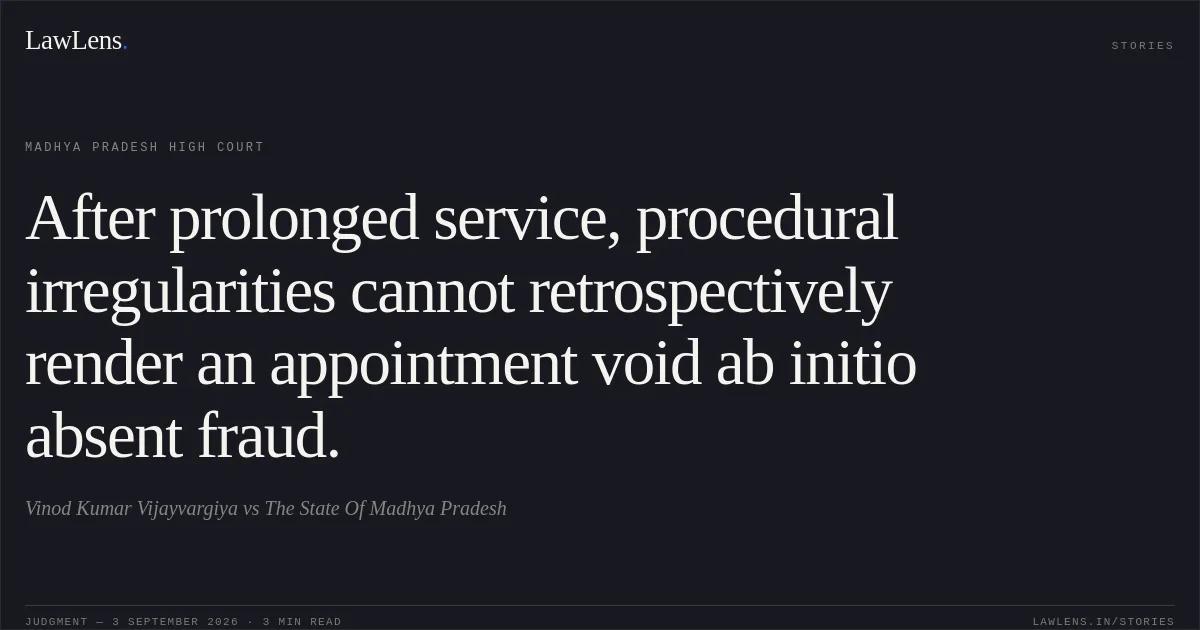
The petitioner was appointed as a Computer Operator-cum-Data Entry Operator in the District Rural Development Authority, Mandsaur, on 15.10.1990 and was regularised as Assistant Grade-III on 31.10.1994.
p. 1Following a Zila Panchayat resolution dated 05.07.2004 and Selection Committee proceedings dated 02.11.2004, he was appointed as Technical Assistant in the pay scale of Rs. 5,500–9,000 by order dated 10.11.2004.
p. 7He continued on the post for nearly 18 years without interruption, and there was no allegation that he had procured the appointment through fraud, misrepresentation, or suppression of material facts.
p. 7After a complaint and departmental enquiry, the authorities issued a show-cause notice dated 28.12.2022.
p. 1Despite the petitioner’s reply dated 30.12.2022, respondent No. 5 cancelled his appointment by order dated 02.01.2023, treating it as void ab initio.
pp. 2–3His appeal was dismissed by the Divisional Commissioner on 07.03.2024.
p. 1The petitioner challenged both orders under Article 226 of the Constitution.
p. 102Issues
i.1. Whether the petitioner’s appointment as Technical Assistant could be retrospectively declared void ab initio and cancelled after nearly 18 years of continuous service, in the absence of fraud, misrepresentation, suppression, or demonstrated ineligibility.
pp. 7–9ii.2. Whether the respondents’ action was vitiated by violation of the principles of natural justice, including failure to conduct an effective enquiry and properly consider the petitioner’s explanation.
pp. 2–4, 6iii.3. Whether any procedural defect or absence of subsequent governmental confirmation justified treating the appointment as fundamentally illegal rather than irregular.
pp. 6–903Law Applied
The Court exercised judicial review under Article 226 of the Constitution.
It applied the distinction between an appointment that is fundamentally illegal or void ab initio—such as one procured by fraud, made without authority, or granted to a wholly ineligible person—and an appointment affected merely by procedural or administrative irregularity.
pp. 7–8The Court relied on the Constitution Bench decision in Secretary, State of Karnataka v. Umadevi (3), (2006) 4 SCC 1, particularly the principle that past appointments should not ordinarily be reopened after a considerable lapse of time.
p. 8It further applied the principles of natural justice, requiring an effective opportunity to meet adverse material and meaningful consideration of the employee’s defence where an order entails serious civil consequences.
pp. 2–4The Court also applied the principle that State instrumentalities must act fairly and consistently and cannot, after accepting an employee’s service for a prolonged period, abruptly adopt a contrary position without satisfactory justification.
p. 904Reasoning
The Court found that the petitioner’s appointment followed departmental consideration, a Zila Panchayat resolution, and proceedings of a duly constituted Selection Committee; the respondents failed to establish that he was wholly ineligible or that the appointment was made through fraud or complete disregard of the recruitment mechanism.
pp. 7–8The State’s contention that subsequent confirmation by the Government was required could, at most, indicate an administrative or procedural defect; it did not establish that the appointment was void from inception.
p. 6, 8The petitioner had served continuously for nearly two decades, and the respondents had accepted his service and had even considered or recommended confirmation/regularisation in 2018–2019.
p. 3, 9Applying Umadevi and the illegal–irregular appointment distinction, the Court held that such a belated defect could not be used to retrospectively extinguish the appointment.
pp. 8–9The Court also noted that the enquiry had allegedly been conducted behind the petitioner’s back and that the impugned order did not adequately deal with his reply, making the procedural safeguards inadequate in view of the adverse civil consequences.
pp. 2–4Accordingly, the cancellation order was arbitrary and legally unsustainable.
05Holding
The Court answered the issues in favour of the petitioner.
It held that the appointment could not be treated as void ab initio merely because subsequent confirmation was allegedly absent, particularly after nearly 18 years of continuous service and in the absence of fraud, misrepresentation, or ineligibility.
pp. 8–9The order dated 02.01.2023 and appellate order dated 07.03.2024 were quashed.
p. 10The respondents were directed to permit the petitioner to continue on the post held pursuant to the appointment order dated 10.11.2004, with continuity of service and all consequential benefits admissible in law, and to implement the order preferably within three months of production of its certified copy.
p. 10The writ petition was allowed and disposed of.
p. 10Original Court PDF
Vinod Kumar VijayvargiyavsThe State Of Madhya Pradesh
Click to open original judgment
Original judgment, available to read, download and summarize on LawLens.in