01Facts
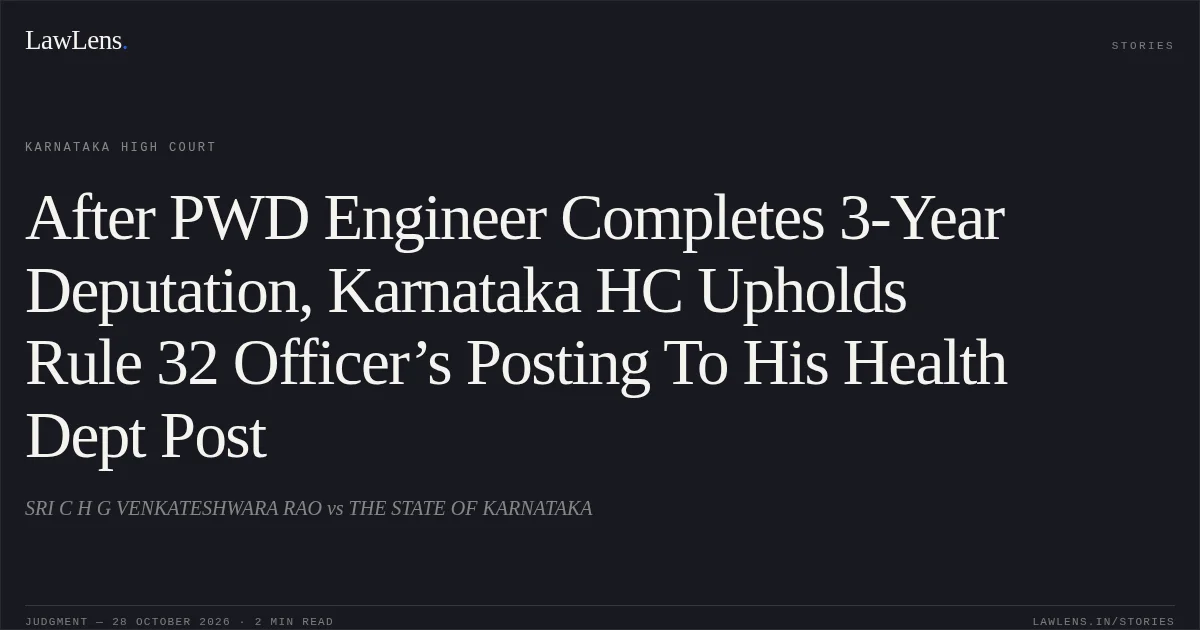
The petitioner, an Assistant Executive Engineer belonging to the Public Works Department, was serving on deputation in the Health and Family Welfare Department. After completing the three-year deputation tenure, he was repatriated to his parent department.
pp. 5–6In the meantime, the authorities posted the contesting respondent—an officer holding independent charge under Rule 32 of the Karnataka Civil Services Rules (KCSR)—to the petitioner’s former post. The petitioner challenged the posting and his repatriation before the Karnataka State Administrative Tribunal, which dismissed his applications on 25 September 2026. He then filed these writ petitions challenging the Tribunal’s orders.
pp. 5–602Issues
i.Whether an officer holding independent charge under Rule 32 KCSR could be posted to a post held by a regular appointee who had completed the applicable minimum tenure.
pp. 6–7, 12–13ii.Whether the Tribunal’s orders dismissing the petitioner’s applications warranted interference under Articles 226 and 227 of the Constitution.
pp. 5, 13–1403Law Applied
Rule 32 KCSR permits the Government to place an eligible government servant in charge of the current duties of a vacant post; Note 1 requires that the officer be eligible for promotion to officiate in that post under the applicable Cadre and Recruitment Rules, or hold an equivalent or higher-grade post.
pp. 7–8In B. Madesh v. State of Karnataka, the Court distinguished Raghurama Shetty v. State: an officer under Rule 32 may replace a regular incumbent who has completed the minimum tenure, provided the officer is eligible and the posting is otherwise lawful; the objection to such replacement is material where the regular incumbent has not completed that tenure.
pp. 11–13The Court also applied the general transfer principle in Rajendra Singh v. State of Uttar Pradesh, (2009) 15 SCC 178: a government servant has no vested right to remain at a particular place, and judicial interference with transfer decisions is ordinarily limited to cases involving mala fides or violation of statutory provisions.
pp. 9–1004Reasoning
The petitioner had completed his three-year deputation tenure and was due for repatriation. The Court held that, in those circumstances, he could not prevent the authorities from posting another officer to the post merely because that officer held independent charge under Rule 32; the relevant exception would be where the incoming officer was ineligible under the applicable statutory rules, which was not the issue established here.
pp. 6–7Applying B. Madesh, the Court concluded that the concern identified in Raghurama Shetty did not assist the petitioner because the regular incumbent’s minimum tenure had been completed.
pp. 11–13The petitioner had also been posted within Ballari and had taken charge of his post there, while the contesting respondent had taken charge in the Health Department; the Court found no resulting prejudice warranting intervention.
p. 1305Holding
The Court held that the posting of the Rule 32 officer did not invalidate the petitioner’s repatriation or the respondent’s posting, and that the Tribunal’s decisions disclosed no basis for interference.
pp. 12–14All three writ petitions were dismissed.
p. 14Original Court PDF
SRI C H G VENKATESHWARA RAOvsTHE STATE OF KARNATAKA
Click to open original judgment
Original judgment, available to read, download and summarize on LawLens.in