01Facts
On 17 February 1999, the informant was at his field when the appellants allegedly surrounded and assaulted him.
¶ 3–8Appellant Rafique Sk. allegedly fired at him twice, causing firearm injuries to his left forearm and left side of the chest; the informant also alleged that the other appellants assaulted and restrained him.
¶ 3–8The trial court convicted the appellants under Sections 307, 341 and 148 of the IPC and Section 27 of the Arms Act, imposing concurrent sentences.
¶ 3–8On appeal, the appellants challenged, among other things, the proof of the alleged unlawful assembly, the non-examination of the investigating officer, and the finding of an intention to commit murder.
¶ 902Issues
i.1. Whether the evidence established the intention or knowledge necessary to sustain the appellants’ convictions under Section 307 of the IPC.
¶ 12, 15–17ii.2. Whether the convictions under Sections 341 and 148 of the IPC and Section 27 of the Arms Act were sustainable on the evidence.
¶ 18–19iii.3. Whether the sentences should be modified in light of the custody already undergone and the time elapsed since the occurrence.
¶ 20–2203Law Applied
Section 307 of the IPC requires proof both of an intention to commit murder and of an act done towards that end; a fatal injury is not essential, and intention may be inferred from circumstances including the weapon used, the accused’s words, the part of the body targeted, and the nature and severity of the injuries.
¶ 16The Court relied on Jage Ram v. State of Haryana, (2015) 11 SCC 366, para. 12, for these principles.
¶ 16The Court distinguished this threshold from the offence under Section 324 of the IPC, applying it to the proved firearm assault.
¶ 17It also considered the alleged restraint and assembly under Sections 341 and 148 of the IPC, and the firearm allegation against Rafique Sk. under Section 27 of the Arms Act.
¶ 18–19Provisions in the judgment · 8 · Linked ones open on LawLens
Indian Penal Code, 1860 Section 147Section 148Section 149Section 307Section 323Section 324Section 341
Arms Act, 1959 Section 27
04Reasoning
The injured informant’s evidence and the doctor’s testimony established that firearm injuries were inflicted on the informant’s chest area and forearm, but the injuries were found to be simple.
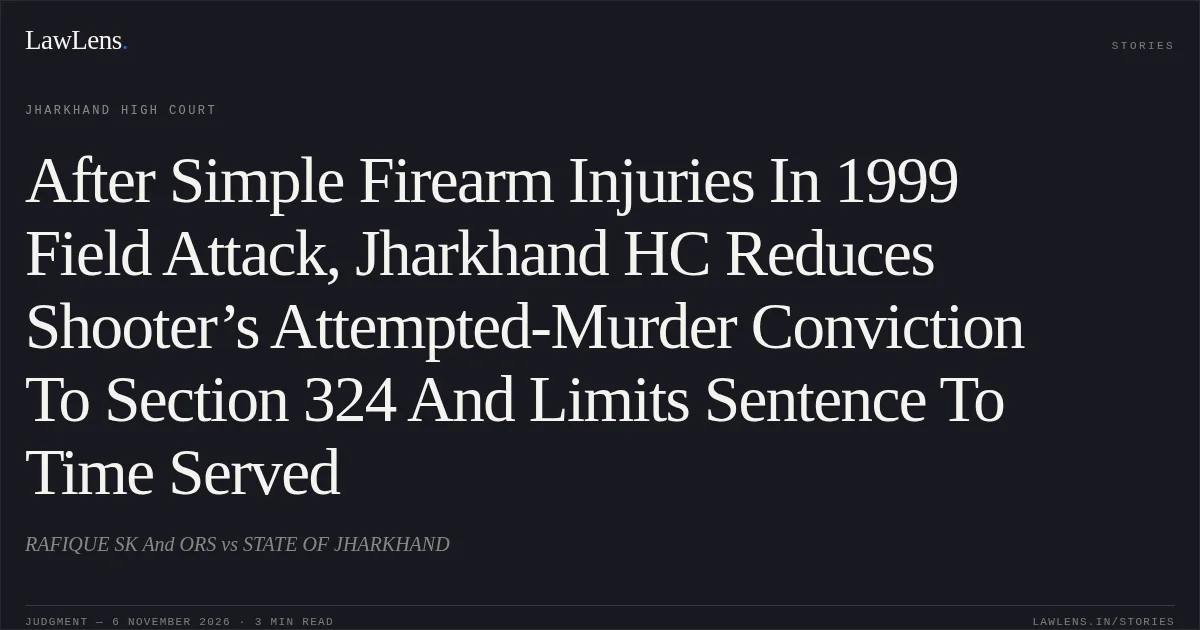
¶ 13Considering the injuries and manner of assault, the Court held that the evidence did not establish the intention or knowledge required for Section 307; it instead found Rafique Sk., against whom the firing allegation was made, guilty under Section 324 of the IPC.
¶ 17The Court upheld the convictions under Sections 341 and 148 because the appellants had restrained the informant by surrounding him and assaulting him, while finding only Rafique Sk. guilty under Section 27 of the Arms Act.
¶ 18–19In determining sentence, it considered the custody already undergone, the 1999 occurrence, and the prolonged trial.
¶ 20–2105Holding
The appeal was dismissed on the merits, but the convictions and sentences were modified: the Section 307 conviction was replaced by a Section 324 conviction against Rafique Sk.; the convictions under Sections 341 and 148 were upheld; and only Rafique Sk. was held guilty under Section 27 of the Arms Act, with the remaining appellants acquitted of that charge.
¶ 17–24The sentences were reduced to the periods already undergone.
¶ 17–24The appellants were discharged from their bail bonds and their sureties were discharged.
¶ 17–24Original Court PDF
RAFIQUE SK And ORSvsSTATE OF JHARKHAND
Click to open original judgment
Original judgment, available to read, download and summarize on LawLens.in