01Facts
The petitioner, as plaintiff, brought a commercial suit seeking possession of leased premises, arrears and other reliefs.
pp. 4–5The respondents filed a written statement and counterclaim on 31 October 2023, pleading that the petitioner had failed to secure conversion of the property from industrial to commercial use and that they had suffered financial loss.
pp. 4–5When the suit had reached the stage of recording the plaintiff’s evidence, the respondents sought to amend the counterclaim to add a prayer for damages, relying in part on information obtained under the RTI Act about a conversion application filed in April 2024.
pp. 9–11The Commercial Court allowed the amendment; the petitioner challenged that order under Article 227 of the Constitution.
pp. 4–5, 9–1102Issues
i.Whether the respondents established the due diligence required by the proviso to Order VI Rule 17 CPC to amend their counterclaim after commencement of trial.
pp. 13–14, 17–18ii.Whether the Commercial Court erred in allowing the amendment in light of the respondents’ existing pleadings and the progress of the commercial suit.
pp. 11–1603Law Applied
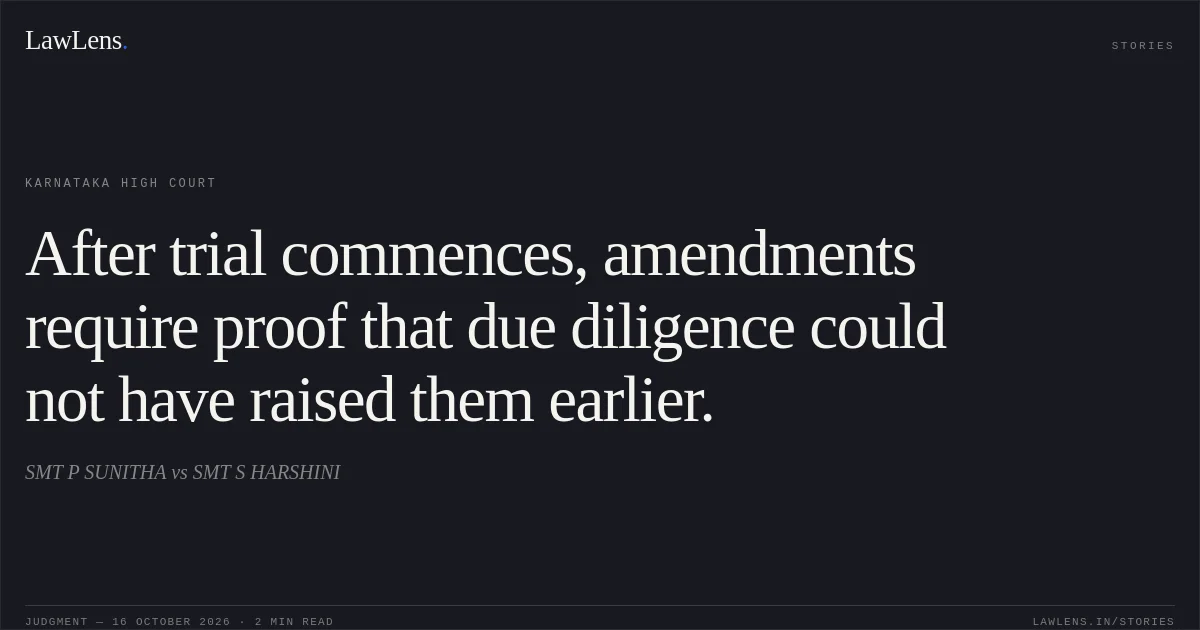
Order VI Rule 17 CPC permits amendment of pleadings where necessary to determine the real questions in controversy, but its proviso bars an amendment after commencement of trial unless the court is satisfied that, despite due diligence, the party could not have raised the matter earlier.
pp. 6, 13–14As explained in Vidyabai v. Padmalatha and Basavaraj v. Indira, satisfying this requirement is a precondition to allowing a post-trial-commencement amendment; the applicant bears the burden of establishing due diligence.
pp. 6, 13–14A liberal approach to amendments, including the principles discussed in Revajeetu Builders and LIC v. Sanjeev Builders, does not displace that statutory condition.
pp. 8, 12–14, 16–17The Court also considered the Commercial Courts Act, 2015’s objective of expeditious adjudication of commercial disputes.
pp. 6, 15–16Provisions in the judgment · 1 · Linked ones open on LawLens
Code of Civil Procedure, 1908 Section 151
04Reasoning
The Court found that the respondents had already pleaded the petitioner’s failure to convert the property, its alleged unsuitability for the intended purpose, and the resulting financial loss.
pp. 11–15The later RTI information and supporting documents did not establish that the underlying facts or the claim for consequential damages could not have been raised when the counterclaim was filed.
pp. 11–15The amendment application and supporting affidavit did not plead or demonstrate the required due diligence.
pp. 17–18The Commercial Court therefore erred by allowing the amendment without addressing this mandatory condition; permitting it at that stage would also risk further delay in the commercial suit.
pp. 11–15, 17–1805Holding
The High Court held that the respondents had not established due diligence as required by the proviso to Order VI Rule 17 CPC and that the Commercial Court’s order could not stand.
p. 18It allowed the writ petition, set aside the order dated 10 June 2025, and dismissed I.A. No. 20 seeking amendment of the counterclaim.
p. 18Original Court PDF
SMT P SUNITHAvsSMT S HARSHINI
Click to open original judgment
Original judgment, available to read, download and summarize on LawLens.in