Facts
The petitioners instituted a suit for partition and separate possession. The defendant’s written statement referred to a Will dated 5 November 1994 and a partition deed dated 1 March 2006; the partition deed also referred to the Will.
Source reference: p. 2; para. 6, p. 5The petitioners had accepted ₹2,00,000 by cheque under a settlement deed dated 9 August 2011.
Source reference: para. 6, p. 5After issues had been framed, the petitioners applied under Order VI Rule 17 read with Section 151 CPC to amend the plaint to challenge the Will and settlement deed as forged or obtained by fraud or coercion.
Source reference: paras. 1, 6, pp. 2, 5The Trial Court rejected the application, and the petitioners sought to set aside that order.
Source reference: para. 1, p. 2Issues
1. Whether the post-commencement amendment application satisfied the due-diligence requirement in the proviso to Order VI Rule 17 CPC.
Source reference: paras. 6–9, pp. 5–62. Whether the proposed amendment could be permitted where the relief sought would be barred by limitation if brought in a fresh suit.
Source reference: para. 10, p. 7Law Applied
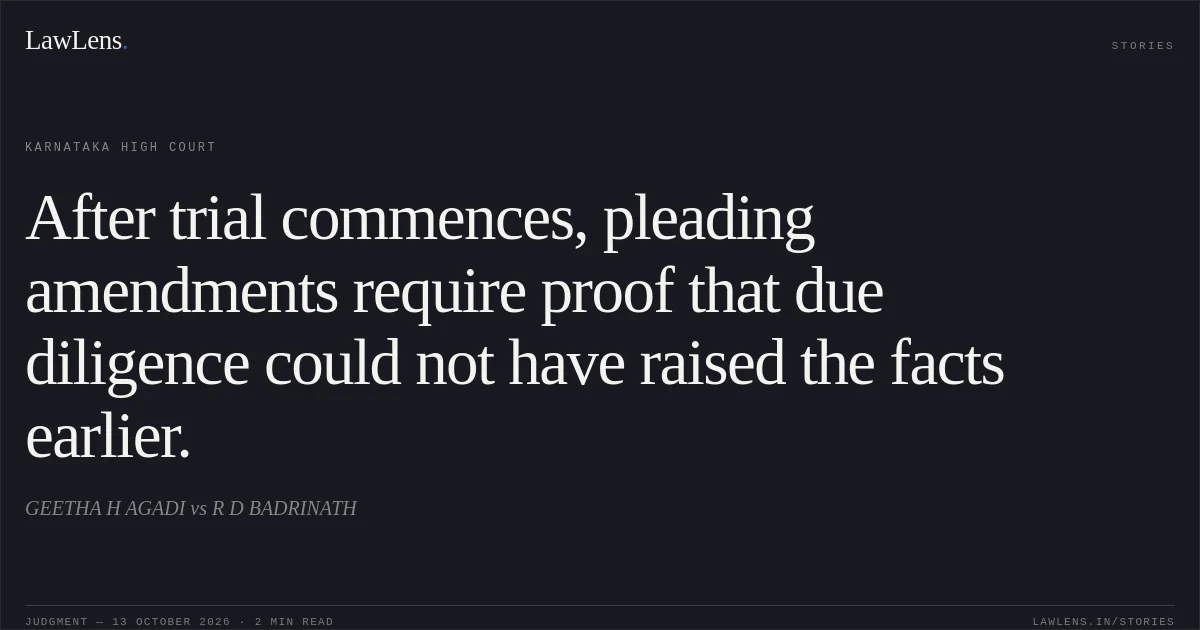
Order VI Rule 17 CPC permits amendment of pleadings where necessary for determining the real questions in controversy; however, after commencement of trial, the proviso requires the applicant to establish that, despite due diligence, the matter could not have been raised earlier. The Court treated framing of issues as commencement of trial in this case.
Source reference: paras. 4, 6–7, pp. 4–5It also relied on Basavaraj v. Indira and others, (2024) 3 SCC 705, for the principle that an amendment introducing relief that would be barred by limitation in a fresh suit should not be allowed, since it would take away a right accrued through passage of time.
Source reference: para. 10, p. 7Reasoning
The proposed amendment sought to challenge documents that were known to the petitioners when they filed the suit; the petitioners had also acted upon those documents, including by accepting the payment under the settlement deed.
Source reference: paras. 6, 8, pp. 5–6As the issues had been framed, the proviso to Order VI Rule 17 applied. The supporting affidavit alleged forgery, fraud or coercion but did not explain why the matters could not have been pleaded earlier despite due diligence.
Source reference: paras. 6–9, pp. 5–6The Court therefore found that the statutory requirement was not met and agreed with the Trial Court that the amendment sought to overcome the consequences of omitting material facts within the petitioners’ knowledge.
Source reference: para. 9, p. 6It also noted the limitation principle in Basavaraj in addressing the Trial Court’s observations on limitation.
Source reference: para. 10, p. 7Holding
The High Court held that the amendment application did not satisfy the proviso to Order VI Rule 17 CPC and found no ground to interfere with the Trial Court’s order.
The writ petition was dismissed.
Source reference: para. 12, p. 8Acts & Sections Cited
1 provisions across 1 statute referred to in this judgment. Each provision opens on LawLens.
Code of Civil Procedure, 19081
Original Court PDF
GEETHA H AGADIvsR D BADRINATH
Click to open original judgment
Original judgment, available to read, download and summarize on LawLens.in


