Facts
The dispute concerned land bearing Survey No. 39/G/5, Block No. 3/1, admeasuring approximately 1,094.28 sq. metres at Jamnagar.
Source reference: p. 3, para. 7The land originally belonged to Khodidas Ratanshi Dhamecha, against whom proceedings under the Urban Land (Ceiling and Regulation) Act, 1976 (“ULC Act”) were initiated after submission of Form No. 1 under Section 6(1).
Source reference: p. 3, para. 7The competent authority declared the land surplus in 1983, and the original owner’s appeal was dismissed in 1984.
Source reference: p. 4, para. 9An order under Section 8(4) was subsequently passed, the appeal against it was dismissed in 1985, and notification under Section 10(3) was issued on 12 March 1986.
Source reference: p. 5, para. 10Notice under Section 10(5) was served on the original owner, and physical possession was taken by the State in the presence of panch witnesses on 28 January 1989.
Source reference: p. 5, para. 10Notwithstanding the earlier vesting and taking of possession, an application was made in 1994 seeking permission to transfer the land to Harubhai Dattani.
Source reference: p. 5, para. 11The application was initially rejected on 11 August 1994, although the Urban Land Tribunal subsequently permitted the sale by order dated 22 September 1994.
Source reference: p. 5, para. 11The property was thereafter transferred through various sale deeds, ultimately being purchased by Shivam Developers on 26 May 1996.
Source reference: p. 2, paras. 3–5Development permissions were also granted by the Jamnagar Municipal Corporation for subdivision and construction.
Source reference: p. 2, para. 5In 1999, the City Survey Superintendent informed the appellant that the land stood recorded in the name of the State Government because it had been declared surplus.
Source reference: p. 3, para. 6The appellant’s request for cancellation of the entry was rejected on 29 May 2003 on the ground that the land had vested in the State and possession had already been taken.
Source reference: p. 3, para. 6The learned Single Judge dismissed the writ petition, holding that the subsequent transactions could not confer any valid interest after State vesting and possession.
Source reference: pp. 7–11, para. 14The present Letters Patent Appeal challenged that decision.
Source reference: pp. 7–11, para. 14Issues
1. Whether the land, having been declared surplus under the ULC Act, vested absolutely in the State Government under Section 10(3), particularly after physical possession was taken on 28 January 1989 under Section 10(5)?
Source reference: pp. 5, 12–15, paras. 10, 18, 22–232. Whether the subsequent permission granted by the Urban Land Tribunal under Section 26 and the sale transactions in favour of the appellant’s predecessors could validly transfer any right, title, or interest in the land after its vesting in the State?
Source reference: pp. 5, 11–14, paras. 11, 15–16, 19, 22–233. Whether the appellant could claim protection under the Urban Land (Ceiling and Regulation) Repeal Act, 1999 on the ground that proper notice was not served upon it or that possession had not been validly taken?
Source reference: pp. 6–11, paras. 12, 144. Whether municipal development permission and entries in the revenue records created or validated the appellant’s title in the land?
Source reference: pp. 11–12, 17–18, paras. 17–18, 24Law Applied
The Court applied the ULC Act, 1976, particularly Section 8(4), under which the competent authority determines the excess vacant land; Section 10(3), under which notified surplus land vests absolutely in the State Government free from all encumbrances; and Sections 10(5) and 10(6), which prescribe the procedure for requiring and taking possession of vested land.
Source reference: pp. 5, 12–15, paras. 10, 18, 22–23Sections 26 and 27 restrict transfers of urban or urbanisable land and require the prescribed notice or prior written permission of the competent authority; however, those provisions cannot validate a transfer after the land has already vested in the State and possession has been taken.
Source reference: pp. 13–15, paras. 20–23The Court also considered the Urban Land (Ceiling and Regulation) Repeal Act, 1999 and the principle recognised in Hari Ram that proceedings may lapse where possession had not been taken before repeal, but distinguished that principle because possession here had allegedly been taken in 1989, well before the Repeal Act came into force.
Source reference: pp. 6, 10–11, paras. 12, 14Municipal development permission and revenue entries do not confer title contrary to the statutory consequences of vesting under the ULC Act.
Source reference: pp. 11–12, 16–18, paras. 16–17, 24Reasoning
The Court found that the statutory proceedings had culminated in the Section 10(3) notification and that physical possession had been taken from the original owner on 28 January 1989 pursuant to notice under Section 10(5).
Source reference: pp. 5, 12, 18, paras. 10, 18Consequently, the State had acquired absolute title free from encumbrances before the alleged 1994 transfer.
Source reference: pp. 11–15, paras. 15–16, 19, 22–23The later application for permission under Section 26 and the Tribunal’s order permitting the sale could not operate upon land that was no longer owned by the transferor; therefore, the subsequent sale deeds, including the appellant’s purchase in 1996, conveyed no valid right, title, or interest.
Source reference: pp. 11–15, paras. 15–16, 19, 22–23The appellant could not be treated as a legally interested person entitled to notice of the earlier possession proceedings because its alleged interest arose only through transactions made after vesting and in circumstances where transfer was statutorily restricted.
Source reference: pp. 8–11, para. 14The Court further held that the Repeal Act did not assist the appellant because possession had already been taken before 30 March 1999.
Source reference: p. 6, para. 12Finally, municipal development permissions and revenue entries could not override the State’s statutory title or validate an otherwise ineffective transfer.
Source reference: pp. 11–12, 16–18, paras. 16–17, 24Holding
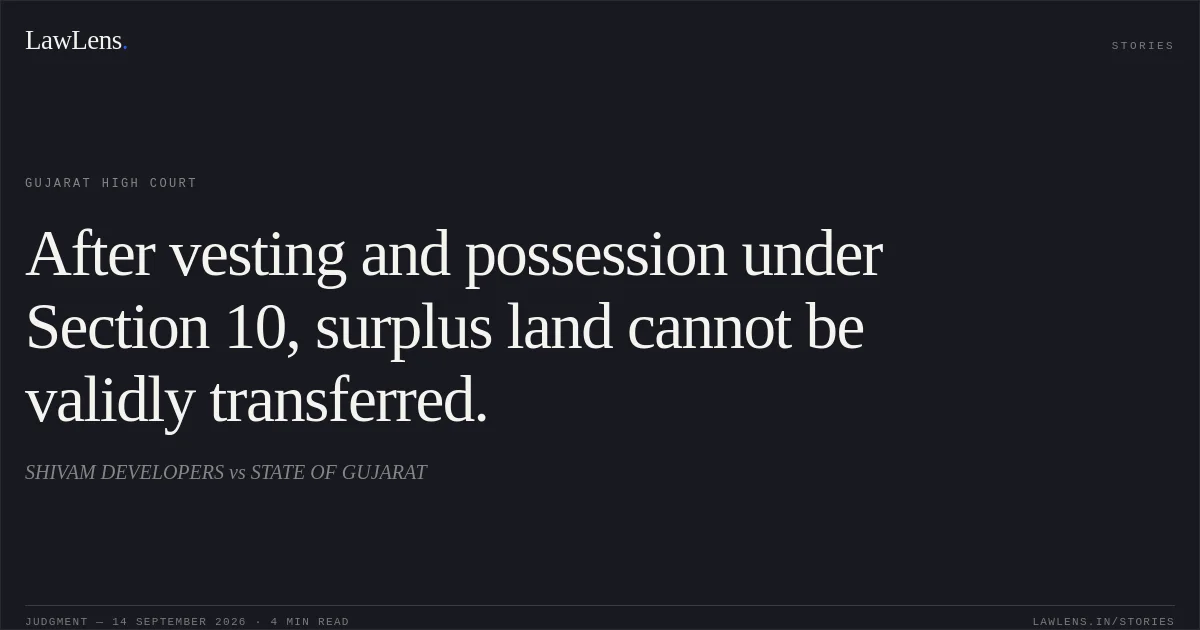
The Gujarat High Court held that the land had vested absolutely in the State Government under Section 10(3) of the ULC Act and that possession had been validly taken on 28 January 1989.
Accordingly, the subsequent permission, sale transactions, municipal development permissions, and revenue entries did not confer any enforceable title or interest upon Shivam Developers.
Source reference: p. 15, para. 24The Court dismissed the Letters Patent Appeal as meritless and affirmed the learned Single Judge’s dismissal of the writ petition, with no order as to costs.
Source reference: p. 15, para. 24The appellant’s post-judgment request for interim protection of possession was also rejected.
Source reference: p. 16, para. 25Acts & Sections Cited
9 provisions across 1 statute referred to in this judgment. Linked provisions open on LawLens.
Urban Land (Ceiling And Regulation) Act, 1976
Original Court PDF
SHIVAM DEVELOPERSvsSTATE OF GUJARAT
Click to open original judgment
Original judgment, available to read, download and summarize on LawLens.in