01Facts
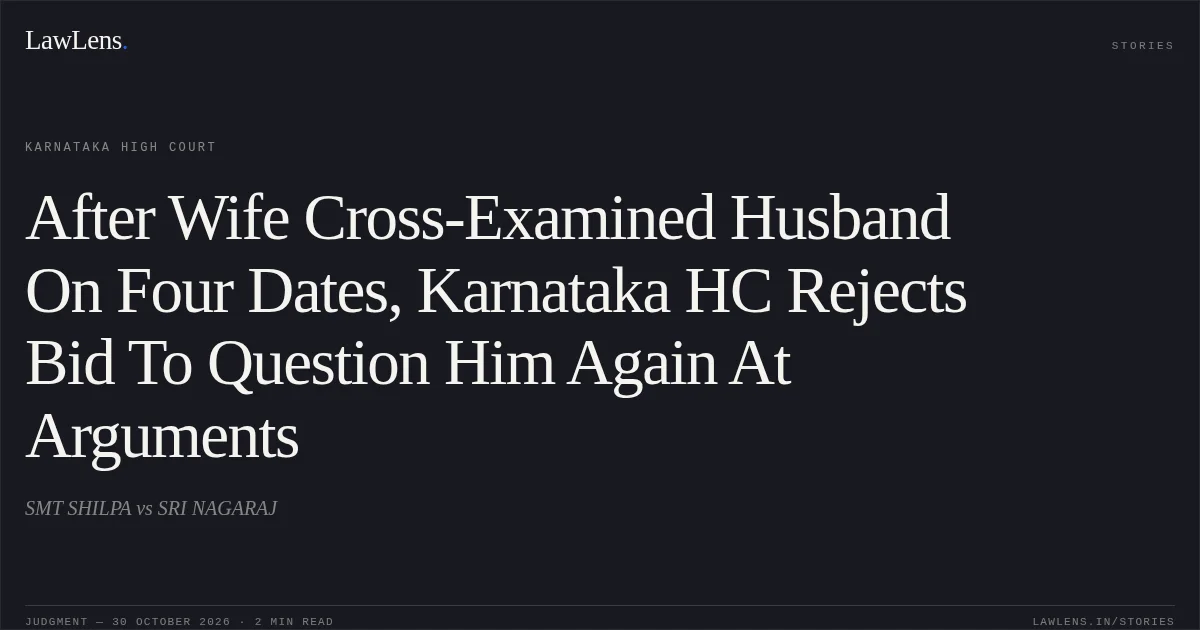
The husband’s divorce petition and the wife’s petition for restitution of conjugal rights were clubbed before the Family Court, Udupi.
pp. 2–6 · ¶ 2–6After evidence had closed and the cases were posted for arguments, the wife applied under Order XVIII Rule 17 read with Section 151 of the Code of Civil Procedure, 1908, to recall the husband (RW.1) for further cross-examination.
pp. 2–6 · ¶ 2–6She said his statement of assets and liabilities created a need for further questioning.
pp. 2–6 · ¶ 2–6The Family Court dismissed the application, noting that the statement had been filed in a separate maintenance case, that the husband had already been cross-examined at length, and that the proceedings had been pending for several years.
pp. 2–6 · ¶ 2–6The wife challenged that order under Articles 226 and 227 of the Constitution.
pp. 2–6 · ¶ 2–602Issues
i.1. Whether the Family Court erred in refusing to recall RW.1 for further cross-examination after the evidence had closed and the matters were posted for arguments
pp. 3–6 · ¶ 3–6ii.2. Whether the Family Court’s refusal disclosed grounds for interference under Articles 226 and 227 of the Constitution
pp. 2, 6–7 · ¶ 2, 6–703Law Applied
Order XVIII Rule 17 CPC concerns the court’s power to recall a witness, and Section 151 CPC preserves the court’s inherent powers; the wife relied on these provisions to seek further cross-examination.
pp. 2–7 · ¶ 2–7The petition invoked Articles 226 and 227 of the Constitution.
pp. 2–7 · ¶ 2–7The Court’s reasoning turned on the circumstances of the application: whether further examination was necessary in the cases before the Family Court, given the issues in those proceedings and the cross-examination already conducted.
pp. 2–7 · ¶ 2–7The judgment cited no precedent or further statutory test.
pp. 2–7 · ¶ 2–7Provisions in the judgment · 1 · Linked ones open on LawLens
Code of Civil Procedure, 1908 Section 151
04Reasoning
The Court found no basis to recall RW.1 in the divorce and restitution proceedings.
pp. 4–7 · ¶ 4–7The statement of assets and liabilities had been filed in a separate maintenance case, not in the proceedings under consideration; neither party had sought maintenance or permanent alimony in those proceedings.
pp. 4–7 · ¶ 4–7The husband had admitted his occupation and earnings, and the wife had already cross-examined him at length, including on income.
pp. 4–7 · ¶ 4–7In those circumstances, the Court found no necessity for further cross-examination and considered that the Family Court had properly taken account of the proceedings’ duration and the need to bring the litigation to an end.
pp. 4–7 · ¶ 4–7Any challenge to the statement of assets and liabilities could be raised in the matter in which it had been filed.
pp. 4–7 · ¶ 4–705Holding
The Court held that the Family Court’s order disclosed no infirmity or illegality warranting interference.
p. 7 · ¶ 7–8It dismissed the writ petition and declined to set aside the order refusing to recall RW.1.
p. 7 · ¶ 7–8Original Court PDF
SMT SHILPAvsSRI NAGARAJ
Click to open original judgment
Original judgment, available to read, download and summarize on LawLens.in