01Facts
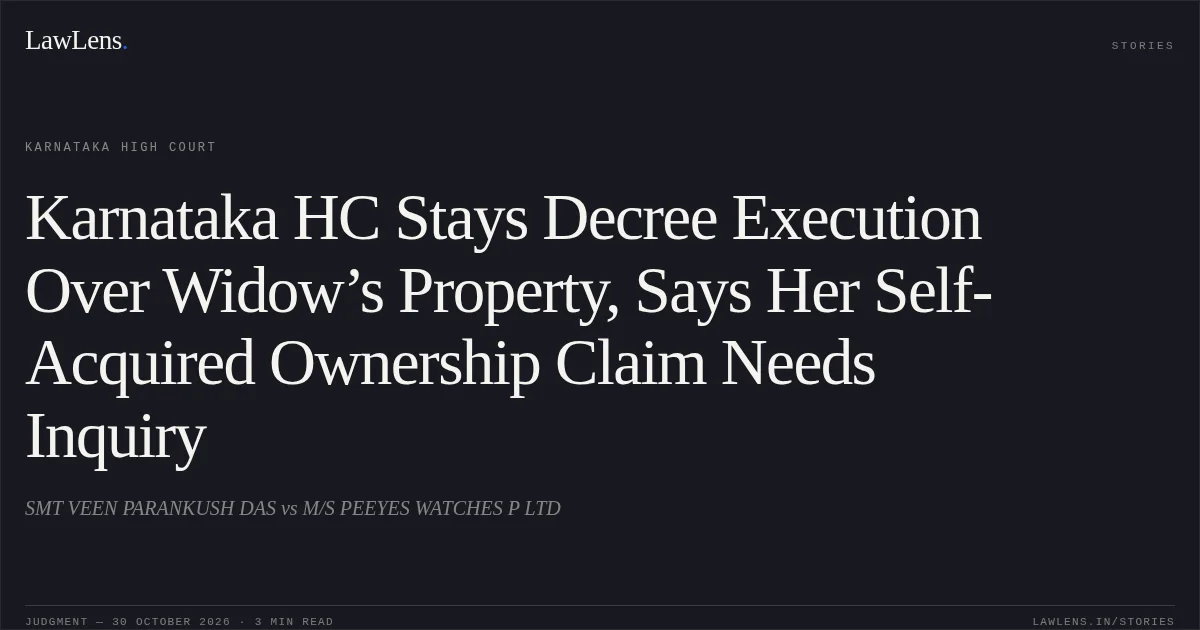
The petitioners, claiming as legal representatives of deceased Judgment Debtor No. 2, challenged the Executing Court’s order rejecting their application under Order XXI Rule 29 read with Section 151 CPC.
The decree in O.S. No. 137/2007, dated 3 November 2016, imposed joint and several liability on the defendants; it had attained finality while Judgment Debtor No. 2 was alive.
p. 8In Execution Case No. 53/2019, the decree-holder sought to proceed against property which the petitioners claimed was the self-acquired property of Judgment Debtor No. 2(a).
pp. 4–5, 10–11The petitioners had also instituted O.S. No. 789/2022 seeking a declaration that the decree was not binding on them or the suit-schedule property.
pp. 4–5, 10–11The Executing Court rejected their stay application on 5 August 2024, prompting this writ petition.
p. 302Issues
i.1. Whether the Executing Court was required under Section 47 CPC to determine the petitioners’ objection that the property sought to be executed against was the self-acquired property of Judgment Debtor No. 2(a).
pp. 10–11ii.2. Whether execution against that property should be stayed pending adjudication of the petitioners’ separate suit concerning the decree’s binding effect on the property.
pp. 10–12iii.3. Whether the petitioners could reopen, at the execution stage, the question of Judgment Debtor No. 2’s status as a partner, or require the decree-holder to proceed first against partnership assets.
pp. 8–1003Law Applied
Section 47 CPC requires the Executing Court to decide questions between the parties or their representatives relating to execution, discharge or satisfaction of the decree; a claim concerning whether property may be proceeded against in execution falls within that inquiry.
p. 10Order XXI Rule 29 read with Section 151 CPC provides a basis for staying execution in the circumstances considered by the Court, including to preserve property pending adjudication of a related suit.
pp. 3, 11–12The Court considered Order XXI Rules 49 and 50 CPC and Topanmal Chhotamal v. Kundomal Gangaram, AIR 1960 SC 388, and held that they do not require a decree-holder to give preference to particular assets where the decree imposes joint and several liability.
p. 9A final decree cannot be reopened in execution on the issue of a judgment debtor’s partnership status where that issue was not disputed during the suit and the decree has attained finality.
pp. 8–9Provisions in the judgment · 3 · Linked ones open on LawLens
Code of Civil Procedure, 1908 Section 151Section 47
Indian Partnership Act, 1932 Section 63
04Reasoning
The Court held that the partnership-status objection could not be raised afresh in execution because Judgment Debtor No. 2 had participated in the suit, the decree imposed joint and several liability, and the decree had become final.
pp. 8–9Nor did the partnership rules require the decree-holder to proceed first against firm assets.
p. 9However, the claim that the attached property was the self-acquired property of Judgment Debtor No. 2(a) had not previously been adjudicated and required a detailed inquiry under Section 47 CPC; the Executing Court therefore erred in rejecting it for want of evidence at that stage.
pp. 10–11Because the separate suit raised a substantially related challenge, proceeding to sell the property before that suit was decided could defeat the petitioners’ asserted rights.
pp. 11–12The Court found it appropriate to stay execution concerning the property pending adjudication.
pp. 11–1205Holding
The writ petition was allowed, and the order dated 5 August 2024 was set aside.
pp. 12–13The application under Order XXI Rule 29 read with Section 151 CPC was allowed, and the Court directed that proceedings in Execution Case No. 53/2019 be stayed pending disposal of O.S. No. 137/2007.
pp. 12–13The reasoning refers to O.S. No. 789/2022 as the related suit, whereas the operative order specifies O.S. No. 137/2007.
pp. 11–13Original Court PDF
SMT VEEN PARANKUSH DASvsM/S PEEYES WATCHES P LTD
Click to open original judgment
Original judgment, available to read, download and summarize on LawLens.in