Facts
The Appellant (Defendant No. 1) challenged a trial court judgment decreeing a suit for possession and mesne profits in favor of the Respondents (Plaintiffs).
Source reference: no citationPlaintiff No. 1 (Surender Singh) was the original owner who transferred the suit property—two rooms in Gazipur Dairy Farm—to Plaintiff No. 2 (Ravinder Singh) via a registered irrevocable General Power of Attorney (GPA) dated 26.03.2010 for consideration.
Source reference: p. 2-3The Plaintiffs alleged the Appellant was a permissive licensee.
Source reference: p. 3The Appellant contended she purchased the property from Plaintiff No. 1 in 2006 for Rs. 10,50,000/- in cash, though no registered documents were produced.
Source reference: p. 5-6During the pendency of the suit, Plaintiff No. 1 expired, and Plaintiff No. 2 was permitted to represent his estate.
Source reference: p. 9, 17Issues
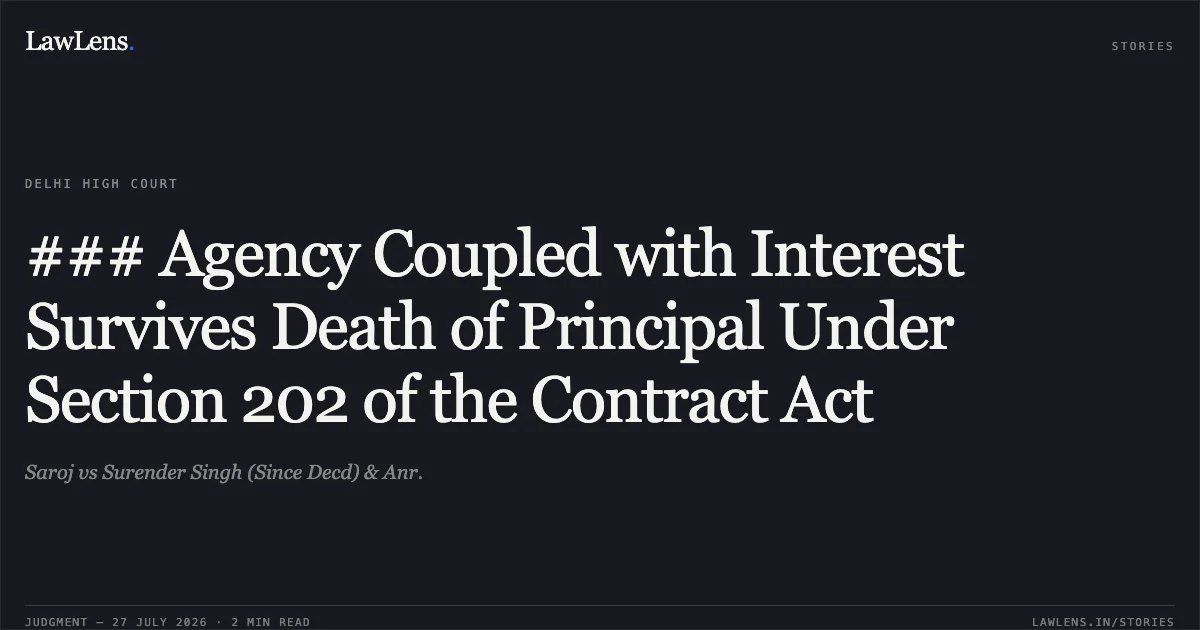
1. Whether the suit abated upon the death of Plaintiff No. 1 or if the agency under the GPA survived under Section 202 of the Contract Act.
Source reference: p. 14 / para. 562. Whether the Respondents established a superior possessory title over the Appellant based on a licensor-licensee relationship.
Source reference: p. 17 / para. 713. Whether the testimony of a witness (PW-2) who died before cross-examination was completed is admissible.
Source reference: p. 9 / para. 32Law Applied
Section 202 of the Indian Contract Act, 1872, which stipulates that an agency coupled with an interest cannot be terminated to the prejudice of such interest, even by the death of the principal.
Source reference: p. 15Reliance on Seth Loon Karan Sethiya v. Ivan E. John and P. Seshareddy (D) v. State of Karnataka.
Source reference: p. 15Evidence-in-chief remains admissible if cross-examination is prevented by death without the party's fault, as per Krishan Dayal v. Chandu Ram.
Source reference: p. 9, 16Section 116 of the Indian Evidence Act, 1872, regarding the estoppel of a licensee/tenant from denying the landlord's title, as affirmed in Sant Lal Jain v. Avtar Singh.
Source reference: p. 22-23Reasoning
The Court reasoned that the GPA [Ex. PW-1/2] was in the nature of an agency coupled with interest because it was executed for consideration with contemporaneous delivery of possession; thus, it did not terminate upon the death of Plaintiff No. 1.
Source reference: p. 15-16The Court found the Appellant’s claim of ownership unsubstantiated as she produced no registered sale deed, failed to provide particulars of payment, and contradicted herself by describing her status as a "tenant" in a previous FIR [Ex. DW-1/2] and oral testimony.
Source reference: p. 18-19The Respondents proved a better title through the registered GPA and the admissions of the Appellant's son in prior litigation.
Source reference: p. 21-22While the GPA did not transfer absolute ownership under Suraj Lamp, it conferred a superior possessory right over a licensee whose permission had been revoked.
Source reference: p. 24Holding
The High Court held that the suit did not abate as Plaintiff No. 2 had a surviving interest in the property.
The High Court dismissed the appeal and affirmed the trial court’s decree, holding the Respondents entitled to recovery of possession, mesne profits at Rs. 600/- per month with 10% annual increase, and a permanent injunction.
Source reference: p. 10, 11, 25-26Acts & Sections Cited
1 provisions across 1 statute referred to in this judgment. Each provision opens on LawLens.
Code of Civil Procedure, 19081
Original Court PDF
SarojvsSurender Singh (Since Decd) & Anr.
Click to open original judgment
Original judgment, available to read, download and summarize on LawLens.in