Facts
The Appellant was convicted by the Trial Court for raping and attempting to murder a minor girl (PW-2) on 22.08.2021.
Source reference: para. 2/5The Appellant allegedly intercepted the victim and her younger sister (PW-6) while they were going to defecate, rendered the victim unconscious, and committed penetrative sexual assault in a nearby garden (gachhi).
Source reference: para. 5The victim sustained severe internal injuries to her anal and urinary tracts, requiring three major surgeries at IGIMS, Patna.
Source reference: para. 18, 33The Trial Court sentenced the Appellant to life imprisonment under Section 6 of the POCSO Act and 10 years rigorous imprisonment under Section 307 of the IPC.
Source reference: para. 2The Appellant challenged the conviction, citing a two-day delay in the FIR, inconsistencies in witness testimonies, and an alleged motive of false implication due to financial dues.
Source reference: para. 11Issues
1. Whether the prosecution established the victim’s status as a "child" under the POCSO Act at the time of the occurrence.
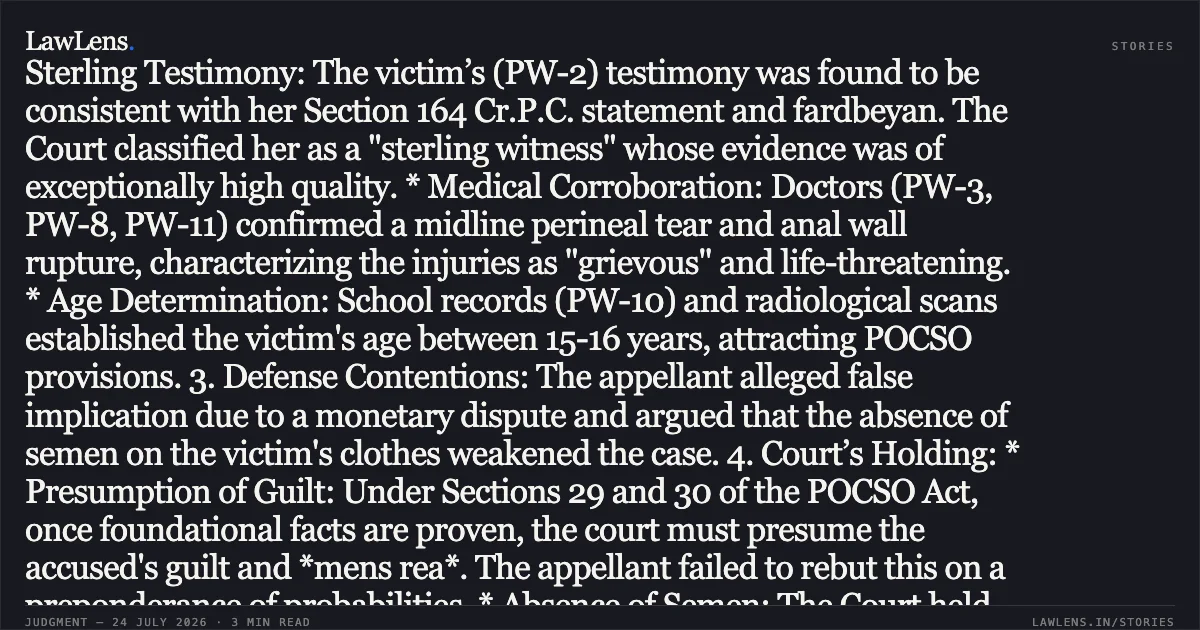
Source reference: para. 45-462. Whether the testimony of the prosecutrix (PW-2) was of "sterling quality" to sustain a conviction without the need for independent corroboration.
Source reference: para. 10, 243. Whether the nature of injuries and the circumstances of the assault justified a conviction under Section 307 of the IPC (Attempt to Murder).
Source reference: para. 48Law Applied
The court applied Sections 376 and 307 of the IPC and Sections 4 and 6 of the POCSO Act.
Source reference: para. 2It relied on the "reverse burden" of proof and mandatory presumptions under Sections 29 and 30 of the POCSO Act, which require the court to presume the guilt and mens rea of the accused once foundational facts are proven.
Source reference: para. 42-43Regarding the reliability of a victim's testimony, the court applied the principle from Manak Chand alias Mani v. State of Haryana, which treats the prosecutrix's evidence as equivalent to an injured witness and of "sterling quality" if consistent.
Source reference: para. 23For age determination, the court followed the hierarchy of evidence (school records over medical opinion) as per the POCSO framework.
Source reference: para. 46Reasoning
The Court found the foundational facts established: the victim’s minority was proven through school admission registers (showing a DOB of 29.12.2006) and corroborated by a Medical Board.
Source reference: para. 46The Court rejected the defense's argument regarding the two-day FIR delay, noting that in sexual assault cases, families often prioritize medical treatment and struggle with social stigma.
Source reference: para. 47The medical evidence from IGIMS (PW-8) confirmed the "grievous" nature of the injuries, specifically a complete perineal tear and communication between the anal wall and vagina, which the Court deemed sufficient to establish an intent or knowledge that such acts could cause death under Section 307 IPC.
Source reference: para. 32, 48The testimony of the child witness (PW-6) and the prompt disclosure to the mother (PW-1) provided immediate corroboration under the res gestae principle.
Source reference: para. 14, 25The Appellant failed to rebut the statutory presumptions under Sections 29 and 30 of the POCSO Act, as his defense regarding unpaid wood dues was deemed an unproven afterthought.
Source reference: para. 41, 49Holding
The High Court held that the victim was a child (approx. 15-16 years) at the time of the incident and her testimony was trustworthy and unblemished.
The Court affirmed that the severity of the internal injuries and the resulting sepsis/surgeries justified the conviction for attempt to murder alongside aggravated penetrative sexual assault.
Source reference: para. 48-49The High Court dismissed the appeal and upheld the judgment of conviction and order of sentence of life imprisonment and the order to pay Rs. 7,00,000/- in victim compensation.
Source reference: para. 2, 50Acts & Sections Cited
10 provisions across 4 statutes referred to in this judgment. Each provision opens on LawLens.
Indian Penal Code, 18602
Protection of Children from Sexual Offences Act, 20125
Scheduled Castes and the Scheduled Tribes (Prevention of Atrocities) Act, 19891
Code of Criminal Procedure, 19732
Original Court PDF
KAILASH SAW @ KAILASH SAHU @ KAILASH SAHvsThe State of Bihar
Click to open original judgment
Original judgment, available to read, download and summarize on LawLens.in