Facts
The parties married on 09.12.2004 and had two sons, born in 2011 and 2014. The husband left the wife and children on 21.06.2018. In the wife’s divorce proceedings under Section 13(1)(ia) of the Hindu Marriage Act, 1955, she sought maintenance under Sections 24 and 26 HMA. The Family Court initially awarded maintenance for the children at ₹37,000 per child per month from 17.09.2019 to 31.12.2020, enhanced to ₹40,000 per child per month from 01.01.2021, considering the parties’ respective incomes, school fees, and the wife’s housing EMI obligations.
Source reference: paras. 4–6; pp. 2–3The Family Court subsequently enhanced the children’s maintenance to ₹50,000 per child per month from April 2024, but declined to determine the parties’ dispute concerning ownership of a vehicle.
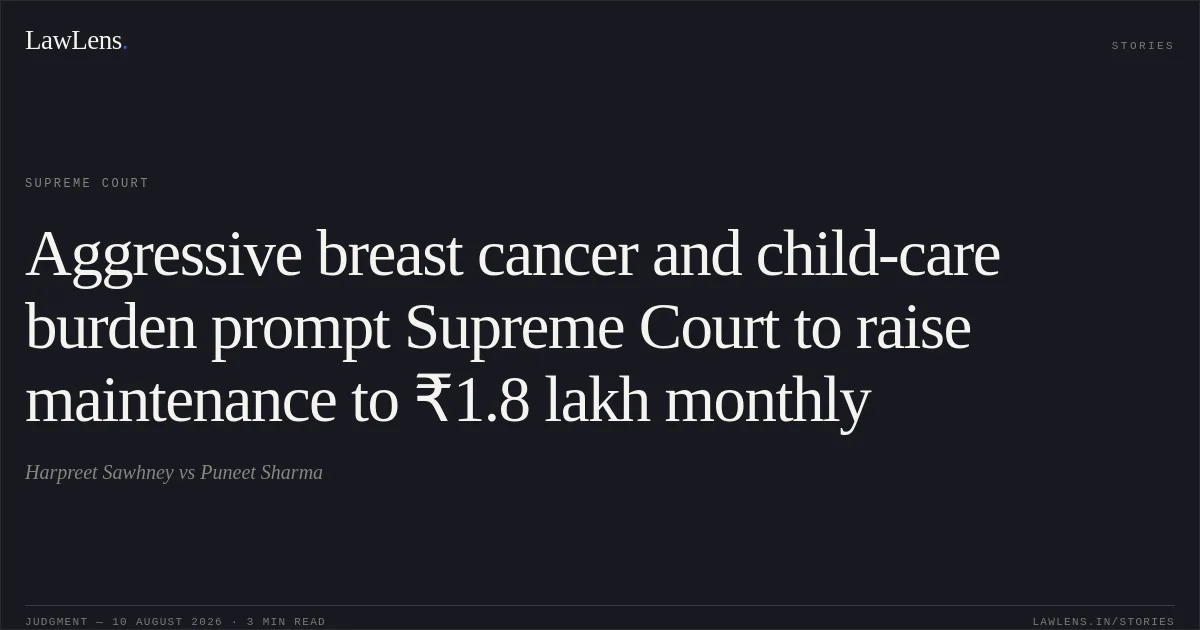
Source reference: para. 10; p. 6During the wife’s appeal before the Delhi High Court, she was diagnosed with aggressive breast cancer, and the High Court awarded her interim maintenance of ₹20,000 per month from 01.12.2024.
Source reference: para. 11; p. 7The High Court ultimately enhanced the maintenance for both children to ₹1,25,000 per month from April 2024 and closed the contempt proceedings against the husband. It later directed payment of arrears within six months.
Source reference: paras. 14–16; pp. 8–9Issues
Whether the maintenance awarded for the two minor children required further enhancement having regard to the husband’s income, the children’s documented expenses, and the wife’s financial and medical circumstances?
Source reference: paras. 17–23; pp. 9–12Whether Provident Fund contributions and Employee Stock Purchase Scheme deductions should be treated as deductions reducing the husband’s disposable income for determining maintenance?
Source reference: paras. 19–20; pp. 10–11Whether the wife was entitled to enhanced personal maintenance in view of her breast-cancer treatment and medical expenses?
Source reference: paras. 21–22; p. 11What consequential directions were required regarding the husband’s undertaking to transfer ownership of the vehicle?
Source reference: para. 24; p. 12Law Applied
The Court applied Article 136 of the Constitution of India in exercising appellate jurisdiction over the High Court’s orders.
Source reference: para. 2; p. 1It applied Sections 24 and 26 of the Hindu Marriage Act, 1955, which empower the court to grant maintenance during matrimonial proceedings and make appropriate orders concerning the maintenance, education, and welfare of minor children.
Source reference: paras. 5–6; pp. 2–3The governing maintenance principle is that the quantum must be determined by a reasonable assessment of the parties’ financial capacity and the actual needs of the children, rather than by mathematical exactitude.
Source reference: para. 7; p. 4For this purpose, deductions such as Provident Fund contributions and ESPS payments, which ultimately accrue to the husband’s benefit, cannot be treated in the same manner as compulsory deductions such as income tax and professional tax.
Source reference: paras. 19–20; pp. 10–11The Court also recognised that a parent’s medical expenses and caregiving responsibilities are relevant circumstances in assessing maintenance.
Source reference: paras. 21–22; p. 11Reasoning
The Court found that the High Court’s assessment required reconsideration because the husband’s salary and bonus yielded an estimated monthly income of approximately ₹4,50,000, while the deductions of ₹1,64,856 included PF and ESPS contributions that remained beneficial to him and were not equivalent to mandatory taxes.
Source reference: paras. 19–20; pp. 10–11The Court also considered the children’s substantial educational and other expenses, the fact that they resided with and were cared for by the wife, and the wife’s aggressive breast cancer and resulting treatment costs.
Source reference: paras. 17, 21–22; pp. 9–11Applying the principle that maintenance must reflect the children’s reasonable needs and the paying parent’s actual financial capacity, the Court enhanced the children’s aggregate maintenance and separately increased the wife’s maintenance.
Source reference: para. 23; p. 12It further held that the wife remained entitled to seek a future enhancement if circumstances changed.
Source reference: para. 23; p. 12Holding
The husband’s maintenance obligation for the two children was enhanced to ₹1,50,000 per month in total, i.e., ₹75,000 per child per month, with effect from 01.01.2025.
The wife’s maintenance was enhanced from ₹20,000 to ₹30,000 per month, particularly in view of her medical expenses.
Source reference: para. 22; p. 11The wife was permitted to seek a further enhancement upon a change in circumstances.
Source reference: para. 23; p. 12The husband was directed to comply with his undertaking to execute the necessary documents for transfer of ownership of the vehicle within three months of the judgment.
Source reference: para. 24; p. 12The civil appeals and connected interlocutory applications were accordingly disposed of.
Source reference: para. 25; p. 12Acts & Sections Cited
4 provisions across 2 statutes referred to in this judgment. Each provision opens on LawLens.
Hindu Marriage Act, 19553
Code of Civil Procedure, 19081
Original Court PDF
Harpreet SawhneyvsPuneet Sharma
Click to open original judgment
Original judgment, available to read, download and summarize on LawLens.in