Facts
The petitioner sought conversion of 20½ decimals of agricultural land for non-agricultural use.
Source reference: pp. 3–8By order dated 12 March 2021, the Sub-Divisional Officer assessed the land at Rs.60,000 per decimal and directed payment of Rs.1,24,300, which the petitioner paid.
Source reference: pp. 3–8On a later conversion application concerning another parcel, the land was assessed at Rs.7,000 per decimal.
Source reference: pp. 3–8The petitioner thereafter sought a refund of Rs.1,09,880, contending that the first assessment had improperly used a commercial valuation.
Source reference: pp. 3–8When his refund representation remained undecided, he filed this writ petition.
Source reference: pp. 3–8The State opposed the petition, including on the ground that an appeal was available under Section 9(1) of the Bihar Agricultural Land (Conversion for Non-Agricultural Purposes) Act, 2010 (“2010 Act”).
Source reference: pp. 3–8Issues
1. Whether the petitioner was entitled to a refund of the excess conversion fee allegedly assessed by valuing his agricultural land at a commercial rate
Source reference: pp. 8–112. Whether the availability of an appeal under Section 9(1) of the 2010 Act prevented the Court from considering the petitioner’s claim when his subsequent refund representation had not been decided
Source reference: p. 10Law Applied
Section 4(1) of the 2010 Act requires an owner or occupier seeking conversion of agricultural land to pay a conversion fee at 10% of the land’s market value, as notified by the Government from time to time.
Source reference: pp. 8–9Under Section 5(1), the competent authority considers the conversion application and assesses the fee.
Source reference: p. 7Section 9(1) provides an appeal to the Collector against an order of the Sub-Divisional Magistrate/Officer.
Source reference: p. 8The Court applied the principle that the conversion assessment must be based on the agricultural land’s applicable market value, rather than an erroneously assigned commercial value.
Source reference: pp. 9–10Reasoning
The Court found that the first assessment valued the petitioner’s land at Rs.60,000 per decimal, while a later assessment by the same authority valued another parcel at Rs.7,000 per decimal.
Source reference: pp. 9–10It concluded that the first assessment had treated the land as commercial in nature and was inconsistent with Section 4(1)’s requirement to assess the relevant market value for conversion purposes.
Source reference: pp. 9–10The alternative-remedy objection did not bar the writ petition because the petitioner challenged the authority’s failure to decide his refund representation; no order had been passed on that representation from which an appeal under Section 9(1) could be filed.
Source reference: p. 10Holding
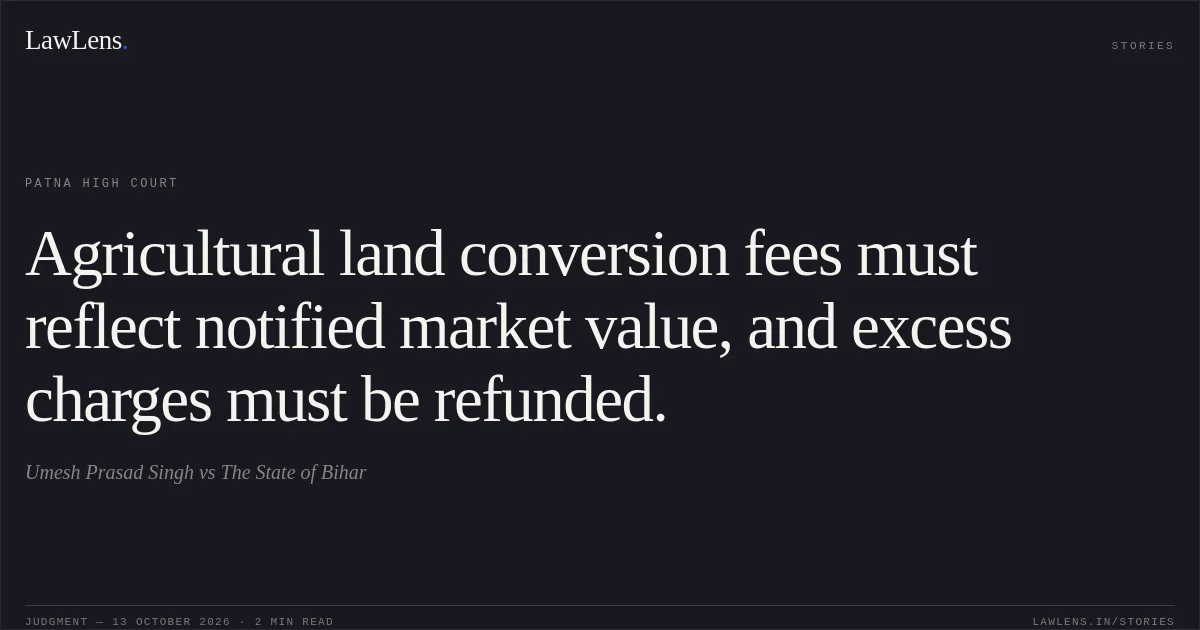
The Court held that the petitioner was entitled to a refund of Rs.1,09,880 and allowed the writ petition.
It directed the Sub-Divisional Officer, Lakhisarai, to pay the amount within eight weeks; if funds were unavailable, the officer was to seek their release from the District Magistrate, who was directed to provide them.
Source reference: pp. 10–12If payment was not made within the prescribed period, the petitioner would be entitled to interest at 6% from 4 January 2024, the date of his refund application, until payment.
Source reference: pp. 10–12Acts & Sections Cited
3 provisions across 1 statute referred to in this judgment. Each provision opens on LawLens.
Original Court PDF
Umesh Prasad SinghvsThe State of Bihar
Click to open original judgment
Original judgment, available to read, download and summarize on LawLens.in


