Facts
The parties to a suit for partition of agricultural land signed written compromise terms on 10 July 2026, identifying how the land would be divided, and asked the Trial Court to pass a consent decree.
Source reference: pp. 1–3The Principal Senior Civil Judge, Dwarka, rejected their request by order dated 29 July 2026. The petitioner challenged that order under Article 227 of the Constitution; before the High Court, both sides supported the petition and requested that it be allowed
Source reference: pp. 1–3Issues
Whether the Trial Court erred in refusing to record the parties’ written compromise and pass a consent decree partitioning the agricultural land
Source reference: pp. 2–4Whether the parties could present a fresh compromise for the Trial Court’s consideration notwithstanding the impugned order
Source reference: pp. 4–5Law Applied
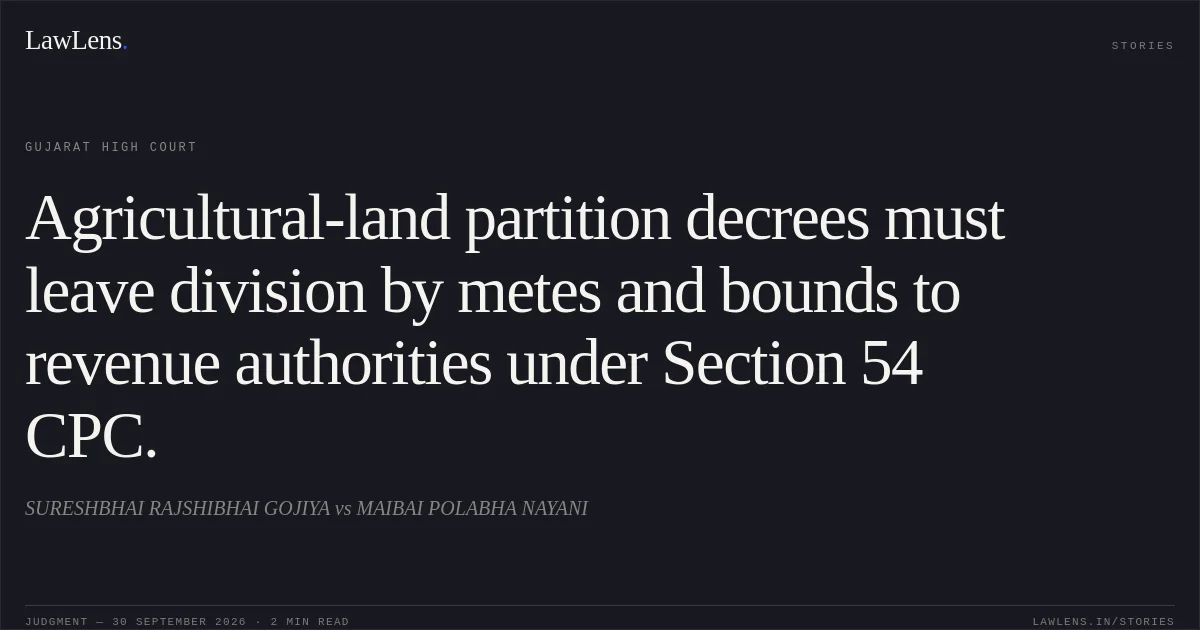
Section 54 of the Code of Civil Procedure applies to partition of agricultural land: after determining the parties’ shares, the Court is required to send the decree to the revenue authorities for partition in metes and bounds
Source reference: p. 4The Court also recognised that parties may agree to a settlement and present it to the Trial Court, which must examine the compromise and pass an appropriate order in accordance with law
Source reference: pp. 4–5Reasoning
The High Court noted that the parties’ written terms earmarked and divided the agricultural land, but held that Section 54 requires the decree to be sent to the revenue authorities for partition in metes and bounds.
Source reference: pp. 3–5On considering the impugned order, the Court found no error warranting interference under Article 227. It nevertheless clarified that the parties could present agreed terms providing for equal shares, and that the Trial Court should consider any such compromise without being influenced by its earlier order
Source reference: pp. 3–5Holding
The Court declined to set aside the Trial Court’s order and dismissed the petition.
It did not direct that the existing compromise be recorded or a consent decree be passed. The parties were left free to submit a compromise for the Trial Court’s consideration, and the Trial Court was directed to examine it and pass an appropriate order in accordance with law
Source reference: pp. 4–5Acts & Sections Cited
1 provisions across 1 statute referred to in this judgment. Each provision opens on LawLens.
Code of Civil Procedure, 19081
Original Court PDF
SURESHBHAI RAJSHIBHAI GOJIYAvsMAIBAI POLABHA NAYANI
Click to open original judgment
Original judgment, available to read, download and summarize on LawLens.in