Facts
The prosecution alleged that, on 22 May 2022, the petitioners used electricity at Kalyan Mantapa by drawing a direct line without a meter or RR number, causing an alleged loss of ₹4,66,097.
Source reference: para. 2.1, pp. 3–4A complaint led to registration of an FIR and, after investigation, the filing of a charge sheet for an offence under Section 135(1) of the Electricity Act, 2003.
Source reference: para. 2.1, pp. 3–4The petitioners sought to quash the proceedings in Special Case No. 1248/2025 under Section 482 of the Code of Criminal Procedure, 1973, corresponding to Section 528 of the Bharatiya Nagarik Suraksha Sanhita, 2023.
Source reference: para. 1, p. 3By the time the petition was heard, the trial court had framed charges and set the matter down for trial.
Source reference: paras. 4, 7, pp. 4–6Issues
1. Whether the High Court should exercise its inherent jurisdiction to quash the criminal proceedings after charges have been framed and the matter set down for trial
Source reference: paras. 7–9, pp. 5–72. Whether the petitioners’ challenges to the alleged electricity theft raised exceptional circumstances warranting quashing, or instead concerned disputed facts for trial
Source reference: paras. 6, 9, pp. 5–7Law Applied
The Court considered its inherent jurisdiction under Section 482 of the Code of Criminal Procedure, 1973, and Section 528 of the Bharatiya Nagarik Suraksha Sanhita, 2023, in relation to proceedings for an alleged offence under Section 135(1) of the Electricity Act, 2003.
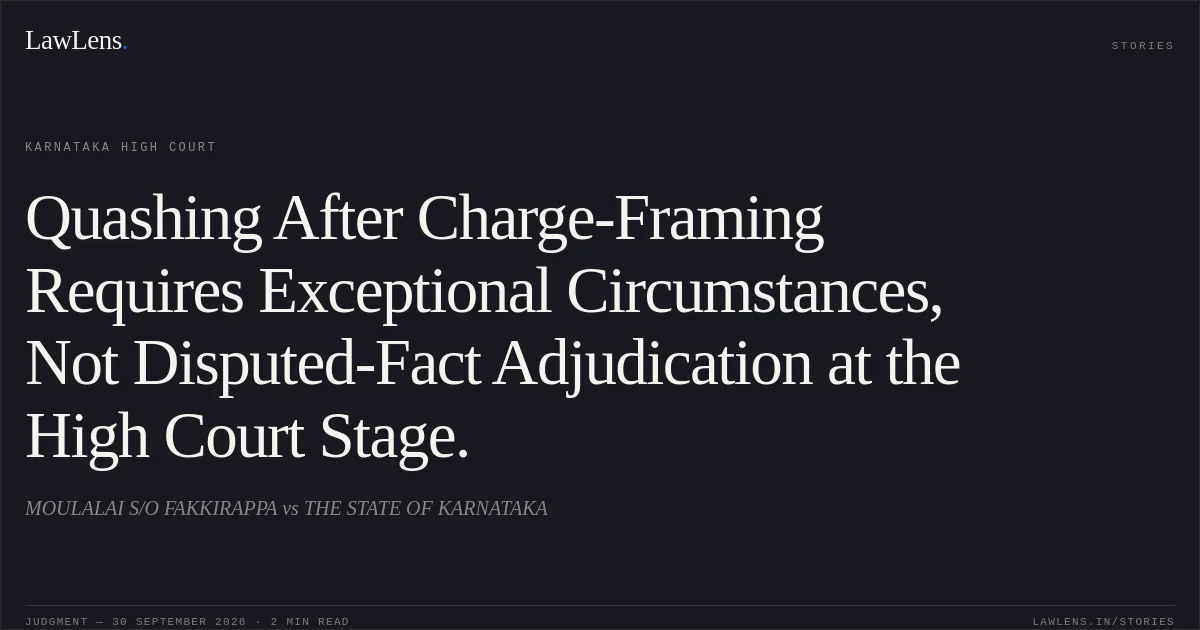
Source reference: para. 1, p. 3It stated that, once charges have been framed and a matter is set down for trial, the High Court should ordinarily be slow to interfere under Section 482, unless exceptional circumstances are shown; disputed questions of fact are generally for determination at trial.
Source reference: paras. 8–9, pp. 6–7The Court referred to this principle as having been established in several Supreme Court judgments but did not identify them.
Source reference: para. 8, p. 6Reasoning
The petitioners’ challenge principally disputed whether they had committed the alleged theft of electricity, a factual question the Court held required adjudication at trial.
Source reference: para. 6, p. 5The trial court had already considered the charge-sheet material, framed charges, and set the case down for trial.
Source reference: para. 7, pp. 5–6As the petitioners demonstrated no exceptional circumstance warranting interference, and their factual disputes could not be resolved in the quashing petition, the Court declined to exercise its inherent jurisdiction.
Source reference: paras. 8–9, pp. 6–7Holding
The Court dismissed the petition, finding no merit in the request to quash the proceedings under Section 135(1) of the Electricity Act, 2003.
Pending interlocutory applications were disposed of as not surviving for consideration, and notice to respondent No. 2 was discharged.
Source reference: Order, p. 7Acts & Sections Cited
3 provisions across 3 statutes referred to in this judgment. Each provision opens on LawLens.
Code of Criminal Procedure, 19731
Bharatiya Nagarik Suraksha Sanhita, 20231
Electricity Act, 20031
Original Court PDF
MOULALAI S/O FAKKIRAPPAvsTHE STATE OF KARNATAKA
Click to open original judgment
Original judgment, available to read, download and summarize on LawLens.in