Facts
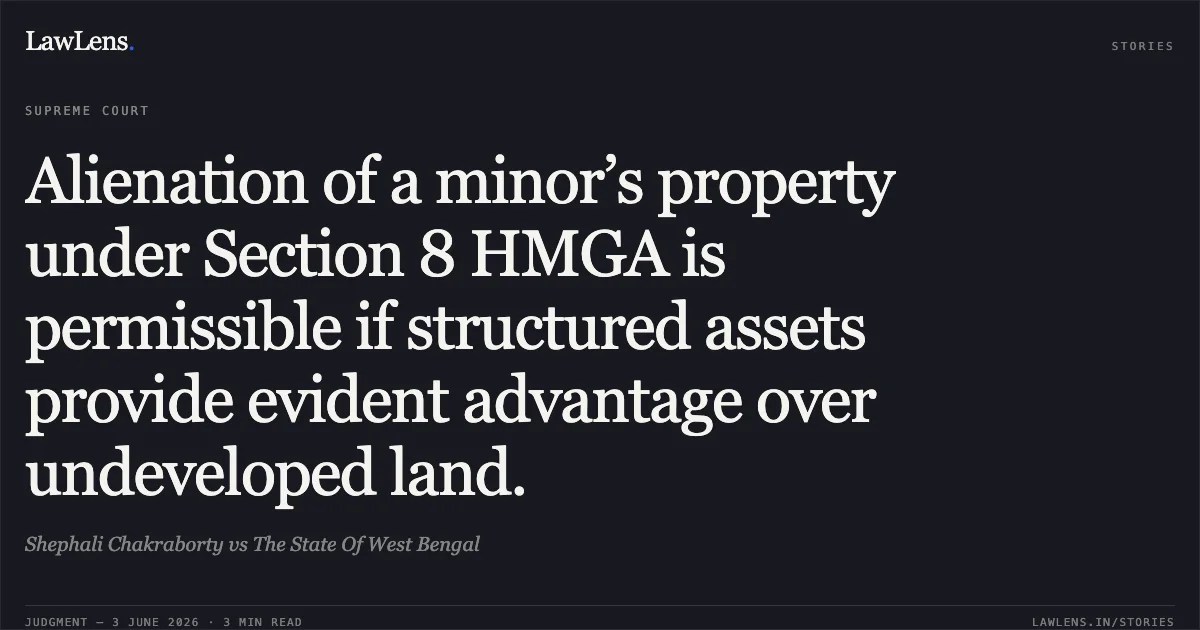
The appellant, Shephali Chakraborty, acting as the natural guardian (mother) of minor Basab Chakraborty, inherited a fractional share of immovable property following the intestate death of her husband in 2018.
Source reference: p. 2In 2022, the family co-owners entered into a development agreement with a developer to exchange the land for a monetary payment of Rs. 10,00,000 and specific residential flats.
Source reference: p. 3To execute this, the appellant sought judicial permission under Section 8 of the Hindu Minority and Guardianship Act (HMGA), 1956, to transfer the minor’s share.
Source reference: p. 1-2The District Court, Darjeeling, rejected the application on the grounds that the "necessity" or "evident advantage" to the minor was not sufficiently proved beyond "bald statements" regarding maintenance and education.
Source reference: p. 4-5The High Court at Calcutta (Jalpaiguri Circuit Bench) affirmed the dismissal.
Source reference: p. 5Issues
1. Whether the proposed transfer of the minor’s interest in immovable property to a developer in exchange for a built-up area and cash consideration constitutes an "evident advantage" to the minor under Section 8(4) of the HMGA.
Source reference: p. 8, 11, 232. Whether the lower courts correctly applied the doctrine of parens patriae and the standard of judicial scrutiny required for the alienation of a minor's property.
Source reference: p. 14, 21Law Applied
Section 8 of the Hindu Minority and Guardianship Act, 1956, which mandates prior judicial permission for the alienation of a minor's immovable property, stipulating that such permission shall only be granted in cases of "necessity" or "evident advantage" to the minor.
Source reference: p. 8-11Procedures from Section 31 of the Guardians and Wards Act, 1890.
Source reference: p. 5, 17The doctrine of parens patriae, establishing that the State and Judiciary act as the ultimate guardians of those lacking capacity.
Source reference: p. 14-16The precedent of Hunooman Persaud Panday v. Mussumat Babooee Munraj Koonweree regarding the limited and qualified power of a manager of an infant’s estate to incur charges only for "rightful need" or "benefit".
Source reference: p. 21Reasoning
The Supreme Court distinguished between ex ante (preventive/anticipatory) and ex post (remedial/retrospective) judicial scrutiny, classifying Section 8 HMGA as an ex ante safeguard designed to protect the minor’s fiduciary interests.
Source reference: p. 5-8The Court critiqued the lower courts for failing to perform a comparative assessment of the minor’s welfare.
Source reference: p. 23-24The Court reasoned that while an undivided share in undeveloped land is often a "passive, potentially vulnerable asset," a structured development agreement yielding a specific residential unit and liquid cash provides "immediate utility" for the minor’s education and health.
Source reference: p. 24The Court found that the presence of a minor should not "unduly limit" the lawful rights of adult co-owners to derive economic benefit, provided the minor’s stake is secured.
Source reference: p. 22-23The Court concluded that the lower courts erred by overlooking the tangible advantages of transforming an illiquid asset into a marketable, developed property.
Source reference: p. 25Holding
The Court held that the development agreement served the "evident advantage" of the minor.
The Court allowed the appeal and set aside the orders of the High Court and District Court, granting permission to realize the Development Agreement subject to four conditions: (i) the minor’s share of the cash consideration must be placed in a nationalized bank with auto-renewal until the minor attains majority; (ii) any changes to the agreement require court approval; (iii) co-owners must seek court permission if selling their shares of the flat before the minor reaches majority; and (iv) the District Judge may impose further reasoned conditions.
Source reference: p. 25-26Acts & Sections Cited
19 provisions across 6 statutes referred to in this judgment. Each provision opens on LawLens.
Guardians and Wards Act, 18905
Code of Criminal Procedure, 19732
Hindu Marriage Act, 19551
Code of Civil Procedure, 19081
Bharatiya Nagarik Suraksha Sanhita, 20238
Original Court PDF
Shephali ChakrabortyvsThe State Of West Bengal
Click to open original judgment
Original judgment, available to read, download and summarize on LawLens.in