Facts
The subject land (Survey No. 266/4-C) was originally a Watan Land granted to Tatya Khadtale under the Bombay Hereditary Offices Act, 1874
Source reference: para. 3In 1958, Tatya executed a conditional sale deed to Shantabai Khadtale
Source reference: para. 3Following the enactment of the Bombay Inferior Village Watan Abolition Act, 1958, and Tatya's death in 1959, Shantabai obtained a re-grant order in 1963 and subsequently converted the land to "old tenure" in 1967
Source reference: paras. 4-5She then sold the land to third parties, eventually reaching the Petitioners (Chavan family) and subsequently Respondent Nos. 5 and 6 (Taskar family)
Source reference: paras. 5, 9In 1976, Respondent No. 1 (the original Watandar’s son) challenged these transfers, claiming the re-grant could only favor the original Watandar or his heirs
Source reference: para. 6After multiple rounds of litigation before revenue authorities, the State Government dismissed the Petitioners' revision in 1997, upholding the restoration of the land to the original Watandar's heir
Source reference: para. 8Issues
1. Whether a transfer of Watan land executed without the prior sanction of the State Government is legally valid under the Bombay Hereditary Offices Act, 1874
Source reference: para. 12.22. Whether a re-grant order obtained by a non-Watandar (an "unauthorised holder") through misrepresentation is sustainable under the Abolition Act
Source reference: paras. 23-263. Whether subsequent purchasers can claim valid title based on a void-ab-initio transfer and a defective re-grant order
Source reference: paras. 27, 31Law Applied
The Court applied Section 7 of the Bombay Hereditary Offices Act, 1874, which mandates that Watan property assigned as remuneration shall not be alienated without the sanction of the State Government
Source reference: para. 15It further applied Section 2(x) of the Bombay Inferior Village Watan Abolition Act, 1958, which defines an "unauthorised holder" as a person in possession of Watan land under an alienation that is null and void under existing Watan law
Source reference: para. 25Additionally, the Court relied on Section 4(1) and Section 5(1) of the Abolition Act, which restrict the right of re-grant primarily to the original Watandar or authorized holders
Source reference: paras. 17, 26Reasoning
The Court found that the initial 1958 sale by Tatya to Shantabai was void-ab-initio because it lacked the mandatory State sanction required under Section 7 of the 1874 Act
Source reference: paras. 16, 27Consequently, Shantabai was categorized as an "unauthorised holder" rather than a "Watandar"
Source reference: paras. 25-26The Court observed that the 1967 conversion and re-grant orders were obtained by Shantabai through false assertions and were facially defective, as the name of the grantee was left blank in the official records
Source reference: paras. 19, 22, 23Since the root of the title (the 1958 sale) was illegal, all subsequent transactions—including those involving the Petitioners and Respondent Nos. 5 and 6—failed to convey valid legal title regardless of the consideration paid
Source reference: paras. 27, 31The Court emphasized that surreptitious acts contrary to statutory embargos cannot be regularized by the passage of time or subsequent revenue entries
Source reference: para. 30Holding
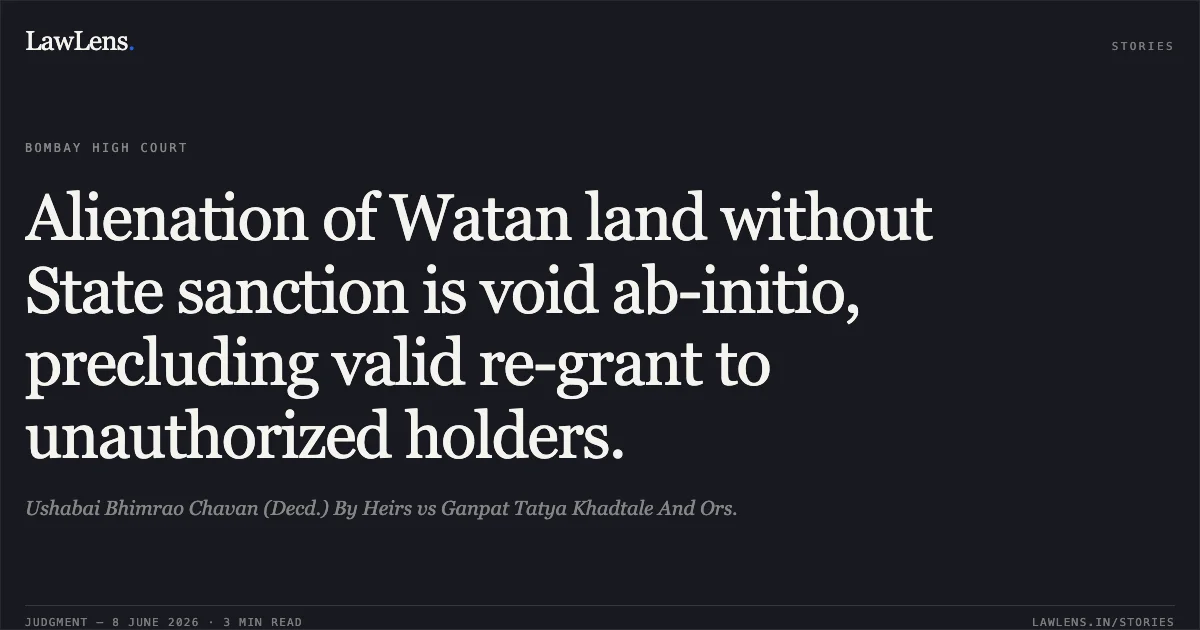
The Court dismissed the Writ Petition and upheld the order dated 31.03.1997 passed by the State Government
It held that the original 1958 transfer was invalid, rendering Shantabai’s subsequent re-grant and sales void
Source reference: paras. 30-32The order of the Tahsildar dated 23.08.1978, which directed the restoration of land to the legal heirs of the original Watandar, was confirmed
Source reference: paras. 28-29All interim reliefs were vacated, and the request for a stay on the judgment was rejected
Source reference: paras. 34, 38Acts & Sections Cited
6 provisions across 3 statutes referred to in this judgment. Linked provisions open on LawLens.
Bombay Hereditary Offices Act, 18742
Bombay Inferior Village Watans Abolition Act, 19583
Bombay Land Revenue Code, 18791
Original Court PDF
Ushabai Bhimrao Chavan (Decd.) By HeirsvsGanpat Tatya Khadtale And Ors.
Click to open original judgment
Original judgment, available to read, download and summarize on LawLens.in


